CAN Sniffing For Steering Wheel Button Presses

You can make those buttons on your steering wheel much more functional if you have a way of monitoring them. Don’t even think of cracking open the factory finish to get to the solder points, just tap into the CAN bus and monitor the data traffic.

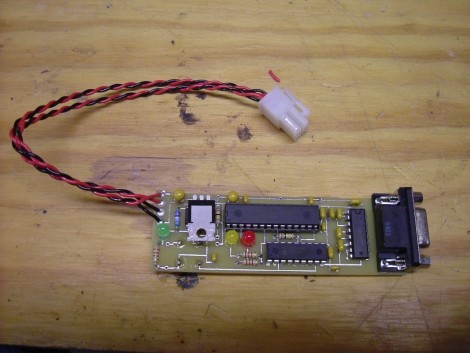
The small board seen above is the result of a project [Peter Shabino] calls the CAN sniffer. The connector on the left will plug into the Control Area Network system on your car, giving the chips on board something to do. There’s an MCP2551 CAN transceiver (hidden under that linear regulator) and an SPI controlled MCP2515 CAN controller which take care of the particulars of the CAN protocol. The big chip in the middle is a PIC 16F876, responsible for making sense out of the data. From there a MAX232 chip is used to provide a serial interface to connect the device to a computer.

This really isn’t tied down to one particular function. Once you have access to the bus for a microcontroller you’ll only be limited by your firmware writing skills. [Peter] has posted an archive with all of the open source files, as well as an illustrated step-by-step board assembly. We’ve embedded the schematic from that archive after the break. Continue reading “CAN Sniffing For Steering Wheel Button Presses”
14.4 Kbps Modem Makes Excuses For Everything

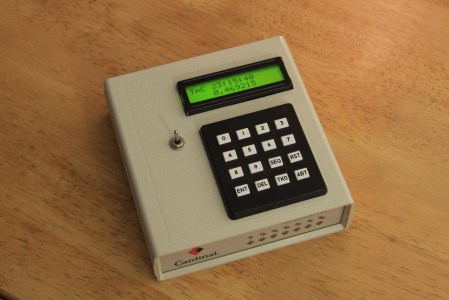
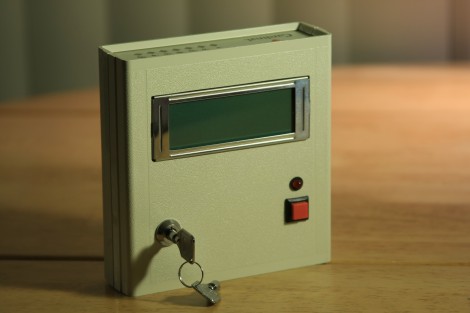
If your boss is like [Michael Scott] you probably find yourself in constant need of plausible reasons for your action or inaction. Now you won’t have to waste away the workday coming up with those ideas yourself because this little box will always provide you with an excuse. It’s actually a 14.4 Kbps modem, which brings back memories of the early ISP days when you’ve find banks of these in the corner to service incoming calls. [Alex] altered the circuit board to map out an ICSP port for the PIC 16F690 that controls the system. Just use your key to unlock the Emergency Excuse Generator and press the button to spit out a doozy. The 8,000 word memory on the microprocessor stores all of the excuses which can be combined a number of different ways based on how the rules files is built. This rule file is by far the most interesting part of the build and worth looking over.

We think this would be a nice addition to the other office electronics you built.

[via Dangerous Prototypes]

Breaking The IClass Security

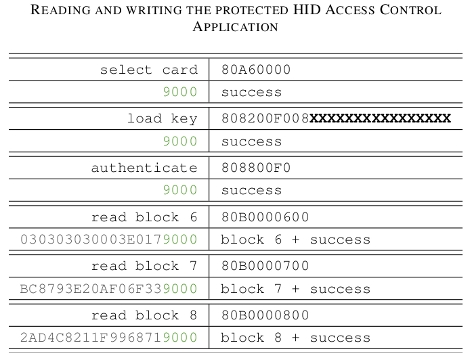
iClass is a popular format of RFID enabled access cards. These are issued to company employees to grant them access to parts of a building via a card reader at each security door. We’ve known for a long time that these access systems are rather weak when it comes to security. But now you can find out just how weak they are and how the security can be cracked. [Milosch Meriac] delved deep into the security protocol for HID iClass devices and has laid out the details in a white paper.

The most invasive part of the process was breaking the copy protection on PIC 18F family of chips in order to read out the firmware that controls card readers. This was done with a USB to serial cable and software that bit-bangs its own implementation of the ICSP protocol. After erasing and attacking several chips (one data block at a time) the original code was read off and patched together. Check out [Milosch’s] talk at 27C3 embedded after the break, and get the code for the ICSP bit banging attacks from the white paper (PDF).

Continue reading “Breaking The IClass Security”

The Interstellar Clock

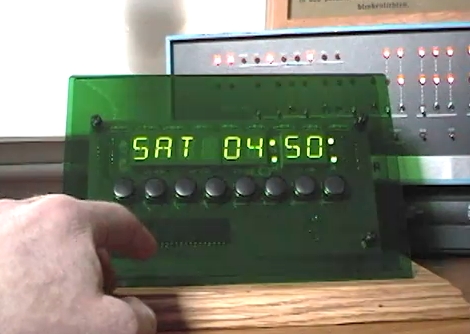
[Alexander Avtanski] has put together a nice clock to meet all your interstellar travel needs. Besides being another PIC based timer, this is a neat little project because it incorporates pretty much every feature you could think of when building a clock for our solar sytem.  For example, it has 16 independent timers and alarms, it can  simultaneously give the time for multiple planets, as well as keep track of other stellar events like the eye of Jupiter or the phases of the moon. To get this project off the ground [Alex] reverse engineered an old dial up modem to serve as an enclosure and power supply and then added in a rechargeable battery so that his  his interstellar clock wasn’t tied to a wall.

[via make]

Over-engineered Clock Finds Purpose As RSS Reader

[Bob Alexander] admits that he over-engineered his clock, giving it eight control buttons, eight twelve-segment alpha-numeric display digits, a GPS module as a time source, and a beefy microcontroller to boot. But he’s found a way to get more for his money out of the device by adding RSS and weather features to it.

Since he’s using the PIC 18F4550 it’s a snap to add USB connectivity. From there he wrote a fantastic PC-side application for communicating with the display. Now he has the option of displaying time, RSS feeds, or weather by scrolling through the options with one of the buttons. Perhaps the best feature is the option to launch a browser on the PC and view the current story just by pressing a button on the display. Check out the two demos after the break; one shows the clock features and the other demonstrates the C# software.

Continue reading “Over-engineered Clock Finds Purpose As RSS Reader”

Three Digit Binary Clock

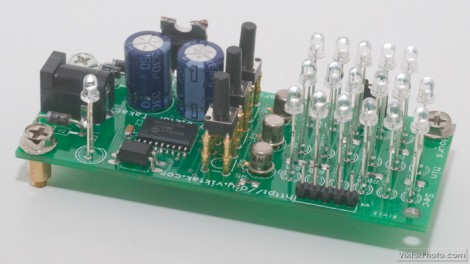
Here’s a three digit binary clock that [Viktor] designed. It uses a multiplexed display to drive one digit at a time with a PIC 16F628A. The video after the break shows it ticking away, display hours, minutes, and seconds in blue LEDs. You may be wondering why those LEDs are not flush to the board? [Viktor] took the project one step further than most binary clock projects, designing a PCB to fit into the enclosure of an old laptop PSU and then having the board manufactured. With options like DorkbotPDX groups orders its has become quite inexpensive to do this and it’s really good practice for when you need to design a highly complicated board for that super-fantastic project of the future.

Continue reading “Three Digit Binary Clock”

Emulating Oric-1 Floppy Disk Hardware

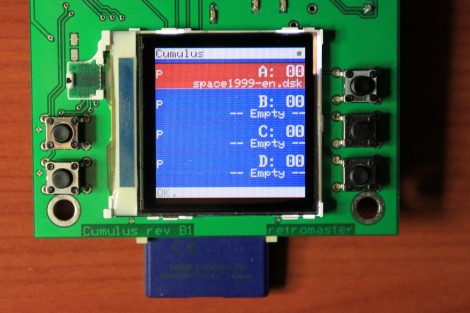
This device is called the Cumulus and it’s used to emulate the floppy disk hardware for Oric-1 and Oric Atmos computers. These 1980’s era computers included an expansion slot to which you could connect a floppy drive. That module, called a Microdisc system, also included the driver circuit which means you can’t just use a modern-day floppy drive as a replacement. [Retromaster] sidestepped the need for magnetic media all together by building an SD card interface which emulates the original module. We can tell by the use of a color screen and clean board layout that a lot of love went into the project. A CPLD implements the communications protocol used by the Microdisc system and creates all of the registers that would have been found on the original hardware. A PIC takes care of the SD card communications and the user interface.

With the exception of comforting noises, we’d bet there are few who have fond memories of using floppy disks. No wonder we’ve been seeing hacks to replace them quite a bit lately.