Paintball Graffitti

Paintball as a large format printer? That’s exactly what facade printer is. A paintball gun was mounted with two controllable axes of movement. A computer reads in the image data and prints it out by shooting paintballs to form a dot-matrix display. There’s a couple of wins here, the paintball paint can be washed off, and this will work on coarse or uneven display medium. Check out a video of the printing process after the break.

If you already built your own paintball turret, give the other guys and chance and hack it to print instead of gunning down unsuspecting adversaries.

Continue reading “Paintball Graffitti”

Makerbot Clone

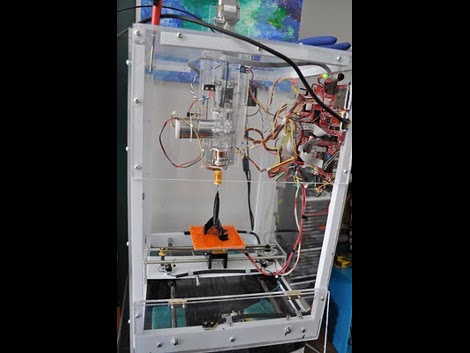
This table-top extruder was modeled after the Makerbot. Instead of laser-cut wood this is built from acrylic, uses salvaged rods from laser printers, some inexpensive stepper motors, and a homemade extruder. All said and done, [Peter Jansen] figures this build came in somewhere around $200-300. It may not look as nice, but at half the price of the Makerbot base kit you also get the fun of building from scratch. Hopefully your fabrication skills are up to the challenge. If so, you’ll be printing useful items soon enough.

3D Printing On A Much Larger Scale

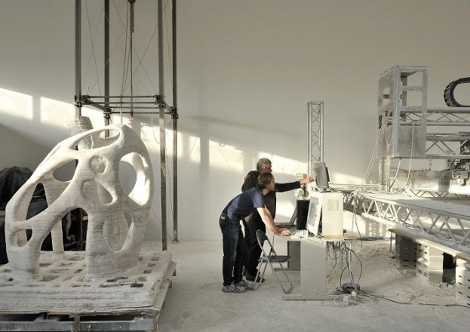
The end goal of this giant rapid prototyping machine is to print buildings. We’re not holding our breath for a brand new Flintstones-esque abode, but their whimsical suggesting of printed buildings on the moon seems like science fiction with potential. The machine operates similar to a RepRap but instead of plastic parts, it prints stone by binding sand with epoxy. This method is not revolutionary, but hasn’t really been seen in applications larger than a square meter or so. It’s fun to see the things we dabble in heading for industrial production applications.

[Thanks Juan]

Why Aren’t We Building Our Own Printers?

We’ll ask it again, why aren’t we building our own printers? We’re building 3d printers, CNC mills, and hacking the ink cartridges on commercial printers. What does it really take to build say a 300 dpi black and white printer? Something that lets you clean and service the print head rather than throwing it out when the ink reservoir is empty?

Someone has set out to answer these question with the Openprinter project. If this interests you, join up and start the revolution. RepRap had simple beginnings and maybe it’s time to take the army of self-replicating 3D printers and use them to print parts for 2D printers that don’t drive us crazy.

[Photo credit]

[via LostScrews]

Continuous Ink Project

CRP_4176

This ancient by internet standards, circa 2002, but its a great read.  [Eddie], frustrated by the high cost of ink cartridges set out to build a continuous inking system. This would mean that the cartridges would be filled from larger, cheaper reservoirs of ink continually. Along the way he transitioned from simple tubes with some putty to more complicated systems. Eventually he had to hack the chips that told the printers the cartridge was in need of replacement.  While the systems he’s using may be difficult to find now, the execution should work on other models. Completely unrelated to the project itself, is that [Billy Mays] as the site favicon? We suspect it is [Eddie] himself.

[via hacknmod]

3D Printing At Home

3dprint

We’ve seen a lot of 3d printing lately, with the RepRap and Cupcake, both the fused deposition modeling type. We don’t often see the Inkjet method. This is a great example of one, built in someones home. Instead of laying down layers of molten plastic, he uses the inkjet system to deposit glue like substances into layers of plaster. This project is much higher resolution than the other two, as you can see in the video of it making an RC engine case below. He is currently rebuilding it to be even better and larger.

Continue reading “3D Printing At Home”