Case Prototyping

[youtube=http://www.youtube.com/watch?v=KsqNPXCm3jc]

[Deviant Ollam], lockpicker and beverage cooling contest host, was recently in Vienna, presumably for DeepSec. While there, he stopped by the Metalab hackerspace and checked out their RepRap rapid prototyping machine. You can see video of his visit above. He had them construct a custom fitted cover for the flash of his point and shoot camera. That’s what we love about rapid prototyping. Many of the projects we cover here solve a particular problem, but would never be considered commercially viable enough to put into production. With the availability of rapid prototyping increasing, hackers can start moving toward producing even more complex objects specific to their needs with a finish closer to commercial products.

3D Printer Uses Office Paper

3dhouse
Mcor Technologies recently launched a brand new rapid prototyping machine. The Mcor Matrix forgoes the standard of expensive and rare build materials by using A4 office paper. The machine selectively deposits glue on the sheet of paper: more glue on the cross-section, less on the waste. It then uses a blade to cut out the part profile. The vertical resolution is determined by the paper thickness. You can use either 20lb paper, which has a thickness of .1mm, or 40lb, which is twice as thick, so it will build twice as fast. The final part can be sanded and painted like wood. The idea is similar to LOM, but those machines require specialized paper. It’s nice to see a company intentionally target a low cost of ownership. If they had used a laser though, you’d only have to worry about sourcing the glue. Machine and material prices have yet to be announced.

[via Fabbaloo]

Direct To Garment Printing

[youtube=http://www.youtube.com/watch?v=f3iOuKzhUlQ]

Reader [deren lik] pointed out the world of direct to garment printing to us. You can purchase commercial machines that will print directly onto a t-shirt using inkjet technology. Unfortunately, these machines cost ~$10K, so hackers have decided to fill in the gaps. DIYDTG hosts plans for how to build your own DTG printer. Their standard instructions are based around the Epson C88 printer. A custom carrier is constructed and then the printer components are bolted on top. Commercial DTG printers are also based on Epson parts and you can easily purchase the garment inks even if you didn’t pay a premium for your printer.

HP Color LaserJet 2600n Teardown


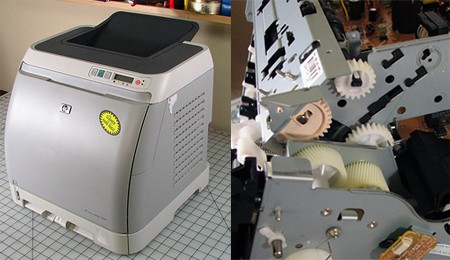
In the ongoing quest to find parts for new projects by scavenging old devices, the curiously sane and benevolent team at Evil Mad Scientist Laboratories took apart an HP Color LaserJet 2600n. They wanted to see what makes it tick and what parts can be culled from it for later use.

Continue reading “HP Color LaserJet 2600n Teardown”