Hackaday Links Column Banner

Hackaday Links: June 14, 2026

Times are tough out there, and many are starting to feel the pressure at the grocery store checkout line or the gas pump. But whenever you start to worry about affording life’s necessities, take comfort in the knowledge that somebody is so flush with cash that on Friday they decided to treat themselves and spend $3 million for a sealed copy of Super Mario Bros for the Nintendo Entertainment System.

Although we’re not going to say it necessarily justifies the insane price — a new record for the most ever paid for a video game, incidentally — Heritage Auctions does note in their press release that this is an exceptionally rare version of what’s admittedly one of the most iconic pieces of software ever produced. This is only one of three copies of this particular variant known to exist, which Nintendo apparently distributed to test markets in the United States ahead of the game’s official 1985 release.

In slightly more modern gaming news, Asha Sharma, the new head of Microsoft’s Xbox division, has been making some big swings to try and get Microsoft’s gaming division back on track after years of declining sales. As part of that effort, she recently penned an article detailing some of the challenges the company is facing, which includes some interesting hardware details.

According to the blog post, she claims that in February, the cost of memory and storage components for the Xbox console had doubled compared to the previous year. But those numbers have jumped again, and by the time the holidays roll around, she expects they’ll be paying five times what they did in 2024. That’s bad news for anyone looking to put an Xbox under the tree come Christmas, but even worse news as the company works on the console’s successor. Considering that today’s hardware from Sony and Microsoft can already set you back $700 USD depending on which version you get, it seems like we’re approaching a point where gaming consoles could price themselves out of the market.

Continue reading “Hackaday Links: June 14, 2026”

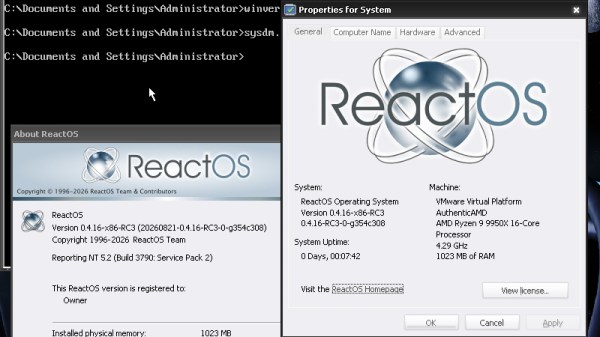
ReactOS Gets Unified Installer Image And A New Storage Stack

Although the ReactOS project is in no rush to dethrone Windows as the desktop operating system of choice, this doesn’t mean that some real changes aren’t happening. Most recently two big changes got merged, the first pertaining to the separate boot- and live CD images that are now merged into a single image, and the second being a new PnP-aware ATA storage stack for ATA and AHCI devices, with NT6+ compatibility.

Although there is still a separate live CD for now, this first change means that testing and installing ReactOS becomes easier, and that the old-school text-based installer may soon be on its way out as well.

Having the new ATA storage stack in place will translate into much better compatibility with real hardware, including the ability to use more hardware to install on and boot from compared to the old UniATA driver.

Combined, these two changes should bring the ReactOS installation and usage experience a lot closer to that of Windows, as well as many Linux distros. If you had issues with the OS on real hardware, this might be just the right time to give it another shake and provide detailed feedback to the developers if any remaining issues are encountered.

Thanks to [jeditobe] for the tip.

Three Decades Of ReactOS

Over the past couple of years with theĀ Jenny’s Daily Drivers series, we’ve looked at a number of unusual or noteworthy operating systems. Among them has been ReactOS, an open source clone of a millennium-era Windows OS, which we tried back in November. It’s one of those slow-burn projects we know has been around for a long time, but still it’s a surprise to find we’ve reached the 30th anniversary of the first ReactOS code commit.

The post is a run through the project’s history, and having followed it for a long time we recognize some of the milestones from the various ISOs we downloaded and tried back in the day. At the end it looks into the future with plans to support more up-to-date hardware as well as UEFI, which we hope will keep it relevant.

When we tried it, we found an OS which could indeed be a Daily Driver on which a Hackaday article could be written — even if it wasn’t the slickest experience on the block. It doesn’t matter that it’s taken a while, if you’re used to Windows XP this has become a usable replacement. We came to the conclusion that like FreeDOS it could find a niche in places where people need a modern version of the old OS to run older software, but perhaps as it now moves towards its mature phase it will move beyond that. We salute the ReactOS developers for bringing it this far, and for not giving up.

You can read ourĀ Daily Drivers review of a recent ReactOS build here.

Jenny’s Daily Drivers: ReactOS 0.4.15

When picking operating systems for a closer look here in the Daily Drivers series, the aim has not been to merely pick the next well-known Linux distro off the pile, but to try out the interesting, esoteric or minority OS. The need remains to use it as a daily driver though, so each one we try has to have at least some chance of being a useful everyday environment in which a Hackaday piece could be written. With some of them such as the then-current BSD or Slackware versions we tried for interest’s sake a while back that’s not a surprising achievement, but for the minority operating systems it’s quite a thing. Today’s choice, ReactOS 0.4.15, is among the closest we’ve come so far to that ideal.

For The N’th Time In The Last 20 Years, I download A ReactOS ISO

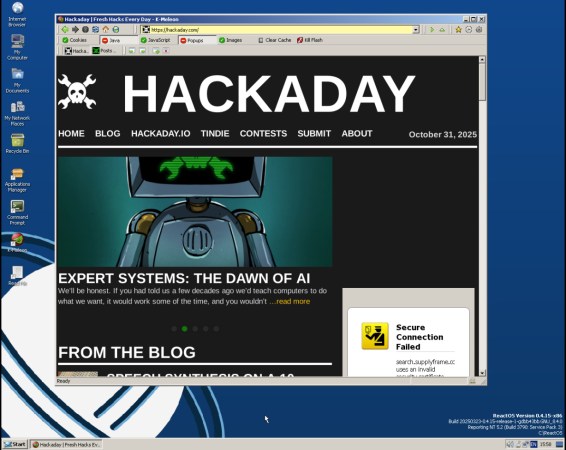
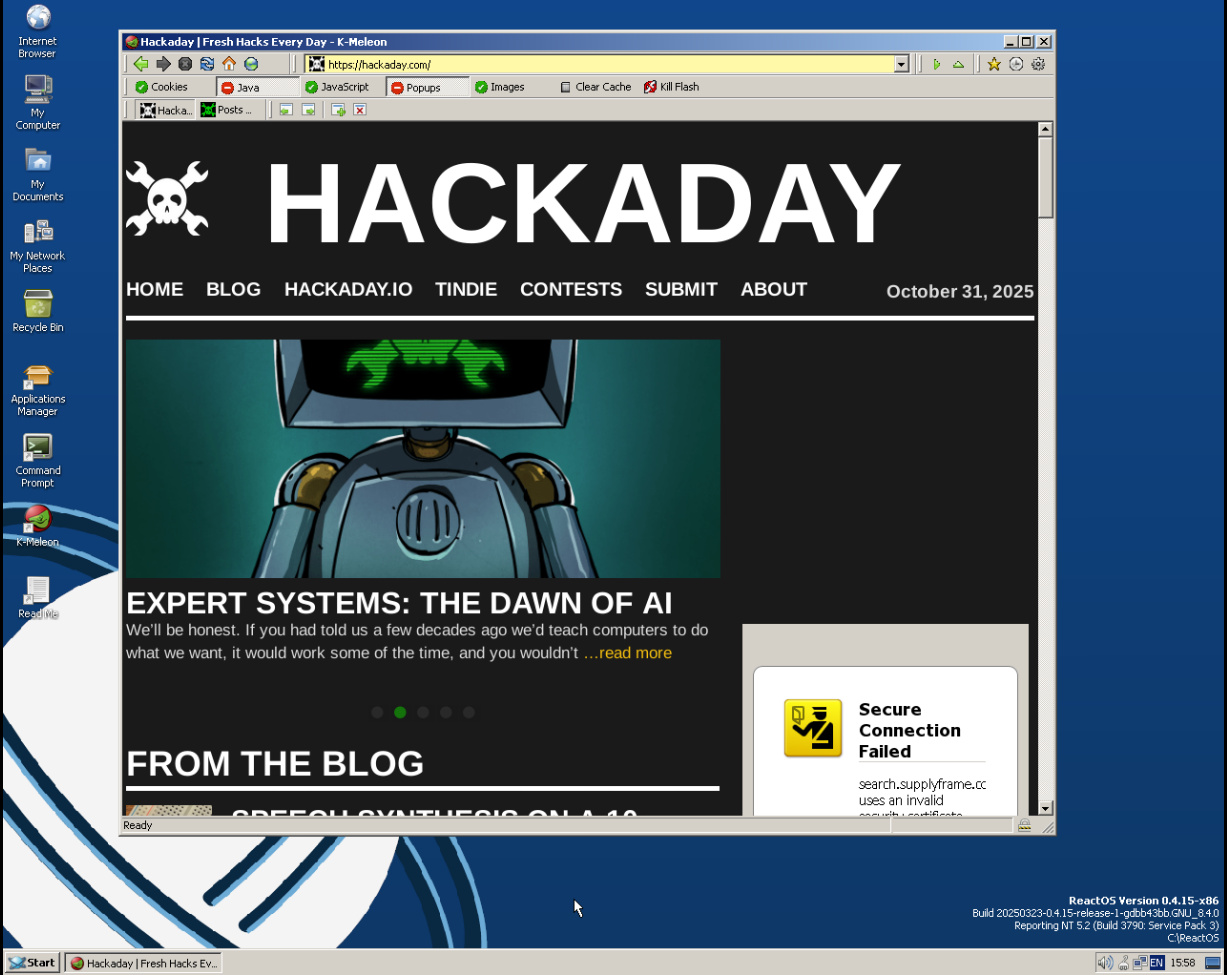
A Windows-style ReactOS desktop with a web browser showing Hackaday
It’s fair to say there are still a few quirks, but it works.

ReactOS is an open-source clone of a Windows operating system from the early 2000s, having a lot on common with Windows XP. It started in the late 1990s and has slowly progressed ever since, making periodic releases that, bit-by-bit, have grown into a usable whole. I last looked at it for Hackaday with version 0.4.13 in 2020, so have five years made any difference? Time to download that ISO and give it a go.

Installing ReactOS has that bright blue and yellow screen feeling of a Windows install from around the millennium, but I found it to be surprisingly quick and pain free despite a few messages about unidentified hardware. The display driver it chose was a VESA one but since it supported all my monitor’s resolutions and colour depths that’s not the hardship it might once have been. Continue reading “Jenny’s Daily Drivers: ReactOS 0.4.15”

ReactOS 0.4.15 Released With Major Improvements

Recently the ReactOS project released the much anticipated 0.4.15 update, making it the first major release since 2020. Despite what might seem like a minor version bump from the previous 0.4.14 release, the update introduces sweeping changes to everything from the kernel to the user interface and aspects like the audio system and driver support. Those who have used the nightly builds over the past years will likely have noticed a lot of these changes already.

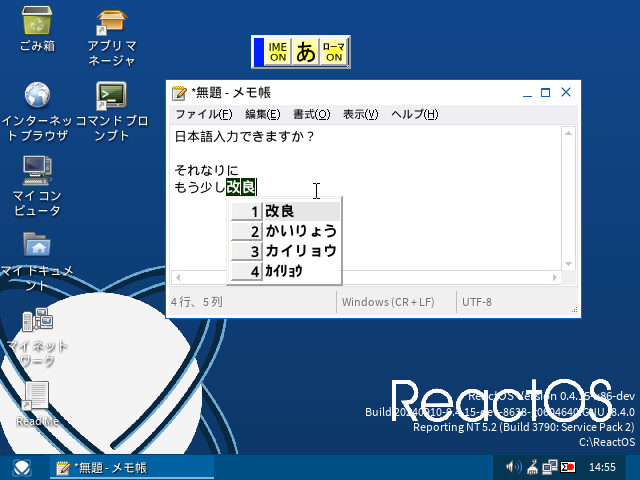
Japanese input with MZ-IME and CJK font (Credit: ReactOS project)

A notable change is to plug-and-play support which enables more third party drivers and booting from USB storage devices. The Microsoft FAT filesystem driver from the Windows Driver Kit can now be used courtesy of better compatibility, there is now registry healing, and caching and kernel access checks are implemented. The latter improvement means that many ReactOS modules can now work in Windows too.

On the UI side there is a much improved IME (input method editor) feature, along with native ZIP archive support and various graphical tweaks.

Meanwhile since 0.4.15 branched off the master branch six months ago, the latter has seen even more features added, including SMP improvements, UEFI support, a new NTFS driver and improvements to power management and application support. All of this accompanied by many bug fixes, which makes it totally worth it to regularly check out the nightly builds.

Freeing Windows

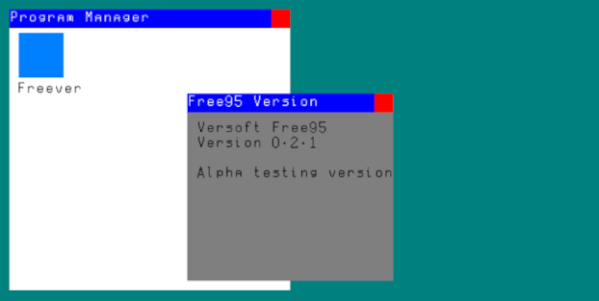
There have been several attempts to make an unencumbered version of Windows. ReactOS is perhaps the best-known. You could also argue that Wine and its progeny, while not operating systems in the strictest sense of the word, might be the most successful. Joining the fray is Free95, a GPL-3.0 system that, currently, can run simple Windows programs. The developer promises to push to even higher compatibility.

As you might expect, the GitHub site is calling for contributors. There will be a lot to do. The src subdirectory has a number of files, but when you consider the sheer volume of stuff crammed into Windows, it is just a minimal start.

Continue reading “Freeing Windows”

ReactOS Is Going Places, With More Stable AMD64, SMP, And Multi-Monitor Support

In the crowd of GNU/Linux and BSD users that throng our community, it’s easy to forget that those two families are not the only games in the open-source operating system town. One we’ve casually kept an eye on for years is ReactOS, the long-running open-source Windows-compatible operating system that is doing its best to reach a stable Windows XP-like experience. Their most recent update has a few significant advances mentioned in it that hold the promise of it moving from curiosity to contender, so is definitely worth a second look.

ReactOS has had 64-bit builds for a long time now, but it appears they’ve made some strides in both making them a lot more stable, and moving away from the MSVC compiler to GCC. Sadly this doesn’t seem to mean that this now does the job of a 64-bit Windows API, but it should at least take advantage internally of the 64-bit processors. In addition they have updated their support for the Intel APIC that is paving the way for ongoing work on multiprocessor support where their previous APIC driver couldn’t escape the single processor constraint of an original Intel 8259.

Aside from these its new-found support for multiple monitors should delight more productive users, and its improved support for ISA plug-and-play cards will be of interest to retro enthusiasts.

We took a close look at the current ReactOS release when it came out last year, and concluded that its niche lay in becoming a supported and secure replacement for the many legacy Windows XP machines that are still hanging on years after that OS faded away. We look forward to these and other enhancements in their next release, which can’t be far away.