InMoov: A 3d Printed Animatronic Hand You Can Download

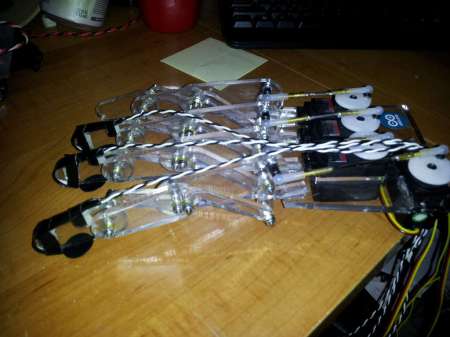
[Hairygael] has been hard at work designing and building this robot structure that can be completely 3d printed. He’s admittedly not a big electronics person, so most of his focus has been on the design and construction of the bot frame. So far, he as a fully 3d printable (and available for download) hand that you can see in action after the break. Once printed, you’ll have to drill it for your own servos and add your own control system.

You can see the action is quite nice and sturdy in the video. [Hairygael] laments his lack of electronics knowledge when you see him hit roadblocks like multiple finger control. But, just as he points out in the video, we’re positive that some of you who are more familiar with that end of things will undoubtedly make this work well.

[via HackedGadgets]

Continue reading “InMoov: A 3d Printed Animatronic Hand You Can Download”

Autonomous Robot Uses An IPhone For Its Brain

At the beginning of the school last year, [Ryan] needed to come up with a project for his master’s thesis. Having a bachelor’s in mech. engineering and doing his graduate work in software engineering allowed [Ryan] to do something really cool for his thesis; he decided to turn an iPhone into an autonomous robot with live video streaming, remote control, and  object detection.

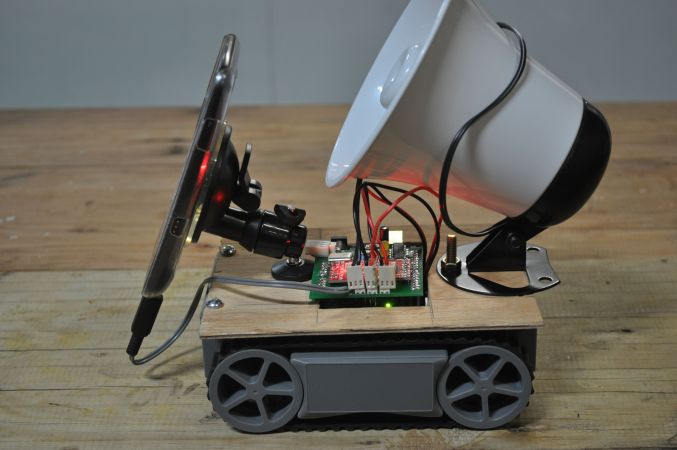
[Ryan] started building his ArduiPhone last October with an Arduino,  motor shield, and a Magician Chassis. The software is based on an iPhone network programming tutorial that opens a socket connection to a desktop PC and relays commands to an Arduino serial port.

One of the more interesting features of [Ryan]’s ArduiPhone is the ability to stream video directly from the phone to a Java application. Instead of FaceTime, [Ryan] streams videos by converting an image from the front-facing iPhone camera to a byte array, sends it over the network, and decodes the image in a Java app. It’s low-level stuff, but the video quality is excellent and something we’ll probably be seeing more of in the future.

As always, videos after the break.

Continue reading “Autonomous Robot Uses An IPhone For Its Brain”

[Easton’s] Robot Arm Takes 2nd Place In The International Science And Engineering Fair

Here we see [Easton LaChappelle] getting a congratulatory handshake from the robotic arm he built. This project is aimed at human prosthetics, and we’re happy to report that [Easton] won second place in Electrical and Mechanical engineering division of this year’s International Science and Engineering Fair (PDF listing the winners).

In the video he gives us a great look of the state of the project. Since we checked in with him last he’s added a body for the arm to mount to. The arm now has shoulder movement, which uses geared DC motors along with some potentiometers for orientation feedback. For the elbow he wanted to have the same setup but ran into trouble mounting the potentiometer. His solution was to use some shapelock to mold a bracket (shapelock is the plastic you melt in water to form any shape). In addition to the aforementioned joints, the wrist, fingers, and hand have all seen improvements in how they are supported and in their performance.

We think this is amazing work for anyone, especially a 16-year-old High School student. Great job [Easton]!

Continue reading “[Easton’s] Robot Arm Takes 2nd Place In The International Science And Engineering Fair”

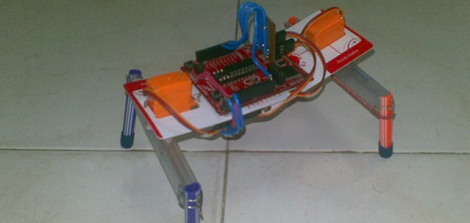
An Arduino Based Quadruped Robot

Arduino-Based-Four-Legged-Robot

Sure, we see hexapods all the time at [HAD], but moving around with four legs can be more tricky kinematics-wise. This Instructable shows you how to make one out of balsa wood.

Although one might not think of balsa to make their robot out of [vexedpheonix] explains that this was chosen because it’s extremely light and easy to work with. Since he was trying to keep costs down, the cheapest servos available were used. These weren’t all that powerful, so the lighter the body the better! According to the included bill of materials, he was able to keep the entire robot build under $100.

According to the article, the hardest part was making four copies of the same leg. We might suggest using a CNC router, but building one would obviously add a huge layer of complication to the project!

Thanks for the tip on this one [SteveT]! Be sure to check out the video of this little robot waving one of it’s legs or trying to walk after the break! Continue reading “An Arduino Based Quadruped Robot”

Retrotechtacular: Shakey Shows Off Robotics Innovation From 1972

In this installement of Retrotechtacular we’re taking a look at Shakey, a robot developed between 1966 and 1972 at the Stanford Reserach Lab. This was a glorious time when students had long hair but still wore long sleeves and ties to do their research.

The robot is actually communicating wirelessly with the PDP-10 computer which handles the processing. No computer monitor is used for interacting with the robot. Instead, a teletype machine lets you type out your commands on paper, and the response from the machine is printed back to you on the same sheet. There’s a camera which is used for image recognition, and sensors that give feedback when the body comes in contact with an obstacle.

We’d sure love to know what kind of budget this project had, but alas we couldn’t find any info about that. You can go and see Shakey in person if you want to. This info page mentions that the machine is on display at the Computer History Museum in Mountain View, California.

Continue reading “Retrotechtacular: Shakey Shows Off Robotics Innovation From 1972”

Meet Stompy, Your New Robotic Overlord

In case you weren’t already depressed about not starting a summer project already, a couple of guys are building a gigantic rideable hexapod they call Stompy.

The project leaders, [Gui Cavalcanti], [Dan Cody], and [James Whong] have worked on a few crazy robotics projects before like PETMAN and BigDog. Stompy won’t be a military-backed project like the others (we sincerely hope), so they’re enlisting the help of fellow makers at Artisan’s Asylum to complete a 15-foot diameter, 1-2 ton rideable hexapod before the end of August.

Right now, the team is still in the planning and preliminary testing stages. So far, they’ve built a 1/2 scale model of one leg to figure out the control systems, and getting the repurposed forklift motor up and running. It may not look like much now, but we’re sure the team is going to have a very fun time building Stompy.

You can check out the updates and progress of Stompy on the Project Hexapod blog

Retrotechtacular: Science Fair Robot Ca. 1984

[Michael Surran] just came across this video from his seventh grade science fair project. He really had some fun building and showing off the robot and we’re glad the footage wasn’t lost in the annals of time. Take a look at the clip after the break. That’s not a robot peeing, it’s the ‘fire defense unit’ that pumps liquid to put out very near-range fires. There’s a solar-powered fan on the front, and the claw will spin if you know how to activate it. The shoulders and base are also motorized, and it looks like the keypad from an early calculator gives some extra control on the back of the bot.

We can’t watch this without smiling, and it’s inspired us to launch a recurring feature on Hackaday. We want you to dig out and digitize your old footage. Anything hack-related is fair game… and don’t be bashful! It doesn’t necessarily have to be you either. For example, we loved the video of [Grace Hopper’s] nanosecond lecture. If you’ve got some old time footage send us a link to it!

Continue reading “Retrotechtacular: Science Fair Robot Ca. 1984”