Medgadget recently published a post about a soccer competition for nanobots at RoboCup. The nanobots compete on a field that measures 1500 by 2500 micrometers with goals on the long sides jutting 500 micrometers out. Like normal soccer athletes, the nanobot teams attempt to push the ball – in this case, a silicon dioxide disc with a 50 micrometer diameter – into the goal. The nanobot competitors are monitored by an optical microscope and are remotely controlled by magnetic signals sent across the arena.
The National Institute of Standards and Technology (NIST) and RoboCup have already held two nanobot competitions in the last year. Nanobots made by different teams from various universities compete to test various abilities that will be critical for their practical applications in medicine, manufacturing, and other industries.
Though it is referred to as nanosoccer, the competition is actually a triathlon. The bots must sprint to the goal with the ball in one event, then maneuver the ball around stationary “defenders” and into the goal in the next event, and finally score as many goals as possible within 3 minutes. NIST and RoboCup hope to show the practical potential of nanobots with this competition and have a little fun in the process.
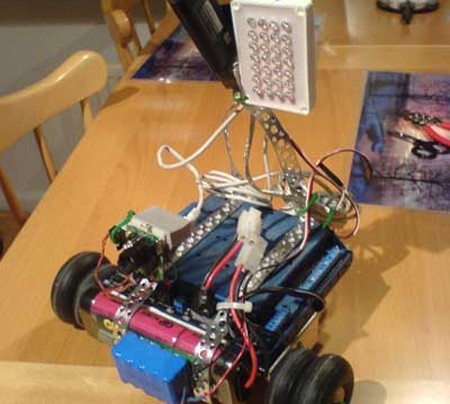
Here’s something else we found while writing up our duplicate Ikea Linux Cluster post. [Janne] also built this simple linux robot. The robot uses the Qwerk robot controller, a webcam with the IR filter removed (something like this one), a usb WiFi card, an IR spotlight, and a set of repurposed model airplane wheels. The WiFi adapter and webcam attach directly to the Qwerk via its on-board usb ports; the servo motors are also connected via built-in ports. Although [Janne] doesn’t post specific instructions, the Qwerk platform seems fairly easy to work with. Have a look at the Qwerk overview for more information.
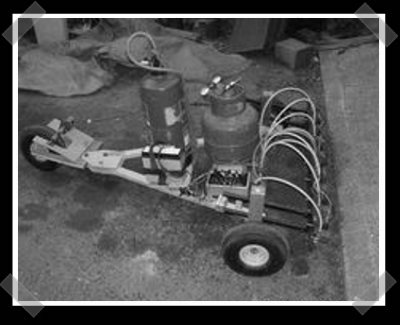
Most people make LEDs light up for their first microcontroller project. [Alex] built a “large scale dot matrix printer.” This beast is a PIC controlled ground graffiti machine. As it rolls across the ground it deposits strategically located bits of spray paint. Rather than use actual spray paint, he opted for a set of solenoid controlled nozzles that shoot the paint downward.
We feel the need to apologize immediately for the use of Yakkity Sax in the preceding video and recommend you watch the longer, yak free, video below. It shows researchers at the Learning Algorithms and Systems Laboratory teaching a robot how to make a ham and cheese omelet. Each working area and food item is labeled with a machine recognizable tag. The researcher demonstrates the task by guiding the robot’s hand. The robot combines multiple demonstrations to generalize the skill. It can then adapt the learned skill to the specific task. You can see this in the video when the robot adjusts to the location of the bowl and cutting board when they’re moved around. Teaching through demonstration would make the use of robotics much easier for the general population.
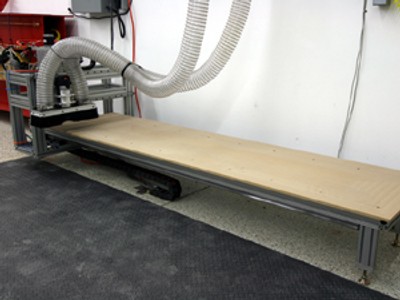
We’ve lost track of the number of home built CNC machines we’ve covered in the past, but we thought a comprehensive list of the best would help you understand why we’re so excited about the LumenLab CNC machine.
[Amnon] sent in this demo of his groups voice controlled wheel chair. I couldn’t find any details, but sometimes just a demo is enough to find some new inspiration. They connected a hm2007 speech recognition kit to an Innovation FIRST controller board on an electric wheel chair chasis. Additional sensors detect stairs and other obstacles.