A Robot’s Favourite Pen

A test of various pens using a robot

Some people are very picky about their pens. Entire forums exist to discuss the topic of pen superiority. However, it comes down to a personal choice. Some people like gel while others prefer ballpoint.

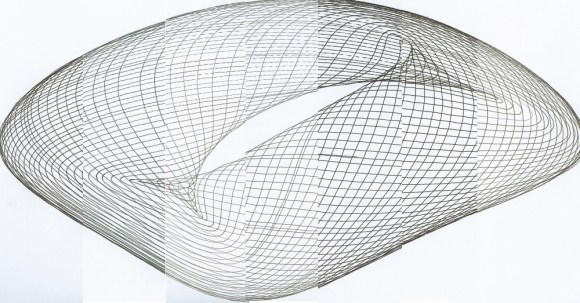
[Jens] built a drawing robot that produces drawings like the one seen here. It uses several linkages connected to two stepper motors, which give fine control over the pen. With the robot working [Jens] set out to find the best pen for robotic drawing.

Seven pens were tested on the machine, each drawing the same pattern. [Jens] found that gel and rollerball pens work the best on the robot, and started examining the performance of each.

The pens all performed differently, but two winners were chosen to use in the machine. The Pentel Energel Deluxe RTX and the Pilot G-2 07 beat out the competition since they maintained good lines at high speeds.

If you’re looking to build a drawing robot, [Jens]’ research should help you pick the best pen for your application. For inspiration, a video of the robot in action is waiting after the break.

Continue reading “A Robot’s Favourite Pen”

The Un-Digital Robotic Arm

556When you think of a robotic arm, you’re probably thinking about digital control, microcontrollers, motor drivers, and possibly a feedback loop. Anyone who was lucky enough to have an Armatron knows this isn’t the case, but you’d still be surprised at how minimal a robotic arm can be.

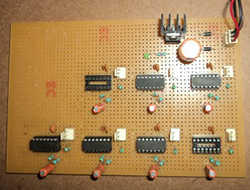
[viswesh713] built a servo-powered robotic arm without a microcontroller, and with some interpretations, no digital control at all. Servos are controlled by PWM signals, with a 1 ms pulse rotating the shaft one way and a 2 ms pulse rotating the shaft the other way. What’s a cheap, popular chip that can easily be configured as a timer? Yep, the venerable 555.

The robotic arm is actually configured more like a Waldo with a master slave configuration. [viswesh] built a second arm with pots at the hinges, with the resistance of the pots controlling the signal output from a 556 dual timer chip. It’s extremely clever, at least until you realize this is how very early robotic actuators were controlled. Still, an impressive display of what can be done with a simple 555. Videos below.

Continue reading “The Un-Digital Robotic Arm”

Canadian Space Robot Will Repair Itself

The video above shows an animation of what the Canadian Space Agency hopes will be the first successful self-repair of the Mobile Servicing System aboard the ISS. The mobile servicing system is basically a group of several complicated robots that can either perform complicated tasks on their own, or be combined into a larger unit to extend the dexterity of the system as a whole.

The most recent addition to the servicing system is the Special Purpose Dexterous Manipulator, otherwise known as Dextre. Dextre is somewhat reminiscent of a human torso with two enormous arms. It is just one of the Canadian Space Agency’s contributions to the station. It was installed on the station in 2008 to perform activities that would normally require space walks. Dextre’s very first official assignment was successfully completed in 2011 when the robot was used to unpack two pieces for the Kounotori 2 transfer vehicle while the human crew on board the ISS was sleeping.

Dextre is constructed in such a way that it can be grabbed by the Canadarm2 robot and moved to various work sites around the Space Station. Dextre can then operate from the maintenance site on its own while the Canadarm2 can be used for other functions. Dextre can also be operated while mounted to the end of Canadarm2, essentially combining the two robots into one bigger and more dexterous robot.

One of the more critical camera’s on the Canadarm2 has started transmitting hazy images. To fix it, the Canadarm2 will grab onto Dextre, forming a sort of “super robot”. Dextre will then be positioned in such a way that it can remove the faulty camera. The hazy camera will then be mounted to the mobile base component of the Mobile Servicing System. This will give the ISS crew a new vantage point of a less critical location. The station’s human crew will then place a new camera module in Japan’s Kibo module’s transfer airlock. Dextre will be able to reach this new camera and then mount it on the Canadarm2 to replace the original faulty unit. If successful, this mission will prove that the Mobile Servicing System has the capability to repair itself under certain conditions, opening the door for further self-repair missions in the future.

mirobot

Introducing Mirobot, A DIY WiFi Robot For Children

We’re quite sure that fathers parents people reading Hackaday wonder how to introduce their children acquaintances to the wonderful world of electronics. The Mirobot (Kickstarter link) might just be a good way to do so. As you may see in the picture above the Mirobot is a small WiFirobotics kit that children can build themselves to learn about technology, engineering and programming.

The laser cut chassis is assembled by snapping it together. All the electronics are left exposed to the outside so children may try to figure out which component does what. The robot is configured over your home WiFi via a Scratch-like visual programming tool. Everything (PCB, Arduino code, user interface) is open source.

The platform is based around the Arduino compatible ATMega328, two stepper motors, a Wifi module that can behave as a client or access point and 5 AA batteries. The campaign stretch goals include a collision detection sensor, line following functionality and finally a sound add-on.

Thanks [nickjohnson] for the tip.

MiniBloq IDE, Graphical Programming For Robots Of All Sizes

MiniBloq

The Arduino IDE only brings the ire of actual EEs and People Who Know Better™, but if you’re teaching robotics and programming to kids, you really don’t want something as simple as a text editor with a ‘compile’ button. For that educational feat, a graphical system would be much better suited. [Julián] has been working for months to build such a tool, and now miniBloq, the graphical programming tool for just about every dev board out there, has a new release.

The idea of a graphical programming language for robotics has been done before, most memorably with the Lego Mindstorms programming interface. That was closed source, of course, and only worked with the magical Lego brick that allowed you to attach motors and sensors to a child’s creation. miniBloq takes the same idea and allows the same programming environment to work with dozens of dev boards for robots of every shape and size. Already, the Pi-Bot, SparkFun RedBot, Maple, Multiplo DuinoBot, and anything based on an Arduino Leonardo works with miniBloq, as will any future dev boards that understand C/C++, Python, or JavaScript. It’s not just for powering motors, either: there’s a few Python and OpenCV tutorials that demonstrate how a robot can track a colored object with a camera.

The current version of miniBloq can be downloaded from the gits, with versions available for Windows and *nix. The IDE is written with wxWidgets, so this could also be easily ported to OS X.

Retrotechtacular: ROTOPARK Is A Futuristic Parking Structure From 40 Years Ago

retrotechtacular-rotopark

Pictured above is a functioning model of an automated underground parking structure which was built and used, but obviously it never caught on widely. That makes us a bit sad, as it removes the need to find an empty parking spot every time you use the garage; and having a robot park your car for you seems very future-y.

The gist of the ROTOPARK system is a carousel and elevator system for parking cars. just drive into a single-stall garage at ground level, take your ticket, and walk out the people-hole. The garage stall floor is a sled which moves down an elevator (shown as blue stalls on the left half of the image) to be stored away in the rotating carousels of cars.

Obviously mechanical failure is a huge issue here. What if the elevator breaks? Also, at times of high traffic we think getting your vehicle back out of the system would be quite a bit slower than the “static” parking garages we’re used to. Oh well, maybe some day. Check out the classic marketing video after the break which shows off the concept, construction, and use of the system.

Continue reading “Retrotechtacular: ROTOPARK Is A Futuristic Parking Structure From 40 Years Ago”

Sci-Fi Contest Roundup: Science Nonfiction

Yep, we have a Sci-Fi contest on our hands, with a week to go until entries are due. There are amazing prizes for the best Sci-Fi build, but in the spirit of the Internet, a few teams have elected to put together a science nonfiction project. We won’t hold that against them, because these builds are really, really cool.

Rockin’ bogie, man

rockerFirst up in the ‘real life science fiction’ category is an adorable little rocker bogie robot designed and built by a team at MADspace, the Eindhoven Hackerspace.

A rocker bogie suspension is rather unique in that it can be used to drive over obstacles twice the size of the wheels, has a zero turning radius, and is found on every rover that has ever gone to Mars. The suspension system has articulated rockers on each side of the chassis , with pivoting wheels at each of the four corners of the robot. While this type of suspension can’t go very fast, it can go just about anywhere.

The team loaded up their bot with a Raspberry Pi, a pair of webcams, 20Ah of batteries, gyro, and a web interface. The suspension works beautifully, and most of the parts are 3D printable. Very cool. There’s a pair of videos with this bot in action below.

Spider bot. Just add two more legs.

Hex

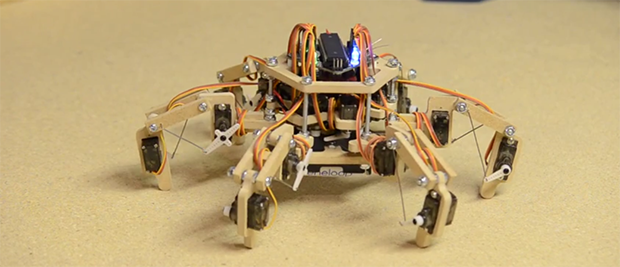
Continuing on with the science nonfiction theme of this post is a cute little hexapod walker reminiscent of designs that have been proposed to visit the moon and asteroids.

This is a rather unique hexapod, controlled entirely with 12 PWM channels on an ATMega1284. Although each leg only has two degrees of freedom (the software has support for 3 DOF, though) the movement is surprisingly smooth. It’s an inexpensive build, too, with 5 gram servos providing all the power to the legs. Video below.

Continue reading “Sci-Fi Contest Roundup: Science Nonfiction”