A Classy SDR Chip, Decapped

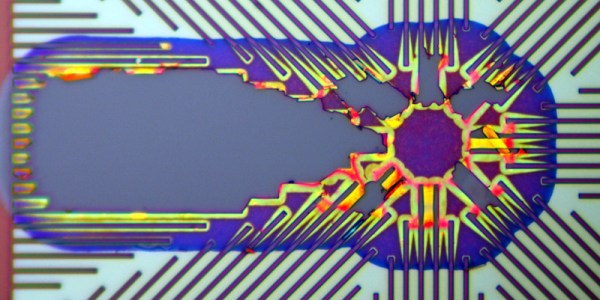
If you are a regular searcher for exotic parts among the virtual pages of semiconductor supplies catalogs, you will have probably noticed that for a given function it is most often the part bearing the Analog Devices logo that is the most interesting. It may have more functionality, perhaps it will be of a higher specification, and it will certainly have a much higher price. [Zeptobars] has decapped and analyzed an AD chip that holds all three of those honors, the AD9361 SDR transceiver.

It’s placed under a slightly inflammatory title, “when microchips are more profitable than drugs“, but does make a good job of answering why a semiconductor device at the very cutting edge of what is possible at the time of release can be so expensive. The AD9361 is an all-in-one SDR transceiver with an astonishing bandwidth, and as such was a particularly special device when it reached the market in 2013. We see some particularly fine examples of on-chip inductors and PLL circuitry that must have consumed a significant design effort to preserve both bandwidth and noise characteristics. This is an item of physical beauty at a microscopic scale as well as one of technical achievement.
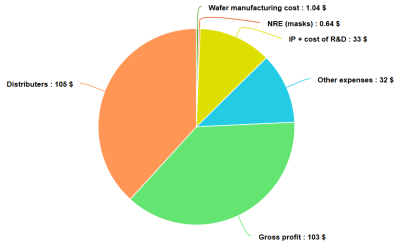
The financial analysis puts Analog Devices’s gross profit at about $103 of the $275 retail purchase price of an AD9361. The biggest slice at $105 goes to the distributor, and surprisingly the R&D and manufacturing costs are not as large as you might expect. How accurate these figures are is anybody’s guess, but they are derived from an R&D figure in the published financial report, so there is some credence to be given to them.

We’ve featured [Zeptobar’s] work before more than once. A look at fake Nordic Semi parts for example or a Soviet i8080 clone have received their treatment. Always a source to watch out for!

Dual SDR Receives Two Bands At Once

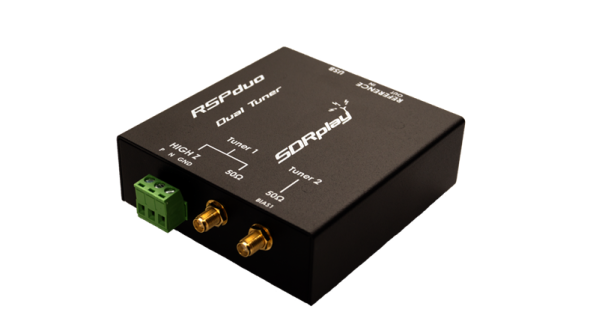
There was a time when experimenting with software defined radio (SDR) was exotic. But thanks to cheap USB-based hardware, this technology is now accessible to anyone. While it is fun to play with the little $20 USB sticks, you’ll eventually want to move up to something better and there are a lot of great options. One of these is SDRPlay, and they recently released a new piece of hardware — RSPduo — that incorporates dual tuners.

We’ve talked about using the SDRPlay before as an upgrade from the cheap dongles. The new device can tune either a single 10 MHz band over the range of 1 kHz to 2 GHz, or you can select two 2 MHz bands. This opens up a lot of applications where you need to pick up signals in different areas of the spectrum (e.g., monitoring both sides of a cross-band repeater).

Continue reading “Dual SDR Receives Two Bands At Once”

Hackaday Links Column Banner

Hackaday Links: May 20, 2018

One of the more interesting pieces of tech from Hollywood that never seems to become a reality is a location tracker. Remember the ‘movement tracker’ in Alien that found the cat in the locker? Yeah, like that. Something that reports the direction and distance to a target, kind of like a PKE Meter from Ghostbusters. I think there was something like this in Predator. On Indiegogo, there’s a device that tracks other devices. It’s called the Lynq, and it’s a small, handheld device that tells you the distance and bearing of other paired devices. Hand them out to your friends, and you’ll be able to find each other at Coachella. While the device and use case is interesting, we’re wondering how exactly this thing works. Our best guess is that each device has a GPS module inside, and communicates with other paired devices over the 900MHz band. It’s a bit pricey at $80 per unit (although you need at least two to be useful), but this is a really interesting project.

The SDRPlay SDR1 and SDR2 are — as you would guess — software defined radio receivers, that retail for $2-300. Problem: a few of these units were stolen from a warehouse, and are winding up on eBay. Solution: SDRPlay has decided to disable the specific receivers ‘via the serial number’. In a move just slightly reminiscent of FTDIgate, a manufacturer has decided to brick products that are stolen or infringe on IP. It’s a solution, but I wouldn’t want to be on the customer service team at SDRPlay.

A few years ago, [Oscar] created the PiDP-8/I, a computer kit that miniaturized the venerable PDP-8/I into a desktop form factor, complete with blinkenlights and clicky switches. It’s a full simulation of a PDP-8 running on a Raspberry Pi, and if you took the PiDP-8/I back to 1975, you could, indeed, connect it to other computers. But the PDP-8/I isn’t the most beautiful minicomputer ever created. That honor goes to the PDP-11/70, a beast of a machine wrapped in injection molded plastic and purple toggle switches. Now, after years of work, [Oscar] has miniaturized this beast of a machine. The PiDP-11/70 is a miniature remake of the PDP-11/70, runs a Raspberry Pi, and is everything you could ever want in a minimainframe. The price will be around $250 — expensive, but have you ever tried to find a PDP-11 front panel on eBay?

The Nvidia TX2 is a credit card-sized computer with a powerful ARM processor and a GPU. The TX2 is a module designed for ‘AI at the edge’, or something along those lines, meaning you can take a trained data set, load it onto an SD card, and the TX2 will do all the fancy image processing and OpenCV without a connection to the Internet. The obvious application for the TX2 is something like an ‘AI camera’, and now this is finally a product. The DNNCam is a 4k, 60FPS camera attached to a TX2 and stuffed into an IP67-rated enclosure. If you’re thinking of building anything like a security camera attached to a GPU, this is the all-in-one solution. It’s pricey, yes, but the TX2 module isn’t exactly cheap.

Spoofing Cell Networks With A USB To VGA Adapter

RTL-SDR brought cheap and ubiquitous Software Defined Radio (SDR) to the masses, opening up whole swaths of the RF spectrum which were simply unavailable to the average hacker previously. Because the RTL-SDR supported devices were designed as TV tuners, they had no capability to transmit. For the price they are still an absolutely fantastic deal, and deserve to be in any modern hacker’s toolkit, but sometimes you want to reach out and touch someone.

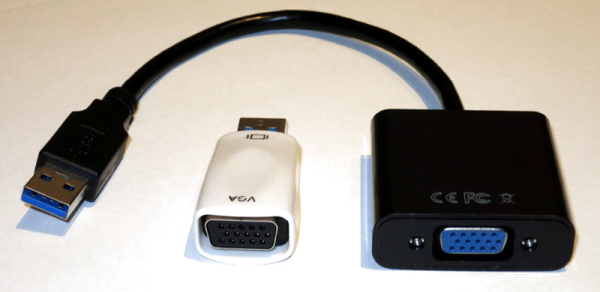
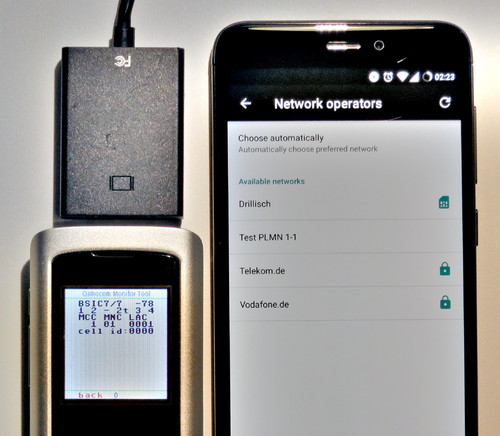
GSM network broadcast from a VGA adapter

Now you can. At OsmoDevCon [Steve Markgraf] released osmo-fl2k, a tool which allows transmit-only SDR through cheap USB 3.0 to VGA adapters based on the Fresco Logic FL2000 chip. Available through the usual overseas suppliers for as little has $5 USD, these devices can be used unmodified to transmit low-power FM, DAB, DVB-T, GSM, UMTS and GPS signals.

In a demonstration on the project page, one of these USB VGA adapters is used to broadcast a GSM cellular network which is picked up by the adjacent cell phones. Another example shows how it can be used to broadcast FM radio. A GitHub repository has been set up which includes more examples. The signals transmitted from the FL2000 chip are obviously quite weak, but the next step will logically be the hardware modifications necessary to boost transmission to more useful levels.

To say this is a big deal is something of an understatement. For a few bucks, you’ll be able to get a device to spoof cellular networks and GPS signals. This was possible before, of course, but took SDR hardware that was generally outside the budget of the casual experimenter. If you bought a HackRF or an Ettus Research rig, you were probably responsible enough not to get into trouble with it, but that’s not necessarily the case anymore. As exciting as this technology is, we would be wise to approach it with caution. In an increasingly automated world, GPS spoofing can have some pretty bad results.

SDR IF Experiments

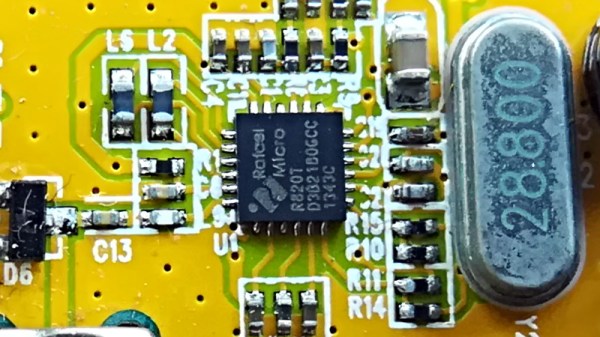
The R820T tuner IC is used in the popular Airspy software defined radio (SDR) as well as many of the inexpensive RTL SDR dongles. [TLeconte] did some experiments on intermediate frequency (IF) configuration of the chip, and you’ll find his results interesting.

Using 5 million samples per second and the device’s real mode, the tests look at a what comes out when the IC reads a noise source. There are two registers that set the IF parameters, but the tests show the effects these registers have in precise terms.

Continue reading “SDR IF Experiments”

The Raspberry Pi 3B+ As An SDR – Without The SDR!

We’ve become used to software-defined radio as the future of radio experimentation, and many of us will have some form of SDR hardware. From the $10 RTL USB sticks through to all-singing, all-dancing models at eye-watering prices, there is an SDR for everyone.

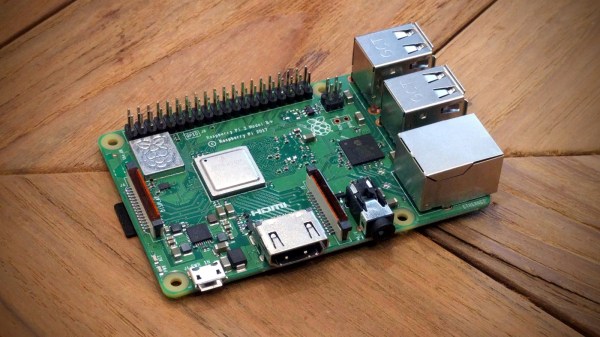
What about the idea of an SDR without any external hardware? Instead of plugging something into your Raspberry Pi, how about using the Pi itself, unmodified? That’s just what the Nexmon SDR project has achieved, and this has been made possible through clever use of the on-board Broadcom 802.11ac WiFi chip. The result is a TX-capable SDR, albeit one only capable of operating within the 2.4 GHz and 5 GHz spectrum used by WiFi.

The team had previously worked extensively with the chipset in the Nexus 5 phone, and the SDR extension was first available on that platform. Then along came the Raspberry Pi 3 B+ with a similar-enough WiFi chipset that the same hack was portable to that platform, et voilá: WiFi SDR on a Pi 3 B+.

If you’ve not looked at the Pi 3 B+ we’d like to direct you to our review. If you don’t have a Nexus 5 kicking around, and you’d like to do some WiFi-band SDR work, it’s looking like an amazing deal.

Via rtl-sdr.com.

Icoboard Software Defined Radio Platform

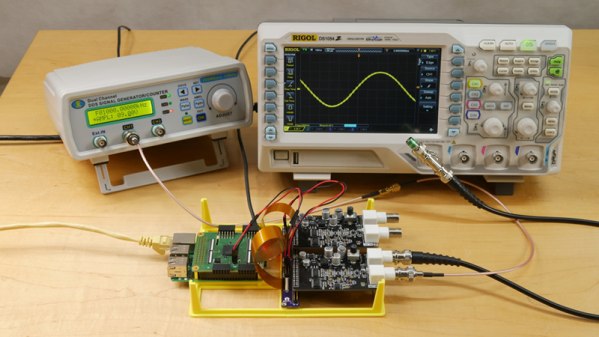
The Icoboard is a plug-in for the Raspberry Pi with a Lattice iCE FPGA onboard. Combined with a cheap A/D converter, [OpenTechLab] build a software-defined radio using all open source tools. He found some inexpensive converters that cost about $25 and were fast enough (32 MHz) for the purpose at hand. The boards also had a digital to analog converter and he was able to find the data sheets. You can see a video with the whole project covered, below.

The video, by the way, is pretty extensive (about an hour’s worth) and covers the creation of a PC board to connect from the Icoboard to the converters. There’s also a 3D printed frame, and that’s explained in detail as well.

Continue reading “Icoboard Software Defined Radio Platform”