Photo Hardware That Automatically Produces Rotating GIFs

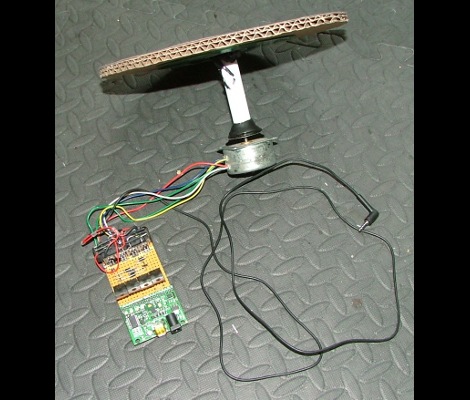
[Fergus Kendall’s] company is making development and breakout boards targeting electronic hobbyists. As with any endeavor that involves selling something, they need marketing. It sounds like [Fergus] was put in charge of getting some nice animated 360 degree images of each component. Instead of going through the drudgery of snapping frames by hand in a stop-motion-style, he whipped up a rotating platform that does the work for him.

The brain of the operation is a Boobie Board, a microcontroller breakout board that is one of their products. It controls a stepper motor attached to the cardboard platform via a quartet of power transistors. [Fergus] mentions in passing that their digital camera didn’t have a connection for a shutter trigger attachment. But they modded it to make things work. There’s no detail on that part of the hack but we’d wager that they soldered a transistor to the contacts for the shutter button.

The stepper motor has 48 steps, so the hardware is programmed to take 48 pictures which become the frames of an animated GIF – embedded after the break – to show off the product.

Continue reading “Photo Hardware That Automatically Produces Rotating GIFs”
Low-voltage Wind Turbine Lighting

led_wind_turbine

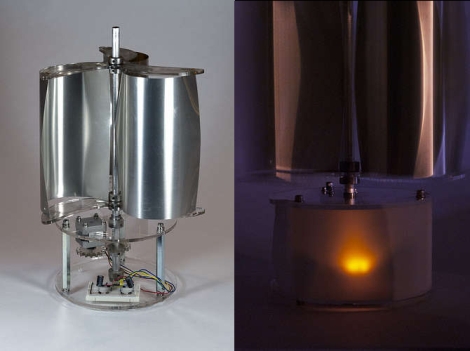
Instructables user [Dustyn] recently constructed a wind-based lantern to provide a bit of free, renewable light in urban settings. The project is based around a vertical-axis wind turbine, which she says are better suited to these environments since wind often comes from all different directions. Despite their lower efficiency compared their horizontal-axis brethren, this style of turbine seems to fit her needs quite well.

She provided a complete bill of materials, down to the last screw and washer you would need to replicate her work. The wind sails were constructed from thin aluminum flashing, and inserted between two acrylic sheets. These were then mounted to the central aluminum shaft of the turbine, which drives the stepper motor built into the base.

The current from the stepper motor is rectified and run through a pair of capacitors before being used to light the attached LED. This allows the bipolar motor to provide current regardless of the direction the turbine is turning, and the caps smooth things out so that the LEDs don’t flicker wildly under varying wind conditions. The turbine is not going to light up a full city block, but it is definitely a nice alternative to sun jars.

Stick around to see a video of the turbine mechanism in action.

Continue reading “Low-voltage Wind Turbine Lighting”

KiwiDrive HouseBot

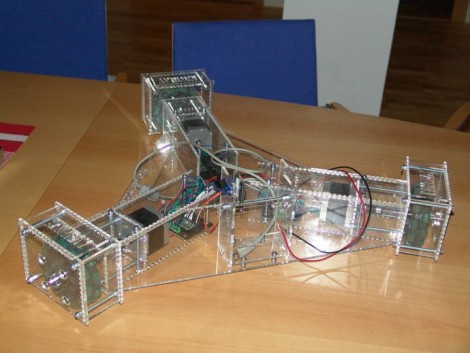
Forskningsavdelningen, a Swedish hackerspace, had a hackathon last weekend and the KiwiDrive HouseBot is one of the items that resulted from the group effort. They set a goal to use standard, easy to obtain parts, so that the robotic platform would be accessible for reproduction by individuals or at other hackerspaces. The three-limbed device rolls around on a triad of omni-directional wheels -which are probably the hardest part to source but you can always print your own. An Arduino Uno was used as the hardware interface, driving the three stepper motors for locomotion.

It’s not pictured above, but the fourth generation of the little guy also includes a webcam. The camera rides in the center of the body and is mounted on a servo. This makes it possible to turn the camera, meaning there’s no real front or back to this design. Future plans include adding an on-board computer (this is larger than it appears) and implementing emoticons on an 8×8 LED matrix, presumably so you can tell how the bot is feeling today.

[Thanks KiwiRay]

DIY Pick And Place Seems Easy To Build

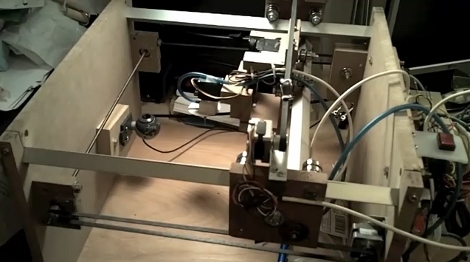
We’re not saying it’s a simple project, but the build methods that [Alan Sawula] used for this DIY pick and place are probably the easiest we’ve seen yet. As this is just a CNC machine, the methods he used would also work quite well for mills or other machines. Instead of using precision rods for the X and Y axes, he used square tubing. The tubing is oriented more like a diamond, with the ninety degree corners providing the travel surface. Two bearings with a shim between them provide a groove that rides along the corner, and since this is square and not just ‘L’ bracket, the sleds are secured both above and below the tube. Stepper motors provide the movement along X and Y, with a servo motor for Z and another one to rotate the medical grade needle that serves as the vacuum tip. Starting four minutes into the video you can see that this not only works, but it’s lightning fast!

Continue reading “DIY Pick And Place Seems Easy To Build”

Stackable Macro Photography Rig

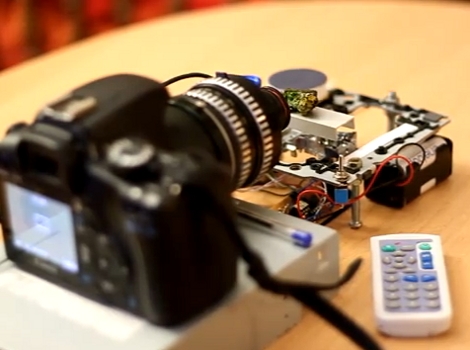
When taking macro photographs you lose a lot of clarity due to a reduced depth of field. One way to get sharp pictures is to take multiple shots at slightly different distances from the subject and then stack them into one image. There’s software to do this for you, but you still need a set pictures to start with. [Dsvilko] built this setup to easily capture a set of macro images.

He’s using the internals from an optical drive as a sled to carry the subject. A PICAXE drives the stepper motor that moves the carriage, which takes input from an IR remote control. This turns out to be a fantastic method as the sled can move in 0.2mm increments. After he’s got his set of images he uses Zerene to stack them together.

Bonus points to [Dsvilko] who used Linux command line tools to edit together the demonstration video embedded after the break.

Continue reading “Stackable Macro Photography Rig”

Stepper Directed HDTV Antenna

Credit: http://www.instructables.com/id/Computer-controlled-OTA-TV-antenna/

Broadcast TV has come a long way from adjusting the rabbit ears on top of the set just to get a fuzzy black and white picture. While nowadays there are often HD signals broadcast in most areas, it can often still be critical to redirect an antenna to get the best possible signal. By harvesting a stepper motor from an old 5 1/2″ floppy drive, and using a PC’s parallel port to control it, this adjustment can be handled automatically. Broadcast tower locations are easily found online, and once you have calibrated your stepper to face North, you are on your way to free HDTV reception.

What we would like to see is this antenna attached to a HTPC, and some kind of script to automatically direct the antenna for the best possible signal for the current channel. If anyone out there makes this happen, be sure to let us know.

Cobbling Together A CNC Mill

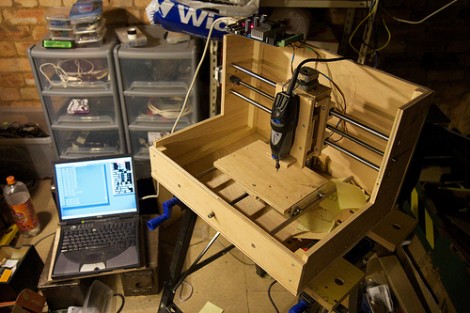
[Howard Matthews] never throws anything away, and because of it he was able to build this CNC mill using parts that he already had on hand. He pulled stepper motors out of broken stage light, precision rod and bearings from old dot matrix printers, and other various bits from his junk bin. We’ve seen [Howie’s] handi-work before, and this project is just as fun as his Land Rover’s replacement speedometer. Some highlights include manufacturing the nuts for the precision rod, and building a rail system for the bed of the machine. The latter looks a bit suspect, as any milling debris on the rails will cause you Z-axis problems, but now that he has bootstrapped a working mill perhaps he’ll machine an upgrade.

Update: Fixed the link, added video after the break.

Continue reading “Cobbling Together A CNC Mill”