Serial communication with cell phones

posted Feb 23rd 2010 10:00am by
filed under: cellphones hacks

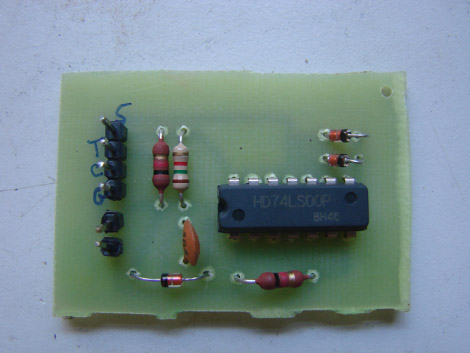
Hackaday alum [Will O'Brien] has been doing some cellphone integration work. He recently picked up some Motorola c168i cellphones from eBay. It turns out there is a serial port that uses TTL communication with a standard head-phone jack as an interface. [Will] soldered up a connector and used a USB to FTDI cable to interface with the phone. To his surprise he was able to read off the stored text messages even though they were PIN protected in the phone’s operating system. The messages on these units were trivial but this is another example of the importance of clearing your data before discarding your devices.

DIY aluminum heat sink casting

posted Feb 23rd 2010 9:00am by
filed under: classic hacks

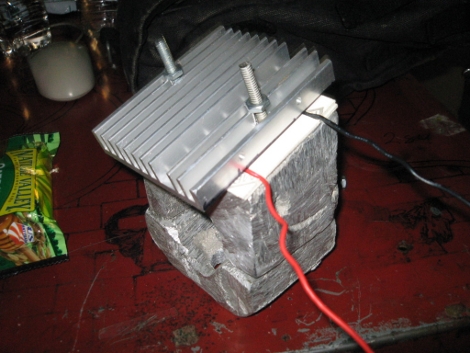
[Peter Wirasnik] has been casting his own aluminum heat sinks. He’s working on capturing the heat from a car’s exhaust system and turning it into electricity, kind of like the candle generator. In the photo above a standard heat sink is bolted to one side of a Peltier cooler with [Peter's] own casting on the bottom. That casting will connect to the exhaust pipe and transfer heat to the Peltier while the other heat sink keeps the opposite side relatively cool. What results is a voltage between 600mV and 1V.

We’re not quite sure what the end product will be but the casting process is fascinating. He carves the shape of the piece he wants to cast from Styrofoam and embeds it in a box of sand. He then melts salvaged aluminum in a cast iron frying pan using what looks like a propane torch. Once molten, he pours the aluminum into the mold and it burns away the Styrofoam as it fills the void. A little cleanup and he’s got the heat conductive mounting bracket he was after.


Building the yellow submarine

posted Feb 23rd 2010 7:19am by
filed under: robots hacks

Submarine builds are always fun but frequently produce headaches when it comes to keeping the water out. [Jason Rollette] built this ROV to explore a shipwreck in Lake Michigan. The main structure is PVC and various bilge pumps are used for propulsion. An AVR ATmega32 controls the on board electronics with an Ethernet tether to the surface. He’s even got a visual basic program that displays system information and a video feed. It may not be as stylish as the last submarine we saw but it’s amazingly well thought out and well built.

[Thanks Daphreak]

Is that some type of new Kindle?

posted Feb 22nd 2010 11:25am by
filed under: misc hacks

[Mr C Camacho] picked up an inexpensive digital picture frame hoping to hack into it. He hasn’t had the time to crack open the hardware so that it will do his bidding but he did find a creative way to make it an ebook reader. Using a python script he processes books, creating images of the pages.

The python script, available after the break, takes free books from Project Gutenburg and spits out JPG images. Page turning and bookmarking are not what they ought to be but the process does work. The thought of someone staring at a picture frame on the subway is a bit amusing but we’re sure that sooner or later someone will ask if it’s a new version of the Kindle.

Read the rest of this entry »

Gentle wake up alarm

posted Feb 22nd 2010 9:07am by
filed under: clock hacks

[Michiel], unsatisfied by his Phillips wake up light, decided just to make his own. He really wanted programmable weekend alarms as well as an easier to find snooze button. At first, his circuit was not reliable enough, losing several minutes per hour, but he gutted another alarm for the 1Hz crystal. After some carpentry, his final alarm ended up quite nice.  After so many aggressive alarm clocks, it’s nice to see that not everyone needs to be assaulted out of bed.

Correction: apparently, there’s no 1Hz crystal. That was a guess on my part. -[Caleb]

[via Hacked Gadgets]


PIC pong clock

posted Feb 22nd 2010 5:56am by
filed under: clock hacks

[Andrew] built this pong clock over the span of a couple of days. The PIC 18f2520 he used can serve as a real time clock with the addition of an external clock crystal. His project proves the usefulness of an oscilloscope as poor board layout caused interference in the crystal connections, something difficult to troubleshoot without this handy lab tool.

Pong clocks have been quite popular. This one is nice because it’s easy to throw together now that [Andrew's] done the coding work for you. Written in assembly, reading and understanding his code might be a good exercise if your low-level language skills are lacking.

Android 2.1 on four more HTC handsets

posted Feb 21st 2010 4:00pm by
filed under: android hacks, cellphones hacks

Tired of fighting Windows mobile on your HTC handset? Now you can fight a beta ROM of Android 2.1. [Slm4996] has put in a flurry of work over the last few days to get Android 2.1 running on the HTC Kaiser (aka AT&T tilt), Vogue, Niki, and Polaris. Right now everything except the camera and bluetooth is working but there is a bug tracker to help with troubleshooting any undiscovered issues. If you want to try it out but don’t want to flash the hacked ROM to your phone you can run it beside Windows Mobile by using HaRET.

Correction: The title of this post originally read “Droid 2.1″ in error. We have corrected it to read “Android 2.1″.  [Thanks GuyFrom7Up]

Robocup bot places wheels perpendicularly

posted Feb 21st 2010 2:52pm by
filed under: robots hacks

[Eric] built this robot for the 2009 Robocup Jr. competition. The game ball has IR LEDs inside of it and this little bot uses eight IR detectors for tracking. Four motors mounted perpendicular to each other provide locomotion. Since this would normally have you traveling in circles, he used some omnidirectional wheels walled Transwheels. As you can see, they have small rollers built-in and allow movement in any direction if the motors work together. A couple of L298 controller chips handle the motors. [Eric] wrote a program to calculate the PWM necessary to drive the controllers and to coordinate movement of the wheels.

Don’t miss the demo videos after the break and, if you’re not a fan of wheels, stop by and see the bi-pedal soccer robots. Read the rest of this entry »


Hack a Day serves up fresh hacks each day, every day from around the web as well as hacking related news.

Send us your hacks


Hacks

Resources