Modding an inkjet for PCB production

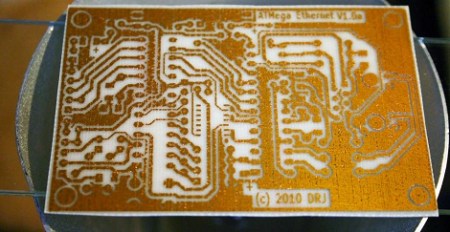
Like all of us, [Ryan] is tired of waiting for board production houses. To reduce some of that turnaround time, he modded an Epson inkjet into a PCB printer. The Instructable of his build is extremely thorough and it looks like he’s getting some quality boards out of his project

The build started off by disassembling an Epson C86 printer he had lying around the house. Going with an Epson printer is important – Epsons have a piezo print head accepts ink that would clog other printers. After tearing all the plastic off his printer, [Ryan] set to work raising the printer (or lowering the bed, whatever) and was off to the races.

The cartridges were filled with etch-resistant yellow ink and a piece of copper clad put onto the printer. After printing, [Ryan] etched his board in ferric chloride. Sadly, he’s getting small pinholes in his traces where a bit of the ink was eaten during etching. He’s tried HCl and Peroxide, but those turn his boards into green junk.

If you’ve got any tips to help [Ryan] out, leave them in the comments. Before that, check out the printing demo [Ryan] put up.

[Read more...]

PCB toner transfer with dowel

dowel

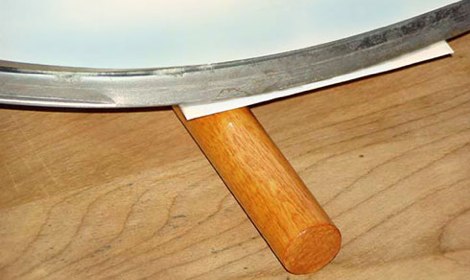
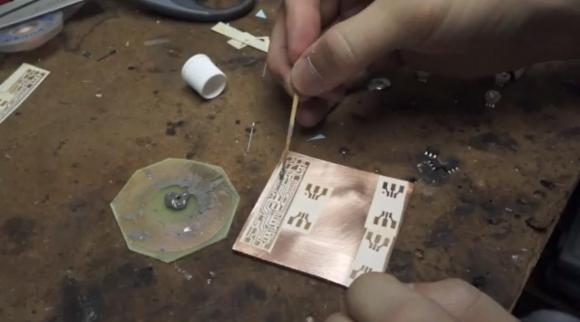
Pulsar Professional FX has a neat tip on their site for getting a really even toner transfer when making your own PCBs. First, the PCB is cut to size, and the paper is tacked to the board. Then, the PCB is placed paper up onto a dowel and rolled back and forth with the iron. Since the board bends slightly over the dowel the toner sticks evenly to the copper. After that, just remove the paper as usual and etch with your preferred method.

Etch PCBs with ferric chloride and a sponge

F7Z9JTTFX23V5VV

Etching a printed circuit board generally takes a bit of time and uses a lot of etchant. [TechShopJim] posted a method that uses a sponge to reduce the amount of etchant used while speeding up the entire process. First, a resist is applied using either a sharpie or the toner transfer method. Using gloves to handle everything, he soaked a sponge in ferric chloride and continually wiped a copper-clad board until all the exposed copper was removed. This technique moves the etchant around more, keeping “fresh” etchant closer to the copper. If you can’t procure ferric chloride, you can also use our method that uses 2 household chemicals: hydrogen peroxide and hydrochloric acid.

RGB etched box


[Dine909] brings us this simple glowing box made out of five etched PCBs. The PCBs control RGB LEDs inside the box, which is also filled with clear glass beads. The four walls are connected to a base controller board that has a Cypress PSoC chip for color mixing. There’s no writeup, and even though it looks a lot like the Lament Configuration, it should be a lot easier to build; any transportation to other dimensions it provides will be strictly figurative.

[via ladyada]