posted May 8th 2012 6:46am by
Caleb Kraft
filed under:
classic hacks,
multitouch hacks

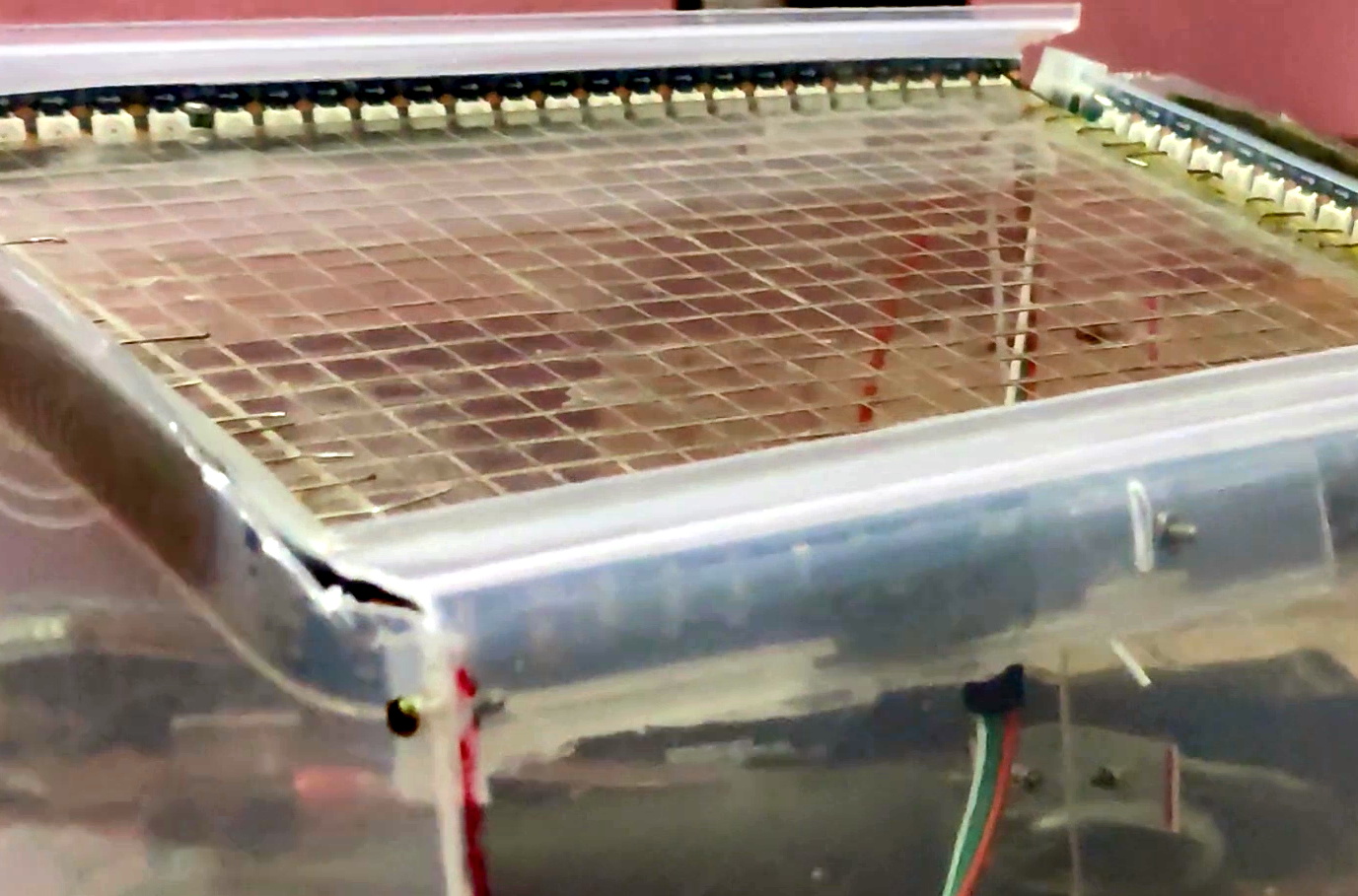
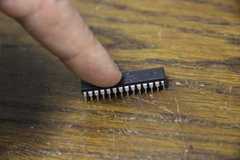
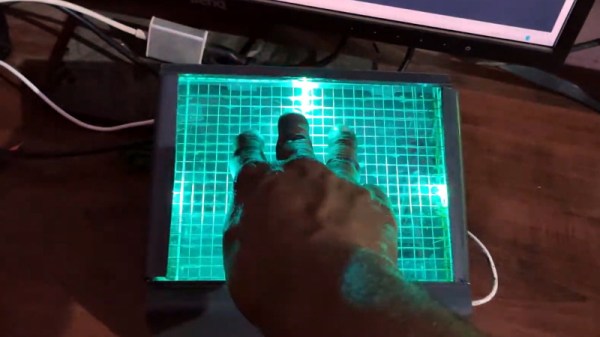
[Sprite_tm], a name many of you will recognize from these pages, has wasted no time in replicating the latest cool thing in a much simpler fashion. En Garde is a touch sensor that can detect up to 32 different points of contact on… whatever you use as the surface. He couldn’t sit idly by and let the Disney funded one from yesterday keep the spot light. As you can see in the video, it works pretty well. If he didn’t tell you that his can only detect up to 32 points as opposed to the 200 of the other, you probably wouldn’t even notice the difference. Of course, [Sprite_tm] also shares how you could easily beef his up to be even more precise. You can also download his source code an schematics from his site and give it a try yourself.
Read the rest of this entry »
posted May 7th 2012 6:01am by
Brian Benchoff
filed under:
multitouch hacks

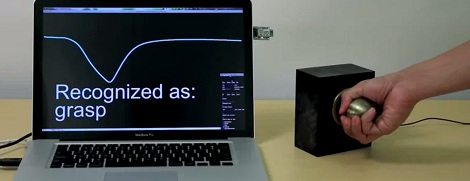
This year at the CHI conference in Austin, [Munehiko Sato], [Ivan Poupyrev], and [Chris Harrison] out of the Disney research lab in Pittsburgh demonstrated their way to make touch sensors out of anything. Not only to they suggest using the surface of your skin to control cell phones and MP3 players, they’re also able to recognize touch gestures, like poking or grasping an object. That sounds a little heady, so check out the video of the Touché tech in action.
Like the capacitive touch sensors in our phones and tablets, Touché measures the rise and fall of a capacitor’s charge over time. Unlike other touch sensors, Touché scans the capacitor at different rates, allowing for a ‘capacitive profile’ that is used to recognized touch gestures.
The applications for this tech are nearly innumerable; the team demonstrated scolding someone for eating cereal with chopsticks (yeah, we know…), an on-body music player interface, and gestures for an office doorknob that notifies passersby if you’ve stepped out for a minute or are gone for the day.
It’s a very interesting build, and we give it two weeks until someone replicates this build. We’ll be sure to post it then.
Read the rest of this entry »
posted Apr 30th 2012 6:01am by
Brian Benchoff
filed under:
Kinect hacks,
multitouch hacks

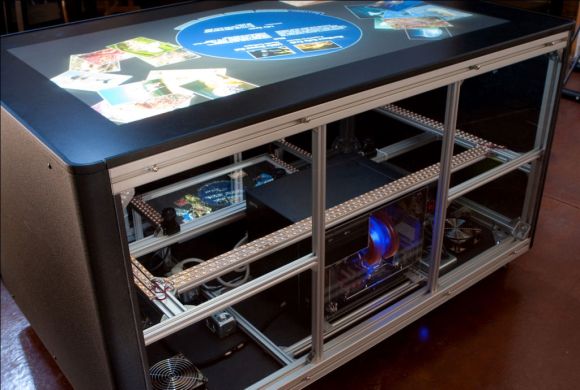
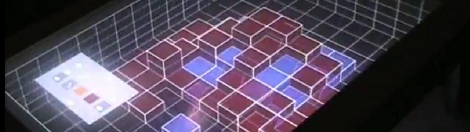
[Bastian] sent in a coffee table he built. This isn’t a place to set your drinks and copies of Make, though: it’s a multitouch table with a 3D display. Since no description can do this table justice, take a look at the video.
The build was inspired by the subject of this Hackaday post where [programming4fun] was able to build a ‘holographic display’ using a regular 2D projector and a Kinect. Both builds work on the principle of redrawing the 3D space in relation to the user’s head – as [Bastian] moves his head around the coffee table, the Kinect tracks his location and moves the 3 dimensional grid of boxes in the opposite direction. It’s extremely clever, and looks to be a promising user interface.
In addition to a Kinect, the coffee table uses a Microsoft Surface-like display; four infrared lasers are placed at the corner and detected with a camera next to the projector in the base.
After the break you can see the demo video and a gallery of the images [Bastion] put up on the NUI group forum.
Read the rest of this entry »
posted Jan 25th 2012 10:01am by
Brian Benchoff
filed under:
android hacks,
Kinect hacks

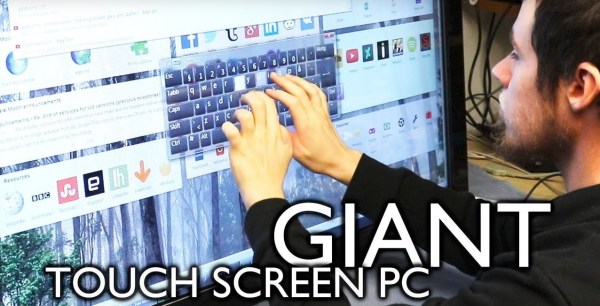
If you’re going to build a giant touch screen, why not use an OS that is designed for touch interfaces, like Android? [Colin] had the same idea, so he connected his phone to a projector and a Kinect.
Video is carried from [Colin]‘s Galaxy Nexus to the projector via an MHL connection. Getting the Kinect to work was a little more challenging, though. The Kinect is connected to a PC running Simple Kinect Touch. The PC converts the data from the Kinect into TUIO commands that are received using TUIO for Android.
In order for the TUIO commands to be recognized as user input, [Colin] had to compile his own version of Android. It was a lot of work, but using an OS designed for touch interface seems much better than all the other touch screen hacks that start from the ground up.
You can check out [Colin]‘s demo after the break. Sadly, there are no Angry Birds.
Read the rest of this entry »
posted Jan 15th 2012 1:26pm by
Brian Benchoff
filed under:
Kinect hacks,
misc hacks

Even though giant multouch display tables have been around for a few years now we have yet to see them being used in the wild. While the barrier to entry for a Microsoft Surface is very high, one of the biggest problems in implementing a touch table is one of interaction; how exactly should the display interpret multiple commands from multiple users? [Stephan], [Christian], and [Patrick] came up with an interesting solution to sorting out who is touching where by having a computer look at shoes.
The system uses a Kinect mounted on the edge of a table to extract users from the depth images. From there, interaction on the display can be pinned to a specific user based on hand and arm orientation. As an added bonus the computer can also recognize users from their shoes. If a user is wearing a pair of shoes the computer recognizes, they’ll just walk up to the table and the software will recognize them.
Read the rest of this entry »
posted Oct 23rd 2011 8:01am by
Brian Benchoff
filed under:
hardware

Finally [Michelle Annett] can talk about her super secret project she did at Autodesk Research.
Medusa, as [Michelle]‘s project is called, is a Microsoft Surface that has been fitted with 138 proximity sensors. This allows the Surface to sense users walking up to it, and detect users hands and arms above the table top. Multiple users can be detected at the same time, and the left and right hands of two users can be mapped to specific users.
The proximity sensors [Michelle] used are inexpensive, so we’re wondering when someone with a crazy multitouch setup will add proximity sensors to their build. We’d like to play with Medusa, even if just for a virtual game of Settlers of Catan. It seems like the perfect setup…
[Michelle] built Medusa last January during her internship at Autodesk. Now that UIST 2011 is over, she can finally talk about it. There’s also a video demonstrating the possibilities of Medusa, check it out after the break.
Thanks [Fraser] for sending this one in.
Read the rest of this entry »
posted Sep 6th 2011 11:19am by
Brian Benchoff
filed under:
hardware,
musical hacks,
Software Development

When we see artists like Daft Punk or Madeon working their magic in a live setting, we’re always impressed with their controllers. Sample-based artist use controllers like the Monome and Kaoss Pad a lot, but these devices are fairly expensive. Thankfully, we live in an age of multitouch displays, so [Graham Comerford] came up with his own multitouch controller that does just about anything.
The build is based on the Kivy framework and includes a Monome emulator, MIDI drum pads, mixer, and a whole bunch of other sliders and buttons. There’s no word on how [Graham]‘s multitouch display was constructed, but if you’re looking to build your own gigantic audio control setup there’s a lot of info on building Microsoft Surface clones, adapting computer monitors, and spherical multitouch rigs.
We’re not sure if [Graham]‘s virtual drum kit is velocity sensitive but even if it’s not, it’s an interesting bit of kit. Check out an earlier version of his setup after the break.
Read the rest of this entry »
posted Oct 31st 2010 9:12am by
Mike Szczys
filed under:
peripherals hacks

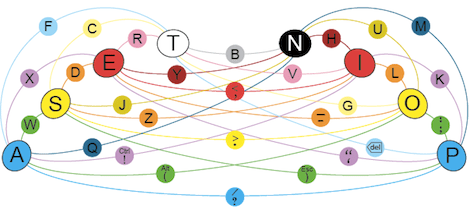
This is a keyboard alternative that [Sebastian] is building from two Apple Magic Trackpads. The multitouch devices are a good platform for this because they’re designed to pick up several events at the same time. To prototype the locations of the keys he’s using printable transparency sheets. He gives you a sense of where the home row is with a dab of clear fingernail polish that you can feel with your digits.
He may laser etch these pads once the key location is just right. This should give a bit of texture in itself and do away with the need for nail polish but we still like the ingenuity of that solution. The device is being developed in Linux, with some kernel hacking to handle the devices. We asked about source code and [Sebastian] is hesitant to post it because he’s been getting a lot of kernel panics. It sounds like once he cleans things up a bit he’ll share his work.
Don’t forget, there’s an easy hack to do away with the batteries in these things.