posted Sep 16th 2011 11:11am by
Mike Szczys
filed under:
digital audio hacks

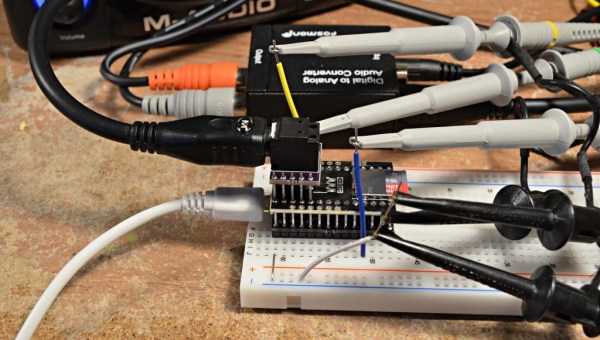
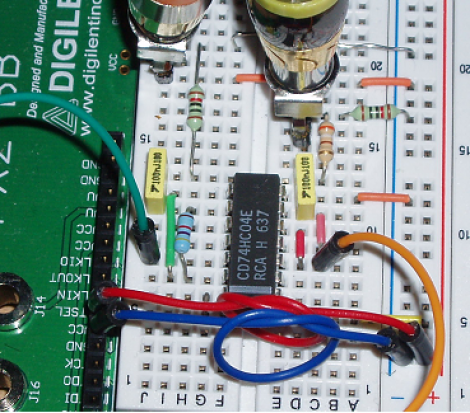
[Mike Field] took what he had learned with a few past projects and combined them to make this FPGA-based SPDIF audio pass-through. In order to get the SPDIF signal ready for the FPGA he needed a few components to use for level conversion. Once everything was connected he used a first in first out (FIFO) buffer to ensure that the outgoing bitrate is the same as the input, while still allowing enough time for the FPGA to do some digital manipulation.
This reminds us of the NeTV, which is an HDMI pass-through device. That one allows you to overlay your own video information to any TV that has an HDMI port. This would allow you patch into any audio system that’s using SPDIF, letting you inject your own audio, such as a paging system in a public lobby, or the ringing of a phone when you get a call, or to create your own sounds.
We like his overhand knot cable management system to keep those jumper wires from becoming too much of a mess on the breadboard.
posted Jul 12th 2011 11:01am by
Mike Szczys
filed under:
digital audio hacks

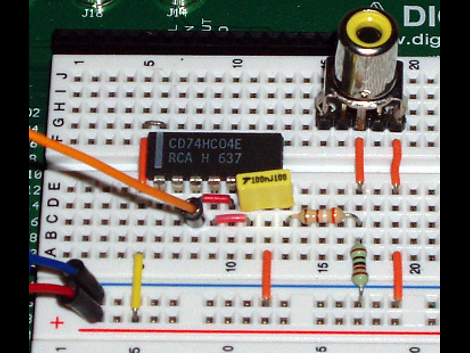
[Mike Field] just finished implementing SPDIF generation on an FPGA. SPDIF is an industry standard for transmitting digital audio signals; the acronym stands for Sony/Philips Digital Interconnect Format. It’s been around for more than a decade and since it’s found on most home-audio equipment, building an SPDIF output into your projects may be quite a desirable feature. [Mike] mentions several ideas for this functionality like building high-end test equipment, or providing a high-quality output for electronic instruments.
He first jumped into analyzing the specification in order to determine the hardware requirements. Due to some issues with jitter, he found it necessary to use a 100 MHz clock signal. This pushes the jitter down to +/- 5ns of jitter, which he concedes may raise the hackles of audio purists, but does satisfy the published standard. Output requires just one pin of the FPGA and the five components seen above. A hex inverter (74HC04) voltage divider, capacitor, and RCA connector transmit the 0.5V signal to your audio-receiver of choice. Of course, since TOSLINK fiber optic connectors use the same protocol, you could redesign the output and make this an optical connection.
posted May 6th 2011 4:05am by
Brian Benchoff
filed under:
digital audio hacks,
Microcontrollers

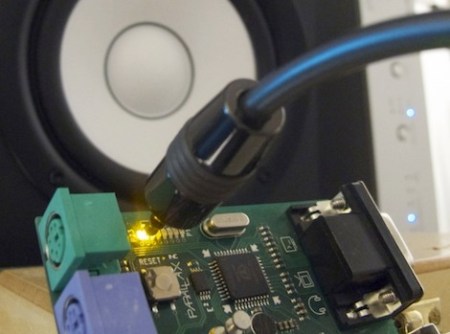
[Beth] had the idea for transmitting digital audio over S/PDIF on a Propeller a few years ago, but only just got around to a writeup. For that, we thank her.
The writeup has a marvelous walkthrough of the S/PDIF protocol and the problems associated with with generating the signal. S/PDIF is a relatively resource-intensive protocol – the signal is clocked at 64x the audio sample rate. That signal is doubled for biphase mark code, keeping everything in sync. [Beth] says the microcontroller would neet at least 24 MIPS of processing power just to generate the S/PDIF signal – processing audio would be another task altogether. Because of the processing power needed, and the weird clock rates needed, [Beth] decided to go with the Propeller. The implementation uses only one core of the Propeller, leaving another seven cores available for sound synthesis or even a visualization over VGA.
[Beth] admits this could be done with just about any microcontroller (although it would need to be clocked at a multiple of 4.096 MHz for a 32kHz audio stream), but we really appreciate the work that went into bit-banging this signal.
Video of [Nick] at Gadget Gangster playing around with digital audio on a Propeller after the break.
Read the rest of this entry »
posted Apr 16th 2009 1:08pm by
Caleb Kraft
filed under:
classic hacks,
video hacks

When [linux-works] found himself needing a switch that could convert coax to opto, he made one. The main chip is a cd4052 cmos analog switch, which he says is really cheap. The rest is pretty self explanatory. This setup can switch between 4 different inputs as well as do the coax to opto conversion.