Bricking A Seagate Drive While Trying To Make It Work In An Xbox 360

If you’re looking to replace the hard drive in your Xbox 360 without just buying an official unit, you may be out of luck. There is a tool which will let you do it if you are using aWestern Digital drive as the replacement. But if your new drive is a Seagate this tool will not work. [Darth Circuit] set out to make his Seagate work in the Xbox 360, but his manual changes ended up bricking the drive because of just one little error.

The tool that does this with WD drives is called HddHackr. [Darth] started his quest by finding out what the program actually does. In order to stand in for the original drive the new one must have the same model number, serial number, LBA, and firmware revision. Once these values are changed in a binary file it is written to the drive at a specific location. He changed these values on the drive itself, and got pretty far. That is until he tried a new command which ended up locking him out of the drive. Right now it’s pretty much a brick but we hope someone can pick up where he left off and turn this work into something useful for others. Good luck!

Exercise Bike Actuates Your Download Speeds; Messes With Music Playback

We’re not featuring this project because it involves the tiniest exercise bike in the world. It’s on the front page because the speed-control features which this dynamic duo added are hilarious. They call it the Webcycle and it’s actually two hacks in one.

Way back in 2009 [Matt Gray] and [Tom Scott] slapped an Arduino on the bike and used it to measure the revolutions of the cranks (how fast your feet are going in circles). This was hooked up to the laptop which is fastened to the handlebars. This way you can surf the Internet while you work out, but the bandwidth is directly affected by pedal speed. If you want to watch video you’re going to have to sweat…. a lot. Check it out in the clip after the break.

This March they pulled the Webcycle out of storage so that it may ride again. This time it’s connected to the sound system in their exercise room. A record player motor is the victim in this case. You guessed it — pedal speed dictates the rate of the turntable, modulating the pitch drastically. Make sure the boss isn’t around when you watch this clip because it will be hard not to guffaw.

These guys really have fun with this hacks. It was [Tom’s] birthday that prompted that hacktacular mini golf course.

Continue reading “Exercise Bike Actuates Your Download Speeds; Messes With Music Playback”

RA 3D Printer Controller Board Does Everything, Has Disco Lights

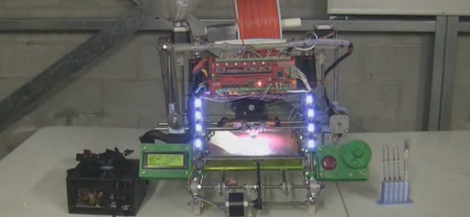
3D printers are getting far, far more complicated than a 4-axis, plastic-squirting CNC machine. These days, you really haven’t earned your geek cred unless you’ve hacked an LCD and SD card interface into your 3D printer, or at least experimented with multiple extruders. There’s a problem with the controller boards everyone is using, though: most boards simply don’t have enough output pins, greatly reducing the number of cool things a 3D printer can do.

Enter RA. It’s a new 3D printer controller board with IO for any imaginable setup. Going down the feature list of RA, we’re wondering why we haven’t seen some of these features before. A 24-pin ATX power header is soldered directly to the board, giving RA users a stupidly easy way to power their printer. Of course there are outputs for LEDs, camera triggers (printer time-lapse movies are really cool), light rings, buzzers, an LCD/rotary encoder/SD card control panel, and support for two heated beds for gigantic printers. If printing in one color isn’t good enough for you, RA has support for three extruders

Compared to other 3D printer boards such as RAMPS or the Sanguinololu, the number of outputs on this board is simply amazing. If you’re planning to build a huge, feature-laden 3D printer, you probably couldn’t do much better than what RA is offering.

Simple Solution Makes Rocket Fin Alignment A Breeze

If you’re building model rockets you want to make sure they fly straight, and most of that is dependent on the stabilizer fins. It has long been a problem come assembly time. How can you make sure that they’re being aligned without any variation? [Rrix] mentioned that one technique is to use a square to position them perfectly perpendicular to the bench on which the rocket is being assembled. But this is still prone to error. His method uses a couple of precision jigs made out of cardboard.

He designed this pair of jigs in Inkscape, then used the files to fabricate them out on a laser cutter. It worked like a charm, but led him to another issue that can be solved in a similar way. Model rockets have rail guides that travel along a rod attached to the launch pad as the craft accelerates to a point where the fins have enough effect to keep it going in a straight line. If those guides aren’t straight, your fin alignment will be all for naught. His second version of the jigs includes a cut out for these guides.

Building A Homebrew Diesel ECU

arduino-diesel-ecu

Over the years automobile engines have become increasingly complex, and with this added complexity comes an increased reliance on intricate computer systems to run them. These control systems are typically the fruit of many hours of research and development, carefully protected by the auto makers who create them. Instead of relying on a closed system to power his car, a Finnish hacker that goes by the name [synkooppi] has decided to do away with his diesel engine’s ECU altogether and build one of his own with little more than an Arduino.

As you can see from his web site, [synkooppi] has created his DIY ECU using an Arduino Mega, which is capable of controlling diesel engines that employ a Bosch VP37 or other inline diesel pump. So far he has all of the basic workings in place, which allow him to run and control an Audi diesel motor.

While many details about his homebrew ECU are hard to come by, he does have a series of development videos posted on YouTube which should help satiate inquisitive minds. For those of you with a spare diesel motor laying around, [synkooppi] has made the first release of his code available to try out.

Stick around to see a video of the ECU in action.

[Thanks, perhof]

Continue reading “Building A Homebrew Diesel ECU”

Tearing Down Disney’s Glow With The Show Props

disneys-glow-with-the-show-teardown

[Andy’s] boss recently returned from a trip to Disneyland with a set of light-up [Mickey Mouse] ears in tow. He said that during the event, every set of “Glow with the Show” ears in the crowd changed colors in sync with the performance. After he and some co-workers speculated on how this was pulled off, [Andy’s] boss gave him a new assignment – to find out how the darned things work!

[Andy] carefully disassembled the ears, sharing his findings and speculations with us. Inside, he found a small flexible circuit board powered by three AAA batteries. At the center of the device resides a TI MSP430G2553 which is tasked with controlling the RGB LEDs embedded in the ears.

In one ear, he spotted what he believes to be a Vishay TSMP6000 IR receiver. Vishay-branded or not, he verified that it does indeed pick up IR signals using his oscilloscope and a TV remote. In the other ear, he found a pair of small IR diodes, which he speculates are used to repeat the IR timing/sync signal received in the opposite side of the device.

The synchronization methods seem completely different than those found in the Xylobands we covered a while back, so we’re really intrigued to find out more about technology behind them.

Stick around to see a video of the light show in action, and since [Andy] says he’s willing to entertain any thoughts on how Disney makes their magic happen, be sure to sound off in the comments.

Continue reading “Tearing Down Disney’s Glow With The Show Props”

Custom Starcraft Controller

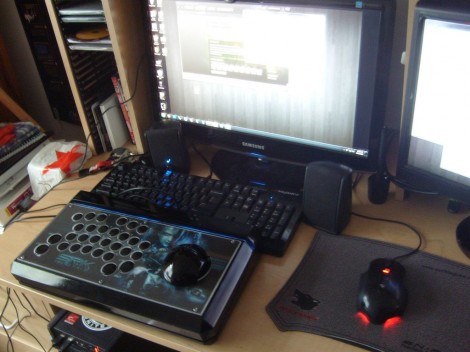
This Starcraft controller was designed as a contest entry. The goal of the contest was to provide a custom controller for the Starcraft Real-Time-Strategy game that shared some of the features seen in First Person Shooter controllers.

The design started as rough sketches. From the there button layout was prototyped before actually building a virtual model of the entire controller. A rendering of the model was submitted as a contest entry, and we’re glad it was also seen through to a physical device. This involved sending the design files off for 3D printing. What came back was painted and assembled to achieve the beautiful look seen above.

On the right is a stick that acts as the mouse controller. The buttons on the left are just the most necessary of Starcraft control keys. They all map to the appropriate keyboard keys and the device enumerates as an HID keyboard so no button mapping is necessary. That being said, a player does have the option of remapping if the layout doesn’t suit.

[Via Reddit with more info at Shoryuken]