Logic Analyzer Add-on For The MSP430 Launchpad

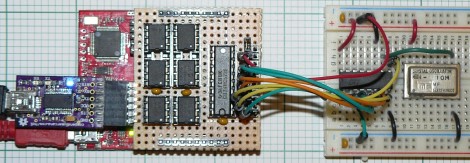
Here’s a 6-channel logic analyzer shield for the MSP430 Launchpad. It manages an eyebrow-raising 16 million samples per second. The prototype seen above is made on a hunk of protoboard with point-to-point soldering. [oPossum] did lay out a PCB — which is just 50mmx50mm — but has not had any produced quite yet.

He calls it the LogicBoost, and based it on the the LogicShrimp design. The sextuplet of 8-pin chips are all SPI RAM. These are responsible for storing the samples, with a 74HC573 latch routing the traffic. The MSP430 chip provides the SPI clock, and the Launchpad’s virtual com port can be used to push the data to a computer for graphing. That’s a bit slow so [oPossum] also included an optional header for an FTDI board that will do a faster job. The sample rate can be adjusted by tweaking the internal oscillator setting of the chip; there’s plenty to choose from so it will work for just about any purpose (as long as you don’t surpass the 16 Msps speed limit).

[via Dangerous Prototypes]
On Not Designing Circuits With Evolutionary Algorithms

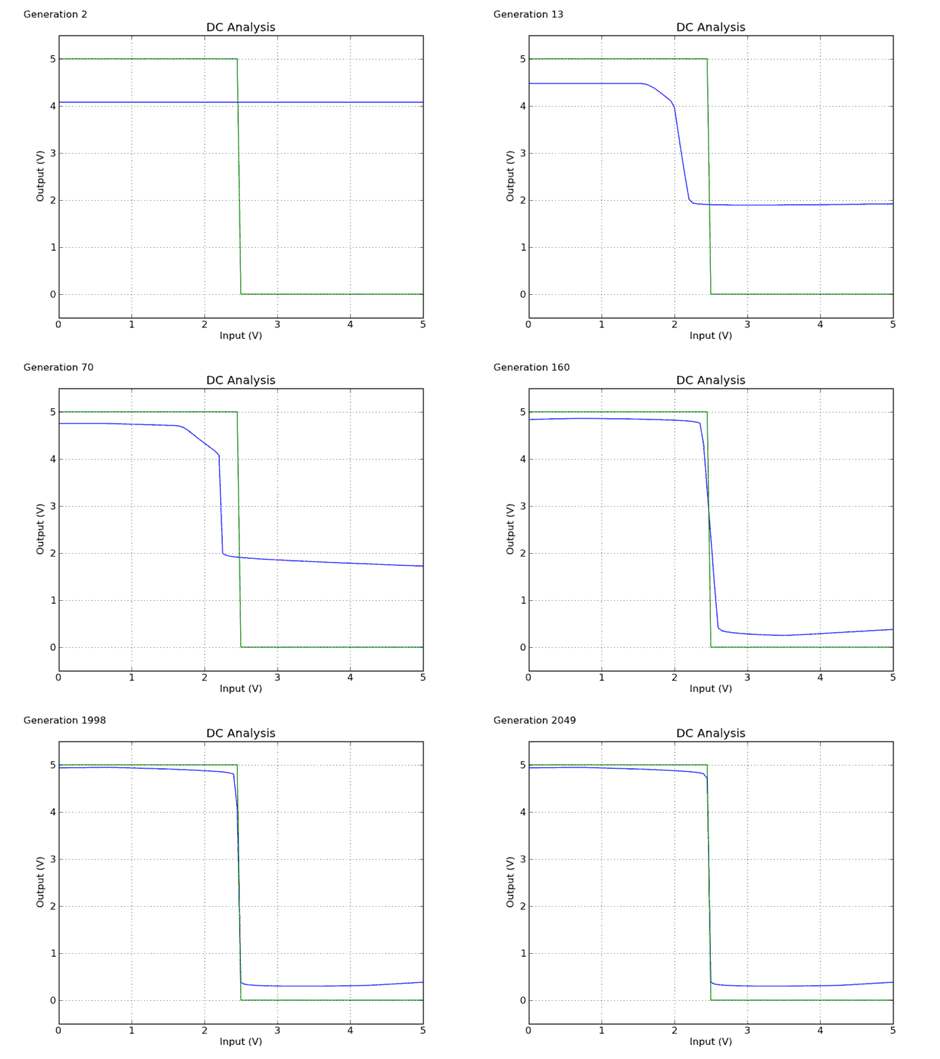
[Henrik] has been working on a program to design electronic circuits using evolutionary algorithms. It’s still very much a work in progress, but he’s gotten to the point of generating a decent BJT inverter after 78 generations (9 minutes of compute time), as shown in the .gif above.

To evolve these circuits, [Henrik] told a SPICE simulation to generate an inverter with a 5V power supply, 2N3904 and 2N3906 transistors, and whatever resistors were needed. The first dozen or so generations didn’t actually do anything, but after 2000 generations the algorithm produced a circuit nearly identical to the description of a CMOS inverter you’d find in a circuit textbook.

Using evolution to guide electronic design is nothing new; an evolutionary algorithm and a a few bits of Verilog can turn an FPGA into a chip that can tell the difference between a 1kHz and 10kHz tone with extremely minimal hardware requirements. There’s also some very, very strange stuff that happened in this experiment; the evolutionary algorithm utilized things that are impossible for a human to program and relies on magnetic flux and quantum weirdness inside the FPGA.

[Henrik] says his algorithm didn’t test for how much current goes through the transistors, so implementing this circuit outside of a simulation will destroy the transistors and emit a puff of blue smoke. If you’d like design your own circuits using evolution, [Henrik] put all the code in a git for your perusal. It’s damn cool as it stands now, and once [Henrik] includes checking current and voltage in each component his project may actually be useful.

Refurbing A C64 With A Raspberry Pi

When [Carl] first heard of the Raspberry Pi, he immeidatly though how freakin tiny this board is compared to a Mini ITX motherboard. After ordering a Raspi, [Carl] decided to put his barely-larger-than-a-credit-card computer inside a Commodore 64.

[Carl]’s updated C64 functions exactly like the original – the 30-year-old keyboard works thanks to the help of a Keyrah keyboard and control port adapter. This adapter was soldered to a stripped USB cable, allowing [Carl] to keep the finished project looking very clean and tidy. Of course, the composite, HDMI, and Ethernet ports are broken out, allowing for this computer to connect to any network or TV.

For a final touch, [Carl] painted the case. He originally wanted to spray on a black, red, and purple motif to match the Raspi, but he eventually settled on a beige and red style. [Carl] really put together an awesome build, and for much, much less money than the rereleased C64 Windows-powered monstrosity goes for. You can check out the build log video after the break.

Continue reading “Refurbing A C64 With A Raspberry Pi”

Make Your Own Integrated Circuits At Home

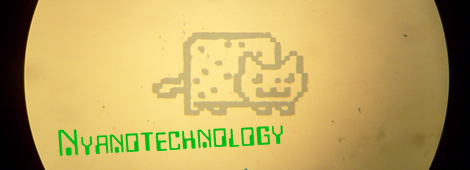
The Nyan Cat you see above is only 600 micrometers from head to tail. To put that into perspective, that’s about 10 times the diameter of a human hair. Also, that Nyan is etched into 200 nanometer thick copper foil and is the work of the HomeCMOS team, who is developing a hobbyist-friendly process to make integrated circuits and MEMS devices at home.

The project is far from complete; HomeCMOS has yet to produce a working IC but a few experiments – getting wet etching down pat and even building an almost working quantum qbit – are remarkable given the small amount of equipment and tools involved.

The HomeCMOS team has yet to actually make an integrated circuit or MEMS device, [Jeri Ellsworth] has shown this is possible by making transistors and integrated circuits at home. While there won’t be chips with millions of transistors coming out of the HomeCMOS lab anytime soon, it’s more than possible to see a few small-scale integration-level tech such as a few logic gates or a regulator.

Bootable Emulator For The DCPU

[Notch], the guy behind Minecraft, is currently working on a new game called 0x10c. This game includes an in-game 16-bit computer called the DCPU that hearkens back to the 1980s microcomputers with really weird hardware architecture. [Benedek] thought it would be a great idea to turn his ThinkPad into a DCPU, so he wrote a bootable x86 emulator for the DCPU that is fully compliant with the current DCPU spec.

This bootable DCPU emulator comes from the fruitful workshop of [Benedek], the brains behind drawing fractals on the DCPU, emulating bit-flipping radiation, and even putting the Portal end credits inside [notch]’s 0x10c computer.

[Benedek] wrote this new in x86 assembly, allowing it to be booted without an OS from a USB flash drive on any old laptop. This allows for direct hardware communication for everything implemented for the DCPU so far.

If you’d like to run your bare-metal DCPU, [Benedek] made all the files avaiable. Since the entire emulator is only 1800 lines of x86 assembly, it’s possible to load this off a floppy disk; an ancient tech we’ll be seeing in [notch]’s new game.

Oh. One more thing. When we were introduced to 0x10c, we said we’ll be holding a contest for the best hardware implementation of the DCPU. We’re still waiting on some of the hardware specs to be released (hard drives and the MIDI-based serial interface), so we’ll probably be holding that when there is a playable alpha release. [Benedek]’s bootable emulator is a great start, though.

Ask Hackaday: How About Some Model Rocket Hacks?

There’s nothing like the smell of black powder in the morning, along with the excitement and burnt propellant in the air that comes after launching a model rocket. All those 60s, 70s, 80s and 90s kids out there may remember the classes of model rocket engines – generally A, B, C, and D sized engines used to push your cardboard tube with balsa fins skyward.

A lot has changed in the world of model and amateur rocketry in the last few years. In 2009, the Tripoli Rocketry Association won a lawsuit against the Bureau of Alcohol, Tobacco, Firearms and Explosives to allow the sale of Ammonium perchlorate rocket engines to anyone. This lawsuit took almost 10 years to come to a head, but finally anyone can walk into Hobby Lobby and come out with D, E, F, and G engines in hand. Even our old favorite, Estes rockets, has gotten into the game by putting out a few awesome G-powered kits. With these off-the-shelf motors, anyone (in the US, at least) can launch a G-powered model rocket weighing under 1500 grams (3.3 lbs) without the need for a certification.

With that in mind, we’re putting out a call for model rocket hacks. If you put together an microcontroller-powered altimeter project, awesomeSend it in. On board video camera? Great! Even if you built a huge replica of the Titan IIIe (or the Estes Star Rider, a personal favorite), send that thing in. If you’re going for a huge Saturn V, the record to beat is a 1/10 scale model, so get on it.

Adding More Frequencies To Your Software Defined Radio

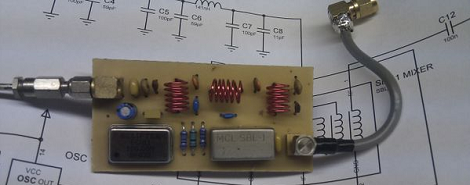
[regveg] was looking for a way to receive signals outside the normal 64-1700MHz range his TV tuner software defined radio dongle can get. After finding a few $100+ upconverters on the Internet, he stumbled across a DIY project that greatly expands the frequencies his RTLSDR can receive.

[George]’s upconverter uses heterodyning to increase the frequencies received by a SDR dongle. The basic idea is mixing a signal from an antenna with a 100MHz frequency oscillator. The resulting output will be λ + 100MHz and λ – 100MHz, allowing for a wider range of frequencies that can be received by the SDR TV tuner dongle.

Now [regveg] has a board and schematic that makes it possible to receive just about anything with his TV tuner dongle. Interestingly, this upconverter contains less than $10 in parts and is easily etched at home thanks to a single-sided construction and through-hole parts.

As a small aside, [Andrew] sent in a tip a few days ago telling us his RTL dongle didn’t have any ESD protection. This is a very bad thing, but the good news is the fix is very cheap: just solder in a 10 cent diode and you’re good to go.