Make A Game For A Retro Console, Win Prizes

For all you old-school console hackers out there, there’s a homebrew coding competition being held by NeoTeam for all the retro (and not so retro) consoles of yesteryear. If you’ve ever programmed for the NES, GBA, PC Engine, N64, or even the Dreamcast, now’s your chance to write a game or app and hopefully win a small prize and a great deal of street cred.

Last year, the Neo Coding Competition saw some very cool entries such as [smealum]’s amazing work in bringing Minecraft to the Nintendo DS ([smealum]’s non-forum DScraft page is here). DScraft won [smealum] a cool $500 USD, but the bragging rights for bringing Minecraft to the DS are far more valuable than any monetary reward.

There are two categories for the competition, an app division and a game division. All the retro platforms are open for development in this contest, so if you want to write something for your Master System, NES, 32X, or Saturn, you better get started: the contest ends August 20th.
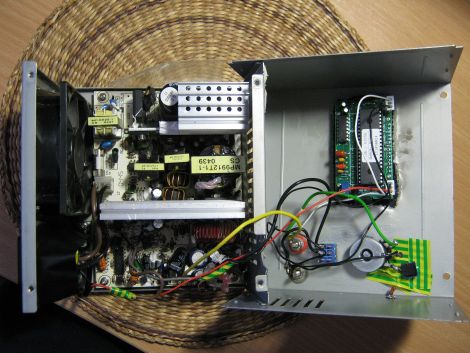
ATX Benchtop Conversion Retains Safety Features, Delivers Plenty Of Current.

atx-benchtop-psu

[Bogin] was looking to add a benchtop power supply to his array of tools, but he didn’t really find any of the online tutorials helpful. Most of what he discovered were simple re-wiring jobs utilizing LM317 regulators and shorted PS-ON pins used to keep the PSUs happily chugging along as if nothing had been changed. No, what [Bogin] wanted was a serious power supply with short circuit protection and loads of current.

He started the conversion by disassembling a 300 watt ATX power supply that uses a halfbridge design. After identifying the controller chip, a TL494 in this case, he proceeded to tweak the PWM feedback circuit which controls the supply’s output. A few snips here, a few passes with a soldering iron there, and [Bogin] was ready to test out his creation.

He says that it works very well, even under heavy load. His tutorial is specific to these sorts of PSUs, so we would be more than happy to feature similar work done with those that implement other design topologies. In the meantime, be sure to check out a video of the hacked power supply in action below.

Continue reading “ATX Benchtop Conversion Retains Safety Features, Delivers Plenty Of Current.”

Cracking Open An Ancient Avionics Gyroscope

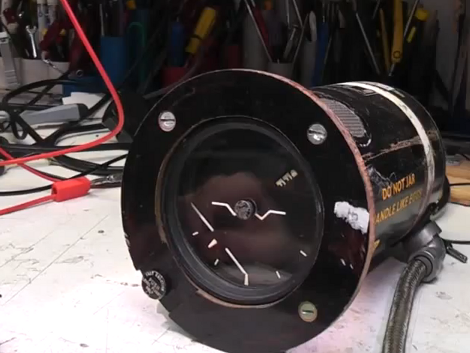
This artificial horizon might as well have come from an alien ship. [Mike] somehow manages to get his hands on most interesting equipment, this time its a very old piece of avionics equipment. The mechanical gyroscope functioned as the artificial horizon, and he’s going to take us inside for a look. He doesn’t spend quite as much time on it as he did that thermal imaging camera, but this electro-mechanical odyssey is just as interesting.

To get the accuracy needed to help keep a plane in the air (well to keep the pilot well-informed anyway) the device needed to be very well manufactured. [Mike] comments several times along the way on how the different rotating parts are so well-balanced and machined that they seem nearly frictionless. It appears that a lot of the positional feedback depends on wirewound resistor rings which connect to a rotating piece via a series of very fine spring wires. As the parts rotate the resistance changes and that’s what gives the feedback. There are also mercury switches to help along the way.

He does his best to explain, but to us the inner workings are still a big mystery. See if you can get a clearer picture from the video after the break.

Continue reading “Cracking Open An Ancient Avionics Gyroscope”

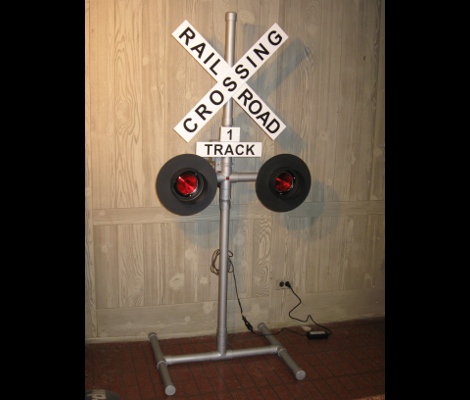
Scratch-built Railroad Crossing Signal

At first glance you would think this is the real thing, but [Kevin] built this railroad crossing signal from parts you can find at the home store. We keep seeing traffic lights used as web-connected signaling devices. This would be right at home for that type of setup, but [Kevin] built it with railroad enthusiasts in mind.

He used Google SketchUp to design the frame for the signal, then purchased all of the PVC parts to match those specifications. Some grey spray paint goes a long way to making it look like steel tubing. But this is much easier to work with and he should have no trouble internalizing the wiring later on. The lights themselves are tail lights for a trailer with a decorative trim piece added. He designed his own driver board to switch the lights and ring the doorbell which give the signal some sound. His first version used a 555 timer, this one upgrades to microcontroller. We like what he’s doing in the video after the break, but think the bell speed needs to be doubled for it to mimick the real thing just about perfectly.

Continue reading “Scratch-built Railroad Crossing Signal”

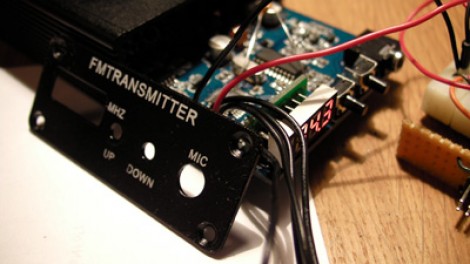
Re-engineering Some FM Transmitter Firmware

[Furrteck] had a little adventure with this FM transmitter he picked up on eBay. It worked alright, but he wanted to be able to scan through the frequencies, and to have the device return to the same settings after power cycling. He cracked it open and got to work to achieve all of his goals.

The device is driven by an ATmega48, and there’s a 6-pin ISP header on the board. An initial read of the chip wouldn’t work, and he soon discovered the unstable power supply was to blame. After connecting his own regulated source he could read the chip id without a hitch, but the code is locked so no dumping was possible. Fortunately he managed to trace out the board, and includes a full schematic in his write up. With this in hand he erased the chip and started programming his own firmware from the ground up.

The video after the break shows off the completed project. He can now scan through frequencies with audio feedback to let he know when he’s found a station to hijack. The new code will also write a tuned station to EEPROM for use the next time the rig is powered up.

Continue reading “Re-engineering Some FM Transmitter Firmware”

Summer Travel Is A Breeze With This Scooter Trunk

Travel backpacks are so passé. All the cool kids, like [Niklas Roy] are using scooter trunks for easy travel. Think of it, not only does it remove the need to carry your heavy baggage, but you get to coast along for the ride as well. We wonder what the officials at air, train, and bus travel hubs are going to think?

The idea came from seeing a similar build with a flight case (plywood box with metal edges and hardware). In that project the flight case folded out to be something of an impromptu street kiosk. But [Niklas] knew the aluminum camera trunk he uses for travel was going to work great in the project. He designed a bracket to replace the steering column on his kick scooter. It holds the case securely in place, but still allows the scooter to fold down to be stowed in the train overhead bin.

At first we thought this would have been better if integrated into the trunk itself. Keeping the two parts separate means you can leave the case wherever you’re staying and take just the scooter for day trips.

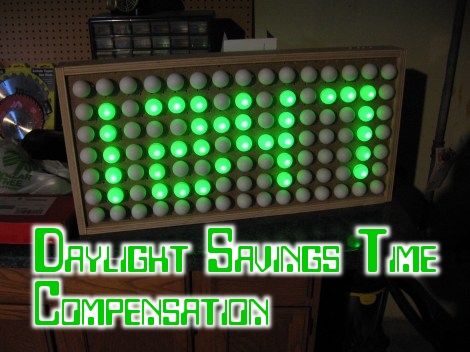
Automatic Daylight Saving Time Compensation For Your Clock Projects

Pretty early in development of my Ping Pong Clock I came up with the idea of automatic Daylight Saving Time compensation. It’s an interesting feature, but it’s a luxury and so I figured I could add it as a future improvement. Now’s the time and I’m reporting back on what I’ve learned and how you can add this to your own projects.

There’s two things to think about before adding this feature. Is it worth the effort and does it make the clock more confusing rather than easier to use?

As to the latter, if you are responsible for setting the time initially but you are not responsible for resetting the clock when we fall back or spring forward will it cause confusion? Perhaps initially, but the battery-backed RTC that I used in my project should mean that you set it once and never have to reset it again. The one exception is DST and that’s what I’m compensating for.

Whether it is worth it or not is difficult to answer until after the fact. You should take into consideration that the DST rules are not set in stone, they change from time to time. Add to that the fact that not all parts of the world observe the practice. This means that not only do you need to implement the compensation, but you should add a method of switching it on and off as well as changing the rules for when it is observed.

Join me after the break to learn the method and code I use to make time adjustments automatically twice a year.

Continue reading “Automatic Daylight Saving Time Compensation For Your Clock Projects”