Simple Proximity Sensor

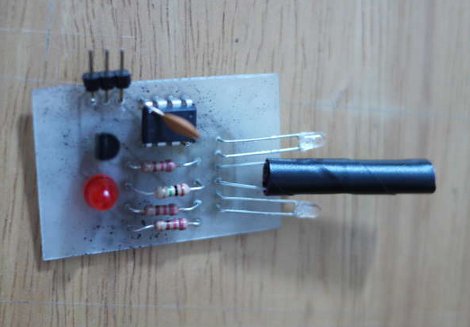
[Dustin Andrews] built this add-on board which works as a proximity sensor. He wanted a standalone sensor for his Arduino projects which would use a single pin as a trigger. This lets him alert the Arduino when an object approaches the sensor without the need for polling or extra code on the Arduino side of things.

As you can see, a single chip on the board takes care of all the work. That’s an ATtiny13, they’re inexpensive and sometimes you can even salvage them from consumer electronics like this color changing light bulb. The microcontroller monitors the phototransistor which is wrapped in electrical tape to isolate it from the IR LED emitters on either side. This setup creates a reflective sensor. When an object nears the board, the infrared light from the emitters reflects off of it and onto the phototransistor. And since the Arduino works as an AVR programmer you don’t need special hardware to program the device.
Computer Control For Your Xbox Controller

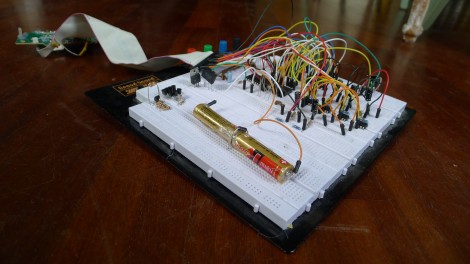
This wiring nightmare lets [H. Smeitink] map all the buttons from an Xbox 360 controller to his PC. It gives him the ability to push control input from his PC to the console. But it goes a step further than that because it actually acts as a pass-through device. He connected a wired controller to the computer and uses a program he wrote to translate those inputs and send them to the hacked controller.

The software is written in C#. It’s got a recording function that lets him save the keypress data from the wired controller while it’s sent to the Xbox in real time. When he finds a combination that he uses frequently he plucks out those commands, sets them up as a macro, and assigns one of the buttons to execute it. The controller hack uses one transistor for each button, and a PIC 18F4550 which controls them and provides USB connectivity with the PC.

This isn’t one nice package like some integrated rapid-fire and macro solutions we’ve seen. But it certainly opens up a lot more possibilities. See for yourself in the clip after the break.

Continue reading “Computer Control For Your Xbox Controller”

Building A Computer With Discrete Transistors

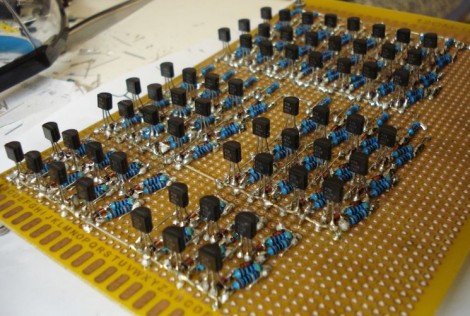
You’re going to want to do some stretching before undertaking a soldering project like this one. We’re betting that the physical toll of assembling this 4-bit discrete processor project is starting to drive [SV3ORA] just a bit crazy. This small piece of electronic real estate is playing host to 62 transistors so far, and he’s not done yet.

It’s one thing to build some logic gates in Minecraft (and then turn then into a huge 16-bit ALU). But it’s another thing to actually commit to a physical build. [SV3ORA] does a great job of showing the scope of the project by posting a tight shot of one inverter, then three in a row, then the entire 8-bit address and display system. These gates are built on the copper side of the board, with the power feed, LEDs for displays, and jumpers for control on the opposite side. We’re excited to see where he goes with this project!

But hey, if you don’t want to do that much soldering there’s a lot you can do on a few breadboards.

Building An Arduino Chiptunes Project Inside An FPGA

From time to time we find ourselves in the mood for some Chiptunes. You know, the music that accompanied all of the best 8-bit console games? These days there are a lot of projects that use the audio chips of yore to recreate the sounds, but you’re always faced with the issue of sourcing those parts. [Jack Gassett] took some inspiration from one of those projects, but solved the rare hardware dilemma by building his own Chiptunes MIDI device in an FPGA.

He saw one of our features on an Arduino controlled YM2149 programmable sound generator. He realized that you can already find FPGA libraries out there that mimic this sound generation hardware, and he’s already done extensive work with an Arduino soft processor. Why not combine the two?

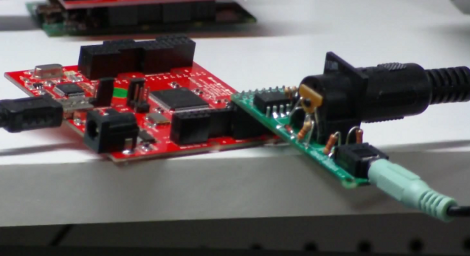
He’s using a Papilio FPGA with a wing that includes a MIDI connector and audio-out jack. As you can hear in the clip after the break this sounds just like the real thing. And he’s got plans to roll as many different types of sound generating chips into the mix as possible. You know, one FPGA synth to rule them all.

Continue reading “Building An Arduino Chiptunes Project Inside An FPGA”

A Flight Simulator Made Out Of A Real 737 Cockpit

[Trent] sent in an awesome story about a single man who bought the nose of a 737, put it in his garage, and built a flight simulator inside the cockpit. His name is [James Price], and right now the only thing we’re wondering is when we can have a visit.

The cockpit came from an aircraft boneyard in Oklahoma. After [James] plunked down $1500 for the shell of a cockpit, he moved his new toy to a Livermore, California aircraft hangar and eventually into his garage. While the plane is meant to be a simulator, [James] is a tinkerer at heart: he says the best part of building his 737 is building the systems, programming the computers, and making everything work together. We’ve got to admire that.

Of course this isn’t the first cockpit-in-a-garage build we’ve seen. Years ago we featured an Avro Lancaster, and just a few months ago we saw a strikingly similar replica 737 flight deck (it’s made out of wood, and not a real 737). [James]’ build is one of the very few home-built simulators made out of a real airplane. Someone get this guy an F15 cockpit stat.

Hackaday Links: April 20, 2012

Introducing Hackaday: how it’s made edition

Ever wonder how the make the forms for marine propellers? Now you have. It turns out they use a bunch of plywood, Bondo, and sandpaper. Awesome viewing for a coffee break.

Finally a new way to hurt yourself!

[Darrell]’s solder flux pen was filled and capped at sea level. When this pen made it to his work bench high in the mountains of Colorado there was a significant amount of pressure in that pen. The flux squirted out right into [Darrell]’s eye. Better get some Visine on that, man.

The most accurate television portrayal of hacking ever

[Russell] was watching TV last night and saw an interesting commercial. It’s a bunch of electronic components, then a nook color showing the front page of Make: Projects, an Arduino schematic, and finally a happy robot. Two observations: firstly, someone in media and advertising doesn’t think ‘hacking’ is WarGames stealing bank accounts. Secondly, an ad exec looked into current users.

Here’s the official YouTube video of the commercial.

In a world… where components aren’t soldered… one man… uses a soldering station.

Adafruit linked to the most outrageous promo video ever. This Weller soldering station provides 240 watts, battles alongside Agamemnon at Troy,  has rework tweezers, and travels to Italy to wage war against the Latins.

An IDE for the 21st century

[Chris] is currently developing a new paradigm for programming. He calls it Light Table, and it’s designed to be an improvement over a simple text editor and project manager. All the documentation is at your fingertips, you can make changes on the fly. It reminds us of the zzstructure emulator we saw last year. It’s something to keep an eye on at least.

One Hackaday Reader’s Experience Going On The Ben Heck Show

In the Hackaday Froums, [Colecago] shares his experience collaborating with [Ben Heck]. They were building some “Robot Luggage”, and you can see the episode after the break below. The idea was that they would build a piece of luggage that would follow you through an airport instead of having to be dragged.

[Colecago] shares a little about the “behind the scenes process”. There’s a surprising amount of work that goes into a very little amount of video. From what we can gather, this video took over a month to make. [Jesse/Colecago] was quite embarrassed to have run into a mistake that he called “UART Dislexia”, where he repeatedly wired the circuit incorrectly. We say, don’t stress, it happens to everyone.

Another point he brings up is how much of a pain in the butt the Arduino was in this process. While people in the comments often argue about the use of the arduino, [Jesse] explains how this specific case would have been much easier without.

Continue reading “One Hackaday Reader’s Experience Going On The Ben Heck Show”