Developing An App For Reduced-Gravity Flying

You’ve likely heard of the “vomit comet” — an rather graphic nickname for the aircraft used to provide short bursts of near-weightlessness by flying along a parabolic trajectory. They’re used to train astronauts, perform zero-g experiments, and famously let director Ron Howard create the realistic spaceflight scenes for Apollo 13. But you might be surprised to find that, outside of the padding that lines their interior for when the occupants inevitably bump into the walls or ceiling, they aren’t quite as specialized as you might think.

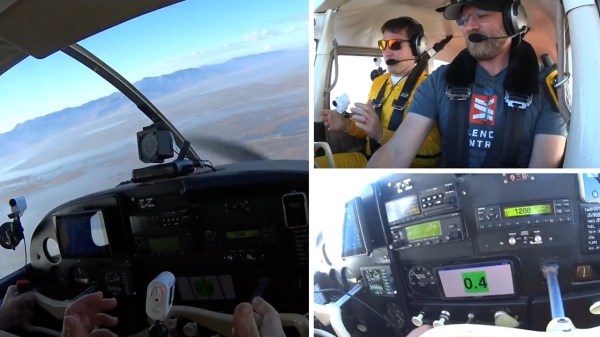
In fact, you can achieve a similar result in a small private aircraft — assuming you’ve got the proper touch on the controls. Which is why [Chaz] has been working on an Android app that assists pilots in finding that sweet spot.
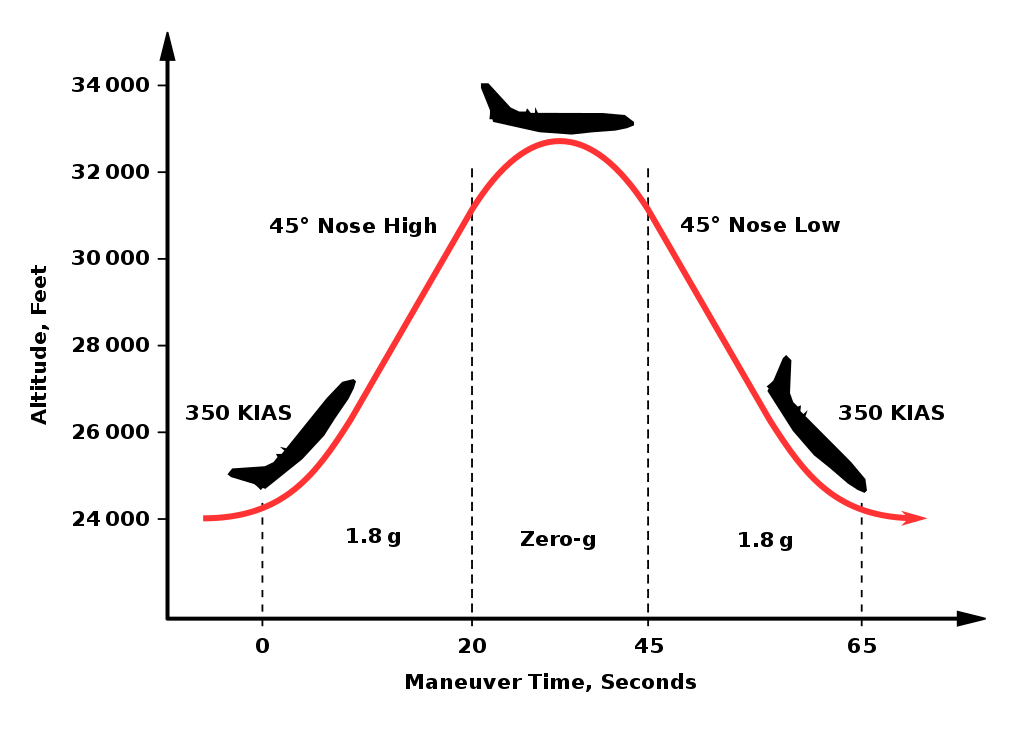
Target trajectory, credit: MikeRun

With his software running, the pilot first puts the plane into a climb, and then noses over and attempts to keep the indicator on the phone’s display green for as long as possible. It’s not easy, but in the video after the break you can see they’re able to pull it off for long enough to get things floating around the cockpit.

Continue reading “Developing An App For Reduced-Gravity Flying”
Building A Simple Compressed Air Cannon Is Easy

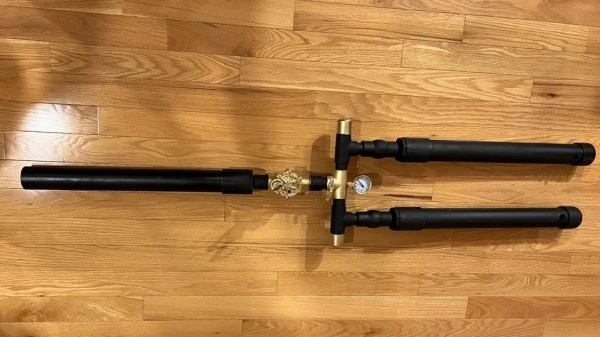
The world of warfare was revolutionized by the development of black powder, fireworks, cannons, and the like. You don’t need any of that chemical nonsense to just have fun, though, as this compressed air cannon from [OtisLiu153] demonstrates.

The build uses PVC pipes for both the barrel and the air tank. In the case of the latter, avoiding over-pressurization is key to avoiding injury, though some will say you should simply never build a PVC pipe pressure vessel at all. In this case, [OtisLiu153] strictly recommends 150 psi as a limit, which is nicely within the 280 PSI rating of the 2″ Schedule 40 PVC being used. Though, as they note, the connections in the design aren’t necessarily up to the same rating.

Off-the-shelf couplings are used to piece everything together, with the twin-reservoir design also acting as a useful shoulder mount. Charging the cannon is done via a Schrader valve, as you might find on a bike’s inner tube, and firing is achieved via a ball valve.

Of course, if you build such an air cannon yourself, just be careful with your aim. Video after the break.

Continue reading “Building A Simple Compressed Air Cannon Is Easy”

A Deep Dive Into Quadcopter Controls

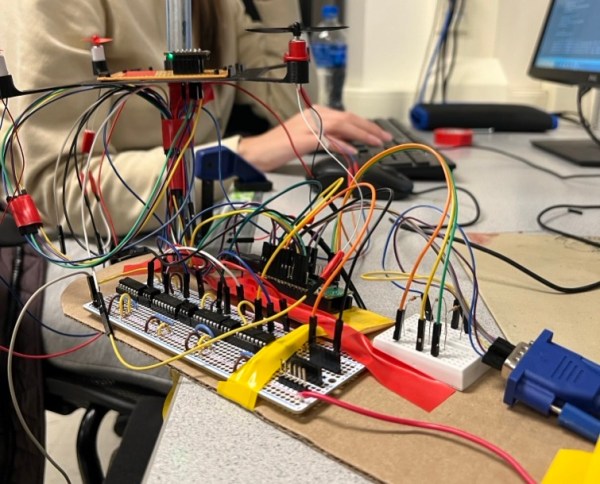
In the old days, building a quadcopter or drone required a lot of hacking together of various components from the motors to the batteries and even the control software. Not so much anymore, with quadcopters of all sizes ready to go literally out-of-the-box. While this has resulted in a number of knock-on effects such as FAA regulations for drone pilots, it’s also let us disconnect a little bit from the more interesting control systems these unique aircraft have. A group at Cornell wanted to take a closer look into the control systems for drones and built this one-dimensional quadcopter to experiment with.

The drone is only capable of flying in one dimension to allow the project to more easily fit into the four-week schedule of the class, so it’s restricted to travel along a vertical rod (which also improves the safety of the lab).  The drone knows its current position using an on-board IMU and can be commanded to move to a different position, but it first has to calculate the movements it needs to make as well as making use of a PID control system to make its movements as smooth as possible. The movements are translated into commands to the individual propellers which get their power from a circuit designed from scratch for this build.

All of the components of the project were built specifically for this drone, including the drone platform itself which was 3D printed to hold the microcontroller, motors, and accommodate the rod that allows it to travel up and down. There were some challenges such as having to move the microcontroller off of the platform and boosting the current-handling capacity of the power supply to the motors. Controlling quadcopters, even in just one dimension, is a complex topic when building everything from the ground up, but this guide goes some more of the details of PID controllers and how they help quadcopters maintain their position.

Continue reading “A Deep Dive Into Quadcopter Controls”

Wii-Inspired Controller Built Using Raspberry Pi Pico

We all thought Nintendo was going to change the world of gaming when it released the Wii all those years ago. In the end, it was interesting but not really fundamentally life-changing for most of us. In any case, [Sebastian] and [Gabriel] decided to build a Wii-like controller for their microcontroller class at Cornell.

The build uses a pair of Raspberry Pi Pico microcontrollers, communicating over HC-05 Bluetooth modules. One Pico acts as a controller akin to a Wiimote, while the other runs a basic game and displays it on a screen via VGA output. The controller senses motion thanks to a MPU6050 inertial measurement unit, combining both gyros and accelerometers in all three axes.

The duo demonstrate the hardware by using it as a pointer to play a simple Tic-Tac-Toe game. It’s in no way going to light up the Steam charts, but the project page does go into plenty of useful detail on how everything was implemented. If you want to create your own motion gaming controller, you could do worse than reading up on their work.

We’ve seen some other great examples of motion controls put to good use, like this VR bowling game. Video after the break.

Continue reading “Wii-Inspired Controller Built Using Raspberry Pi Pico”