Luthier Crafts Guitar From Cardboard

The people at Signal Snowboards are well known not only for producing quality snowboards, but doing one-off builds out of unusual and perhaps questionable materials just to see what’s possible. From pennies to glass, if it can go on their press (and sometimes even if it can’t) they’ll build a snowboard out of it. At some point, they were challenged to build different types of boards from paper products which resulted in a few interesting final products, but this pushed them to see what else they could build from paper and are now here with an acoustic guitar fashioned almost entirely from cardboard.

For this build, the luthiers are modeling the cardboard guitar on a 50s-era archtop jazz guitar called a Benedetto. The parts can’t all just be CNC machined out of stacks of glued-up cardboard, though. Not only because of the forces involved in their construction, but because the parts are crucial to a guitar’s sound. The top and back are pressed using custom molds to get exactly the right shape needed for a working soundboard, and the sides have another set of molds. The neck, which has the added duty of supporting the tension of the strings, gets special attention here as well. Each piece is filled with resin before being pressed in a manner surprisingly similar to producing snowboards. From there, the parts go to the luthier in Detroit.

At this point all of the parts are treated similarly to how a wood guitar might be built. The parts are trimmed down on a table saw, glued together, and then finished with a router before getting some other finishing treatments. From there the bridge, tuning pegs, pickups, and strings are added before finally getting finished up. The result is impressive, and without looking closely or being told it’s made from cardboard, it’s not obvious that it was the featured material here.

Some of the snowboards that Signal produced during their Every Third Thursday series had similar results as well, and we actually featured a few of their more tech-oriented builds around a decade ago like their LED snowboard and another one which changes music based on how the snowboard is being ridden.

Continue reading “Luthier Crafts Guitar From Cardboard”

This Week In Security: Second Verse, Worse Than The First

Isn’t there some claim events come in threes? After the extremely rare leak of the iOS Coruna exploit chain recently, now we have details from Google on a second significant exploit in the wild, dubbed Darksword.

Like Coruna, Darksword appears to have followed the path of government security contractors, to different government actors, to crypto stealer. It appears to focus on exploits already fixed in modern iOS releases, with most affecting iOS 18 and all patched by iOS 26.3.

Going from almost no public examples of modern iOS exploits to two in as many weeks is wild, so if mobile device security is of interest, be sure to check out the Google write-up.

Another FBI Router Warning

The second too early to be retro – but too important to ignore – repeat security item is a second alert by the FBI cautioning about end-of-life consumer network hardware under active exploitation, with the FBI tracking almost 400,000 device infections so far.

Like the warning two weeks ago, the FBI calls out a handful of consumer routers – but this time they’re devices that may actually still be service in some of our homes (or our less cutting edge friends and family), calling out devices from Netgear, TP-Link, D-Link, and Zyxel:

  • Netgear DGN2200v4 and AC1900 R700
  • TP-Link Archer C20, TL-WR840N, TL-WR849N, and WR841N
  • D-Link DIR-818LW, 850L, and 860L
  • Zyxel EMG6726-B10A, VMG1312-B10D, VMG1312-T20B, VMG3925-B10A, VMG3925-B10C, VMG4825-B10A, VMG4927-B50A, VMG8825-T50K

While many of these devices are over ten years old, they still support modern networking – some of them even supporting 802.11ac (also called Wi-Fi 5).  Unfortunately, since support has been ended by the manufacturers, publicly disclosed vulnerabilities have not been patched (and now never will be, officially) Continue reading “This Week In Security: Second Verse, Worse Than The First”

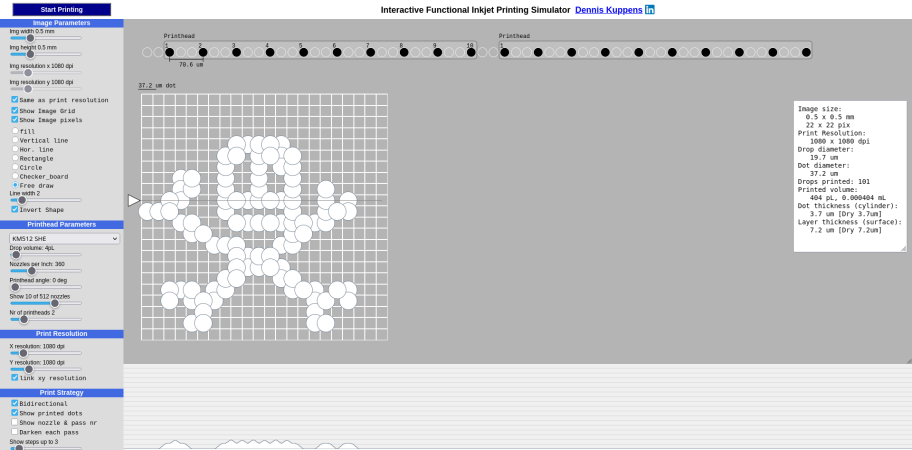
A screenshot of the inkjet simulator project

Understand Your Printer Better With The Interactive Inkjet Simulator

Love them or hate them, inkjets are still a very popular technology for putting text and images on paper, and with good reason. They work and are inexpensive, or would be, if not for the cartridge racket. There’s a bit of mystery about exactly what’s going on inside the humble inkjet that can be difficult to describe in words, though, which is why [Dennis Kuppens] recently released his Interactive Printing Simulator.

[Dennis] would likely object to that introduction, however, as the simulator targets functional inkjet printing, not graphical. Think traces of conductive ink, or light masks where even a single droplet out-of-place can lead to a non-functional result. If you’re just playing with this simulator to get an idea of what the different parameters are, and the effects of changing them, you might not care. There are some things you can get away with in graphics printing you really cannot with functional printing, however, so this simulator may seem a bit limited in its options to those coming from the artistic side of things.

You can edit parameters of the nozzle head manually, or select a number of industrial printers that come pre-configured. Likewise there are pre-prepared patterns, or you can try and draw the Jolly Wrencher as the author clearly failed to do. Then hit ‘start printing’ and watch the dots get laid down.

[Dennis] has released it under an AGPL-3.0 license, but notes that he doesn’t plan on developing the project further. If anyone else wants to run with this, they are apparently more than welcome to, and the license enables that.

Did you know that there’s an inkjet in space? Hopefully NASA got a deal on cartridges. If not, maybe they could try hacking the printer for continuous ink flow. Of course that’s all graphics stuff; functional printing is more like this inkjet 3D printer.

This Flow Battery Operates With No Pump Required

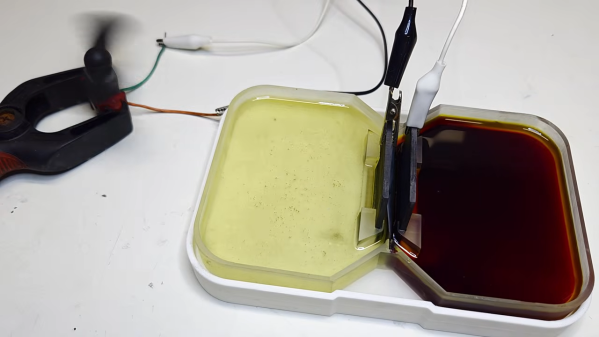
Flow batteries are rather unique. They generate electricity by the combination of two fluids flowing on either side of a membrane. Typically, this involves the use of some kind of pump to get everything moving. However, [Dusan Caf] has demonstrated another way to make a flow battery operate.

[Dusan]’s build is a zinc-iodide flow battery. It uses two 3D printed reservoirs, each holding a ZnI2 solution and a graphite electrode. Unlike traditional flow batteries, there is no mechanism included to mechanically push the fluid around. Instead, fluid motion is generated by the magnetohydrodynamic effect, which you may know from that Japanese boat that didn’t work very well.

When charging the liquid-based cell, current flows through the conductive electrolyte that sits between both electrodes. This sees zinc electroplated onto the graphite anode, while iodide ions are oxidized at the cathode. There’s also a permanent magnet installed beneath the electrodes, which provides a stable magnetic field. This field, combined with the current flowing through the electrolyte, sees the Lorentz force pushing the electrolyte along, allowing the flow battery to operate. When the cell is being discharged, the reactions happen in reverse, with the flow through the electrodes changing direction in turn. Neatly, as current draw or supply increases, the flow rate increases in turn, naturally regulating the system.

[Dusan] notes this isn’t feasible for large batteries, due to the limited flow rate, but it’s fine for small-scale demos regarding the operation of a flow battery. We’ve featured some more typical flow battery designs in the past, too.

Continue reading “This Flow Battery Operates With No Pump Required”