Hackaday Europe 2026: Open Source Hardware Goes Underground, Literally

These days open source is everywhere, and frankly, we couldn’t be happier about it. But even with as prevalent as open software and hardware has become, we still occasionally hear about a project that takes the concept somewhere unexpected. Which is precisely why we were so eager to hear more about the fascinating work [Phil Underwood] has been doing.

In his talk Open Source Caving: 20 Years of Making Cave Mapping Tools at Hackaday Europe 2026, [Phil] takes us through a series of progressively more advanced open hardware devices that he’s designed to increase the speed and accuracy of underground mapping efforts. Along the way, he’s learned a number of valuable lessons about designing hardware that’s robust enough to handle the uniquely challenging environment underground while still being accessible enough for a hobbyist to build and use.

Continue reading “Hackaday Europe 2026: Open Source Hardware Goes Underground, Literally”

Printing FDM Filaments That Are Just Plain Weird

The fun thing about thermopolymers like PLA is that you can blend in additives, some of which are necessary to make it at all usable, while so many other additives are either just cosmetic or arguably just plain weird. In a recent video, [Zack Freedman] goes over some of the weirdest ones that he’s come across so far.

These range from the pretty-normal-but-unusual, like CMYK sets of filament for full-color printing, to the rather unusual, like very silky PETG and foamy TPU and TPE, all the way to the WTAF ones, such as Timeplast filaments that can be used as soap as well as fish food.

He also tried a range of filaments that vie for being the blackest filament possible, while others pretend to be paper or are made out of literal landfill trash. Some hit your olfactory senses with a hammer by smelling like all the lemons just got squirted right up into your nose, purportedly to keep flies at bay. There is also pumpkin spice-flavored PLA, for when you really need to make the holidays extra fragrant.

Overall, the range of filaments here is quite dizzying, with some being actually practical, while others are mostly about their green credentials, or about being pretty or having a specific olfactory experience. Whether any of them are for you depends. Do you have a longing for 3D prints that smell like pumpkin spice or are fish food?  We’ve noticed before that [Zack] likes strange filament.

Continue reading “Printing FDM Filaments That Are Just Plain Weird”

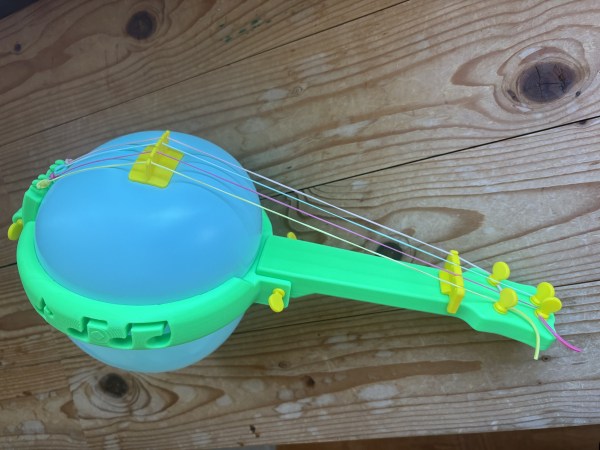
A small, 3D-printed banjo frame that uses a party balloon for the resonating chamber.

May This Balloon Banjo Resonate With You

Most instruments, with maybe the exception of pianos, have consumable parts. Guitars need string changes, bows need rosin, saxophones need reeds. [Co:Creation Lab]’s balloon banjo requires both fishing line and a party balloon, lest it be semi-silent.

If you want to change the resonance, just increase or decrease the amount of air inside the balloon. Neither the balloon nor the strings need tools to adjust, but we might argue that tuning pegs are tools.

The balloon banjo was the result of a design constraint: a parent should be able to build it with their child. To that end, there are no metal screws, no recurring snap-fits in the assembly, and a single, internal, one-time-use snap fit for the adult’s tactile satisfaction. Instead, the balloon banjo uses 3D-printed screws. A six-year-old can turn them with their fingers, and it’s difficult to over-tighten them and strip the plastic threads.

Be sure to check it out in action after the break. If you would rather use extant plastic to make music, the Bottlephone 2.0 is calling.

Continue reading “May This Balloon Banjo Resonate With You”