

Rosy Retrocomputing

Most of us are guilty of romanticizing the past. Do you long to be the captain of a tall ship? Just as long as you don’t mind weevils in your food, vitamin deficiencies, and death from an infection when there were no antibiotics. Want to be a medieval knight? Even worse. But surely, retrocomputing is as fun as we remember, right? Turn your computer on, and it comes up with BASIC! Ready for you to write your own programs. None of this GUI foolishness. Of course, this is just another example of rosy retrospection.

Even if you like BASIC or a similar language today, things have changed. You have a nice text editor, a fast computer, debugging tools, along with things like named functions, no line numbers, and modern control structures. None of those things were very common in the 1980s. At least, not on a hobby-grade computer.

Why am I thinking about this? Well, the Hackaday Retrocomputing Challenge is on, and it occurred to me that I wanted to work with some young students in glorious MBASIC on a CP/M machine I built and modified from a Hackaday project. Perfect, right? Many of us started that way, so why shouldn’t they?

But it quickly got old. Even a simple program gets bogged down with GOTOs and GOSUBs to mysterious line numbers. It made me remember the time back in the early 1980s, or maybe even the late 1970s, that I wrote a BASIC preprocessor to scan BASIC with no line numbers and produce proper source, converting labels to line numbers in two passes.
Continue reading “Rosy Retrocomputing” →

It’s The Speech Synthesiser You Wanted, For The Computer You Had

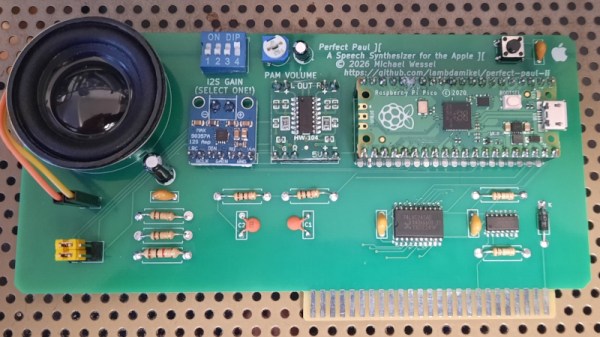
If you had an 8-bit computer in the 1980s and bought a speech synthesiser for it, what you got was invariably an alophone-based synthesiser using the SP0256 or similar. You definitely couldn’t afford DEC’s DECtalk, a high-end standalone speech synthesiser made famous to the masses as the unit used by Stephen Hawking. But now those two worlds can come together, thanks to [Michael Wessel], whose Perfect Paul ][ is a drop-in DECtalk emulator card for the Apple ][.

The PCB includes an RP2040-based Raspberry Pi Pico Zero, plus an I2S DAC and amplifier, speaker, and bus-interface logic. It appears at a set of memory addresses, and interfacing to it is as simple as POKEing DECtalk commands to those addresses. Looking at it, we are guessing this would be easy to bring to other 8-bit era machines.

You can see and hear it sing in the video below the break, and it certainly has the feel of the real thing. We can say with certainty that this would have been a sensation had it appeared back in the early 1980s. This one may be a modern reproduction, but it’s not the first time DECtalk has appeared here; we’ve even brought you a real one.

Continue reading “It’s The Speech Synthesiser You Wanted, For The Computer You Had” →

CircuitPython Goes Turbo With Precompiled Functions

It would not be at all original to declare that Python is the new BASIC. Like BASIC, it has been the first programming language for a whole generation of coders, and its main advantage is that it’s quick and easy to write in. Like BASIC it is an interpreted language, and thus rather slow to execute.

Thus while CircuitPython can be very useful for beginners and quick projects, it hits the limitations of the hardware far sooner than it needs to — unless you can pre-compile critical parts of the code, which you now can, thanks to CircuitPython Turbo by [Mikey Sklar] with some help from Anthropic’s Claude LLM.

Now if that sounds a lot like MicroPython’s ‘Viper’ and machine-code compiler, that’s because it is. CircuitPython is a fork of MicroPython with some handy extras on Adafruit boards, but Viper wasn’t one of them until now. Before the Turbo version, CircuitPython only ran in interpreted mode.

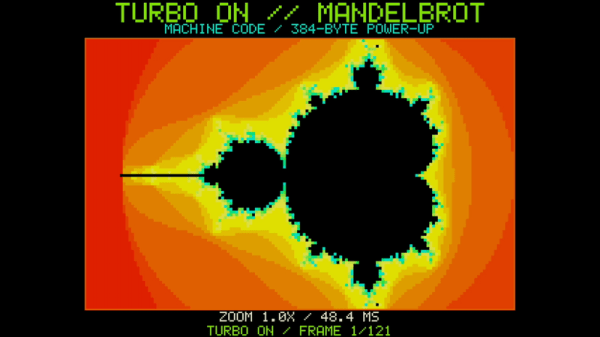
Like MicroPython, using CircuitPython Turbo you can flag sections to run as ‘native’, where instructions are compiled but values stay as python objects, which gets you about a 3X speedup. A little more rewriting to declare your variables and pointers and you can use ‘viper’ mode, which can — depending on what you’re up to — result in a 20x to 70x speedup. In Adafruit’s documentation, they demonstrate a Metro RP2040 calculating the Mandelbrot set 3x faster in Native and 19.7 times faster with Viper than normal Python bytecode.

The one thing that we miss from BASIC that CircuitPython Turbo doesn’t give is inline assembly– though interestingly enough, that is in the upstream MicroPython implementation, so perhaps its day will come here too. Not every job is suited to the use of Python on microcontrollers, but we’ve seen it used for everything from e-bikes to a Winamp-inspired music player.








