DIY Router On X86 E-Waste: OpenWrt And OPNsense

In previous installments of this series we looked at how creating a DIY router using an e-waste-level PC has changed over the years, before attempting to boot OpenWrt for x86 on it. After an initial SD card booting failure on one system, another system with a newer mainboard – an Intel Board D2500CC – was used which happily booted OpenWrt from an SD card inserted into a USB card reader.

Unfortunately, OpenWrt didn’t see any usable Ethernet interfaces despite having no less than four Intel Ethernet controllers and two hooked up to active networks. After recently getting back to the project, I found out why both onboard Intel 82574L Ethernet controllers didn’t show up in OpenWrt: the drivers for the Intel 82574L controllers are in the e1000e driver package, while only the e1000 package is present in the provided x86 image. This issue persists in the ‘generic’ image profile to this day.

Yet rather than diving head-first into building my own image that includes the kmod-e1000e package, I decided to give OPNsense a shake first.

Continue reading “DIY Router On X86 E-Waste: OpenWrt And OPNsense” →

Searching For Dark Matter With A Levitating Magnet

Much of science is performed through inference, with the readings on instruments, a flash of light in heavy water, or the results of parsing through terabytes of sensor data after a particle accelerator collision either backing up a proposed scenario or weakening its foundations.

In the case of so-called dark matter, this is even more relevant, as we are talking about a proposed form of matter whose most pertinent feature is that it doesn’t interact with anything else except through gravity. This is where the wiggling of a levitating magnet may be the key to detecting it.

In this experimental setup by Rice University and Dutch researchers at the Leiden Institute, a tiny permanent magnet the size of a grain of sand is levitated above a superconductor, surrounded by highly sensitive detectors that should be able to spot even minuscule movements. So far, they have collected a month’s worth of data, with no conclusive results yet.

Even if they don’t detect any ‘knocks’ on this tiny levitating magnet, it will still help refine existing models of what dark matter’s properties might be. For the next phase of this research, they’ll add more of these sensors, which will also make it easier to distinguish background noise from any unusual readings.

We’ve previously talked about [Vera Ruben]’s contributions to the hunt for dark matter and the mysteries that prompted the idea that it might exist.

The Sinclair Spectrum Gets A Desktop GUI

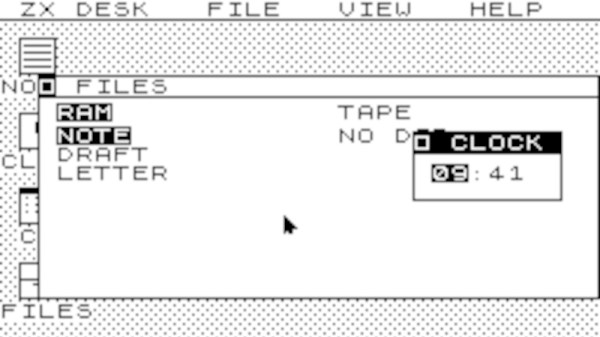
Of the popular 1980s 8-bit computers, it’s fair to say that Sinclair’s ZX Spectrum punched above its weight. Sir Clive’s love of squeezing more functionality out of less hardware meant the compromises he made left it less powerful than competitors from Apple, Commodore, or Acorn. Still, the brightest programmers of the age took the little machine to heart and made it do some very impressive things. A desktop GUI, though, surely that would be pushing things too far. Never say never because now [mindbox77] has done it.

ZXdesk is an assembly language program for the 48k Spectrum that gives you something that looks a lot like GEM. It’s got all the things you’d expect from a desktop GUI, with menus, windows, and applications, and we find ourselves suitably impressed.

Continue reading “The Sinclair Spectrum Gets A Desktop GUI” →