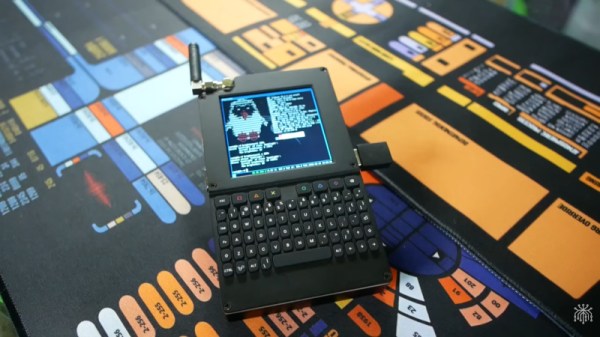
We’re used to handheld Linux devices of varying usefulness appearing on a regular basis, but there’s something about the one in a video from [Rootkit Labs] which sets it aside from the herd. It’s a fork of a conference badge.
The WHY2025 badge had pretty capable hardware, with an ESP32-P4, a really nice screen, and the lovely SolderParty keyboard. Here it’s been forked, to become a carrier board for their previous project, the Flipper Blackhat. This is a Linux add-on for the Flipepr Zero, and it seems that plenty of people wanted it in a more useful context. The result is something that looks a lot like a WHY badge, but running Linux.
It’s a great shame when badges end up lying unused after the event, and ones like the WHY 2025 badge are a serious effort to make something that endures. Here, the badge endures in spirit by being forked and re-engineered, and we like it a lot. The full video is below the break.
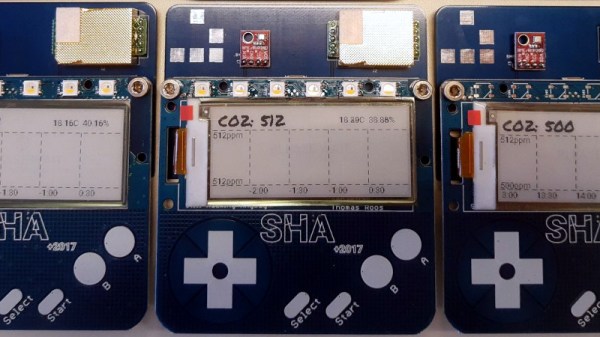
By now we’re all used to the requirements imposed by the pandemic, of social distancing and wearing masks indoors. But as [polyfloyd] and the rest of the board at Bitlair hackerspace in Amersfoort in the Netherlands were concerned, there are still risk factors to consider when inside a building. Without fresh air the concentration of virus-bearing droplets can increase, and the best way they could think of to monitor this was to install a set of CO2 sensors. To run them they didn’t need to buy any new hardware, instead they turned to a set of event badges, from 2017s SHA hacker camp.
This badge sported an ESP32 module with an e-ink screen, and of most interest for this project it still has a supported software platform and comes with a handy expansion connector on the rear. The commonly-available MH-Z19 infra-red CO2 sensor and BME280 humidity sensor fit on a PCB that follows the shape of the badge with a protrusion at the top on which they appear as an integrated unit. Processing those readings is a MicroPython badge app that issues warnings via MQTT and plots a CO2 graph on the screen. Everything is available, both the hardware in a GitHub repository and the software as a badge.team app.
We applaud anyone who makes use of an event badge for a project, and especially so for using one years after the event. The SHA badge and its descendants are uniquely suited to this through their well-supported platform, so if you have one in a drawer we’d urge you to pull it out and give it a try.
There are still a few days before the doors open on this year’s Hackaday Supercon in Pasadena, but for the most dedicated attendees, the badge hacking has already begun…even if they don’t have a badge yet.
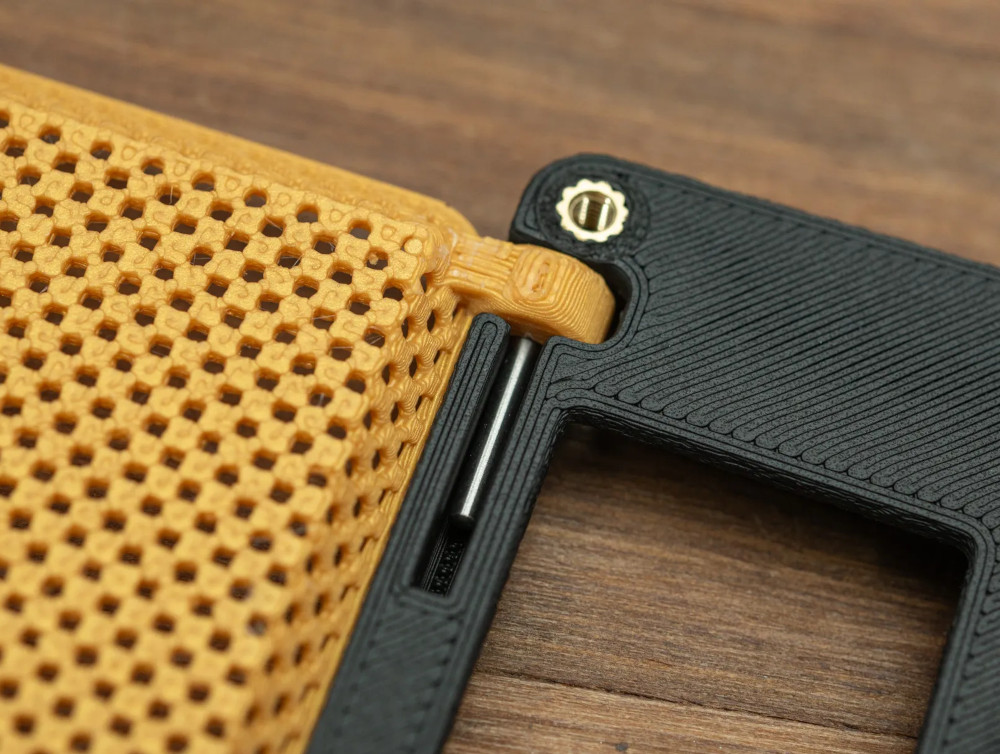
Metal hinge pin? Brass inserts? Scotty would be proud.
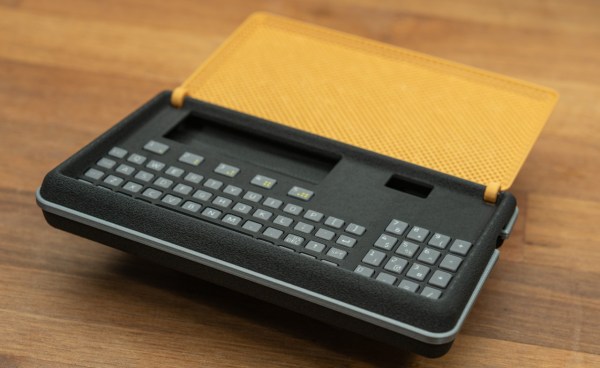
Although the layout of this year’s badge is about as far from the slim outline of the iconic flip-up Trek communicator as you can get, [Thomas] managed to perfectly capture its overall style. By using the “Fuzzy Skin” setting in the slicer, he was even able to replicate the leather-like texture seen on the original prop.
Between that and the “chrome” trim, the finished product really nails everything Jadzia Dax loved about classic 23rd century designs. It’s not hard to imagine this could be some companion device to the original communicator that we just never got to see on screen.
While there’s no denying that the print quality on the antenna lid is exceptional, we’d really like to see that part replaced with an actual piece of brass mesh at some point. Luckily, [Thomas] has connected it to the body of the communicator with a removable metal hinge pin, so it should be easy enough to swap it out.
Considering the incredible panel of Star Trek artists that have been assembled for the Supercon 2025 keynote, we imagine this won’t be the last bit of Trek-themed hacking that we see this weekend — which is fine by us.
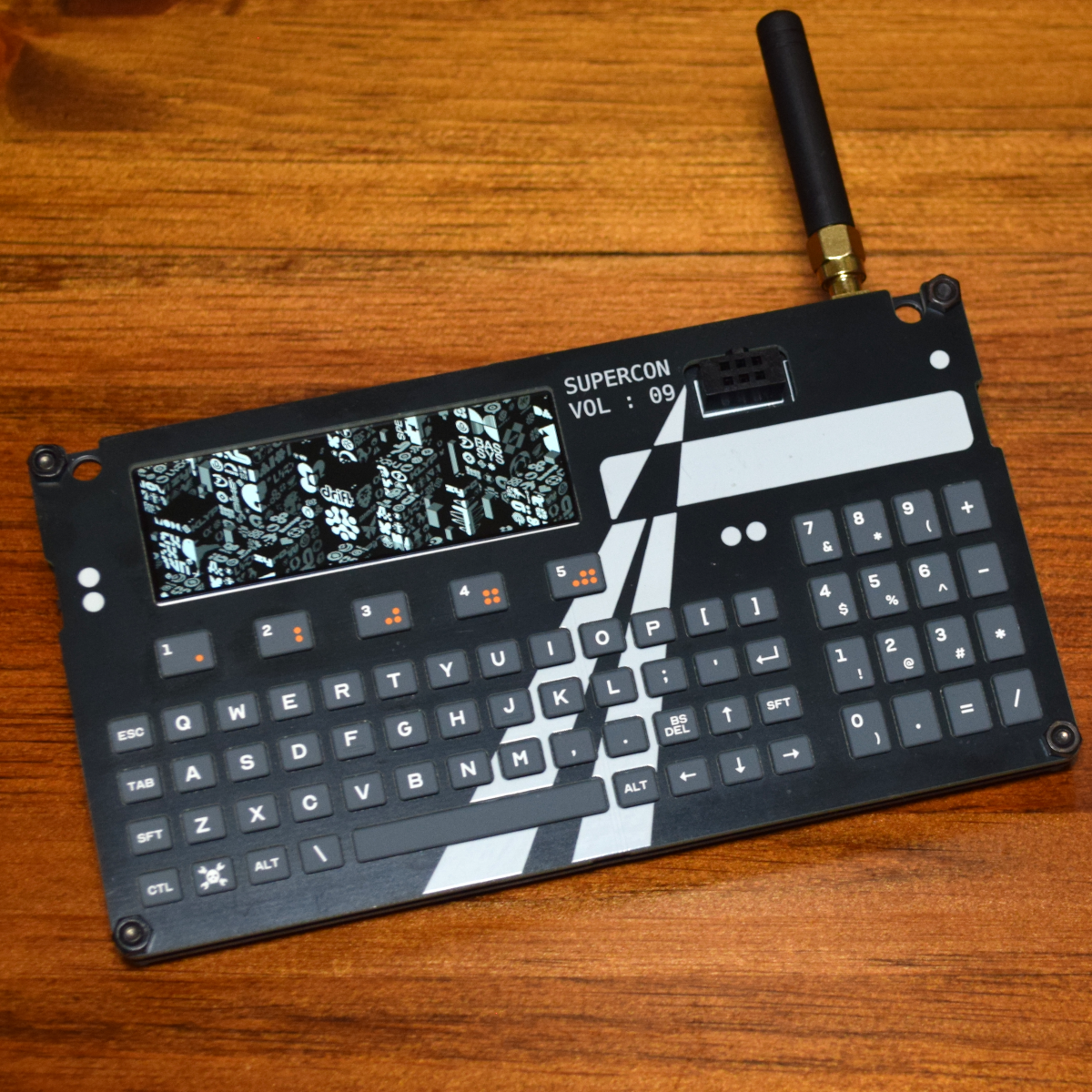
It’s the moment you hard-core hardware nerds have been waiting for: the reveal of the 2025 Hackaday Supercon Communicator Badge. And this year, we’ve outdone ourselves, but that’s thanks to help from stellar collaboration with folks from the community, and help from sponsors. This badge is bigger than the sum of its parts, and we’ve planned for it to be useful for you to hack on in the afterlife. Indeed, as always, you are going to be the final collaborator, so we can’t wait to see what you’ll do with it.
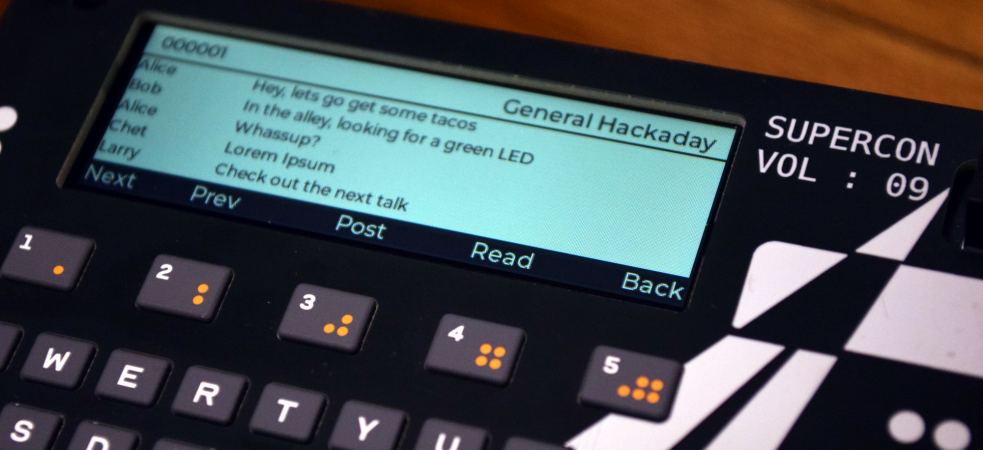
We’re going out – wide out – on a limb and trying to create a dense mesh network of badges talking to each other at Supercon. It’s going to be like a badge-hosted collection of chat rooms, as connected as we can make them without talking over each other.
You look up a topic, say Retro Computing or SAO trading, punch in the channel number on the numpad, and your badge starts listening to everything going on around that topic. But they also listen to everything else, and repeat anything they hear on to their neighbors. Like IRC, but LoRa.
In the history of entertainment, few properties have made the sort of indelible mark on popular culture as StarTrek has. In 950 episodes across the twelve television series that have carried the name, the franchise has made a spectacle not of explosions and machismo, but of competent professionals working together to solve complex problems. In the world of Star Trek, the coolest people in the room are the scientists, engineers, physicists, and doctors — is it any wonder so many in the sciences credit the show for putting them on their career path?
Hardware hacker, maker, and Trekkie Andrew [MakeItHackin] will lead the panel.To celebrate the impact of Star Trek, we’re proud to announce our keynote event for the 2025 Hackaday Supercon: Crafting the Final Frontier. This round-table discussion led by Andrew [MakeItHackin] will bring together some of the artists that have helped cultivate the look and feel of the final frontier since Star Trek:The Next Generation and all the way into the modern era with Star Trek: Picard.
While the art direction of the original Star Trek series from 1966 was remarkably ahead of its time, these are some of the key individuals who were brought in to refine those early rough-hewn ideas into cultural touchstones. Their work ended up becoming more than simple entertainment, and ultimately helped inspire some of the real-world technology we use on a daily basis. The iconic LCARS computer interface predicted the rise of the touch screen, while its impossible to look at props such as the PADD and Tricorder and not see the parallels with modern tablets and smartphones.
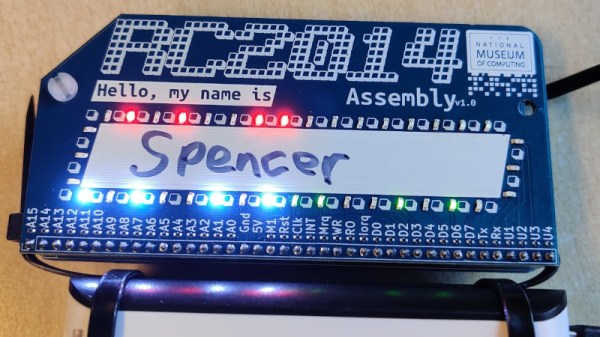
Over the years, we’ve brought you many stories of the creative artwork behind electronic event badges, but today we may have a first for you. [Spencer] thinks nobody before him has made a badge powered by a Z80, and we believe he may be right. He’s the originator of the RC2014 Z80-based retrocomputer, and the badge in question comes from the recent RC2014 Assembly.
Fulfilling the function of something you can write your name on is a PCB shaped like an RC2014 module, with LEDs on all the signal lines. It could almost function as a crude logic analyser for the system, were the clock speed not far too high to see anything. To fix this, [Spencer]’s badge packs a single-board RC2014 Micro with a specially slow clock, and Z80 code to step through all memory addresses, resulting in a fine set of blinkenlights.
Thus was created the first Z80-based event badge, and we’re wondering whether or not it will be the last. If you’re curious what this RC2014 thing is about, we reviewed the RC2014 Micro when it came out.
The largest European hacker camp this year was in the Netherlands — What Hackers Yearn (WHY) 2025 is the latest in the long-running series of four-yearly events from that country, and 2025 saw a move from the Flevoland site used by SHA2017 and MCH2021, back to just north of Alkmaar in Noord-Holland, where the OHM2013 event took place. WHY has found itself making the news in the Dutch technical media for all the wrong reasons over the last few days, after serious concerns were raised about the fire safety of its badge.
This is the cell supplied with the WHY badge, complete with manufacturer’s warning.
The concerns were raised from the RevSpace hackerspace in Leidschendam, and centre around the design of the battery power traces on the PCB between the battery holders and the power supply circuitry. Because the 18650 cells supplied with that badge lack any protection circuitry, bridging the power traces could be a fire risk.
In short: their report names the cell holders as having tags too large for their pads on the PCB, a too-tight gap between positive and negative battery traces, protected only by soldermask, and the inadequacy of the badge’s short circuit protection. In the event that metal shorted these battery tags, or wore through the soldermask, the batteries would be effectively shorted, and traces or components could get dangerously hot.
The WHY organizers have responded with a printed disclaimer leaflet warning against misuse of the cells, and added a last-minute epoxy coating to the boards to offer additional protection. Some people are 3D-printing cases, which should also help reduce the risk of short-circuiting due to foreign metal objects. Using an external powerbank with short-circuit protection instead of the cells would solve the problem as well. Meanwhile a group of hackers collecting aid for Ukraine are accepting the batteries as donations.
It’s understood that sometimes bugs find their way into any project, and in that an event badge is no exception. In this particular case, the original Dutch badge team resigned en masse at the start of the year following a disagreement with the WHY2025 organizers, so this badge has been a particularly hurried production. Either way, we are fortunate that the issue was spotted, and conference organizers took action before any regrettable incidents occurred.