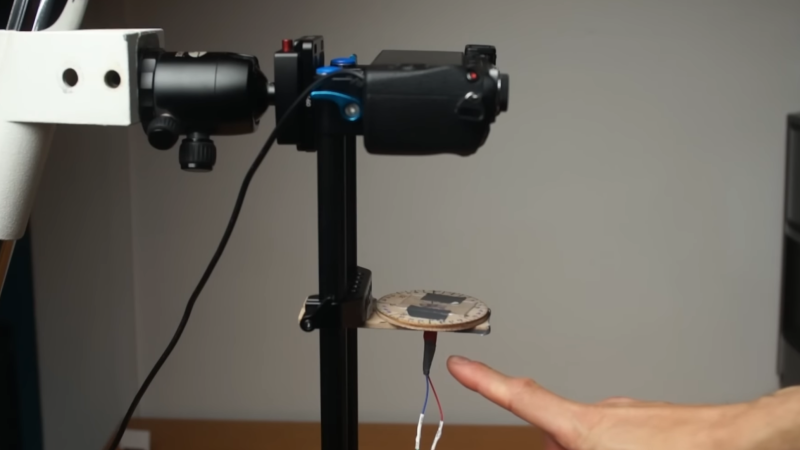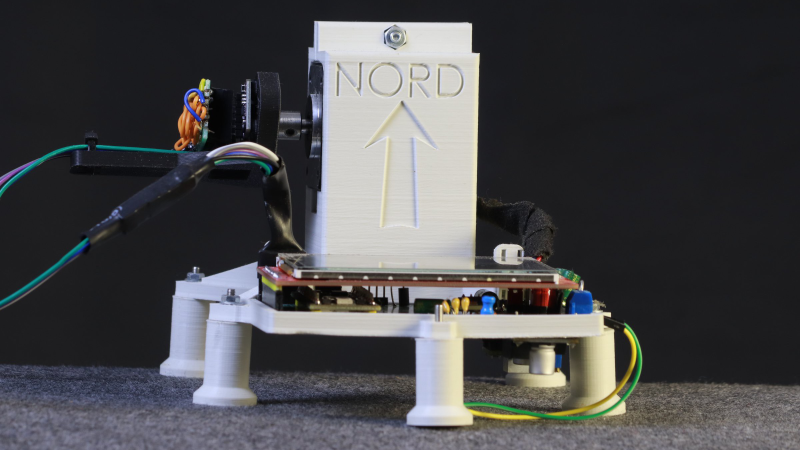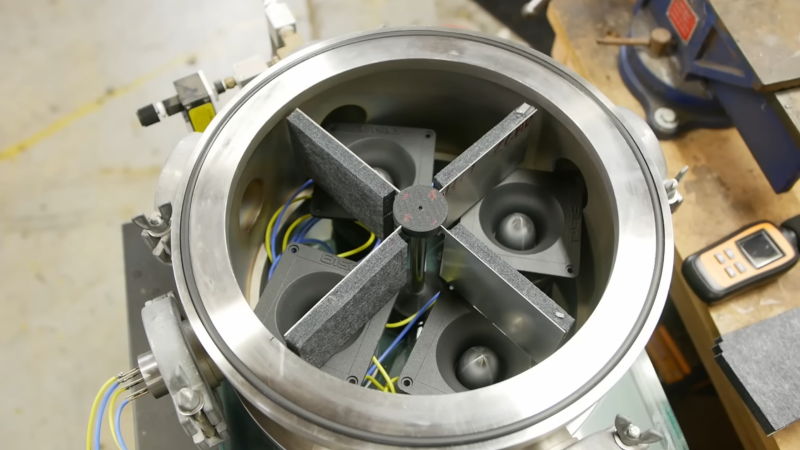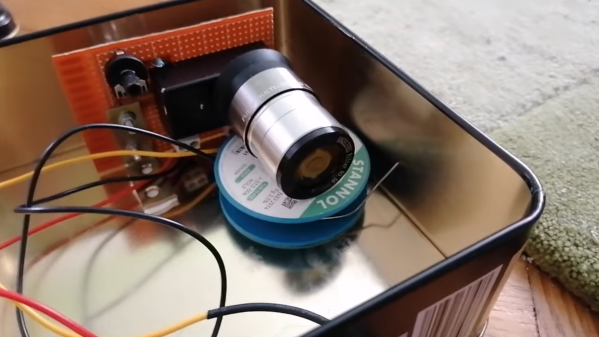
A camera-based microscope is on a stand, looking down towards a slide which is held on a plastic stage. The stage is held in place by three pairs of brass rods, which run to red plastic cranks mounted to three stepper motors. On the opposite side of each crank from the connecting rod is a semicircular array of magnets.

Designing An Open Source Micro-Manipulator

When you think about highly-precise actuators, stepper motors probably aren’t the first device that comes to mind. However, as [Diffraction Limited]’s sub-micron capable micro-manipulator shows, they can reach extremely fine precision when paired with external feedback.

The micro-manipulator is made of a mobile platform supported by three pairs of parallel linkages, each linkage actuated by a crank mounted on a stepper motor. Rather than attaching to the structure with the more common flexures, these linkages swivel on ball joints. To minimize the effects of friction, the linkage bars are very long compared to the balls, and the wide range of allowed angles lets the manipulator’s stage move 23 mm in each direction.

To have precision as well as range, the stepper motors needed closed-loop control, which a magnetic rotary encoder provides. The encoder can divide a single rotation of a magnet into 100,000 steps, but this wasn’t enough for [Diffraction Limited]; to increase its resolution, he attached an array of alternating-polarity magnets to the rotor and positioned the magnetic encoder near these. As the rotor turns, the encoder’s local magnetic field rotates rapidly, creating a kind of magnetic gear.

A Raspberry Pi Pico 2 and three motor drivers control this creation; even here, the attention to detail is impressive. The motor drivers couldn’t have internal charge pumps or clocked logic units, since these introduce tiny timing errors and motion jitter. The carrier circuit board is double-sided and uses through-hole components for ease of replication; in a nice touch, the lower silkscreen displays pin numbers.

To test the manipulator’s capabilities, [Diffraction Limited] used it to position a chip die under a microscope. To test its accuracy and repeatability, he traced the path a slicer generated for the first layer of a Benchy, vastly scaled-down, with the manipulator. When run slowly to reduce thermal drift, it could trace a Benchy within a 20-micrometer square, and had a resolution of about 50 nanometers.

He’s already used the micro-manipulator to couple an optical fiber with a laser, but [Diffraction Limited] has some other uses in mind, including maskless lithography (perhaps putting the stepper in “wafer stepper”), electrochemical 3D printing, focus stacking, and micromachining. For another promising take on small-scale manufacturing, check out the RepRapMicron.

Continue reading “Designing An Open Source Micro-Manipulator”

In the center of the picture is a colored drawing of a man wearing a kimono, climbing out of a window. To the left and right the sides of two other pictures are just visible.

The Challenges Of Digitizing Paper Films

In the 1930s, as an alternative to celluloid, some Japanese companies printed films on paper (kami firumu), often in color and with synchronized 78 rpm record soundtracks. Unfortunately, between the small number produced, varying paper quality, and the destruction of World War II, few of these still survive. To keep more of these from being lost forever, a team at Bucknell University has been working on a digitization project, overcoming several technical challenges in the process.

The biggest challenge was the varying physical layout of the film. These films were printed in short strips, then glued together by hand, creating minor irregularities every few feet; the width of the film varied enough to throw off most film scanners; even the indexing holes were in inconsistent places, sometimes at the top or bottom of the fame, and above or below the frame border. The team’s solution was the Kyōrinrin scanner, named for a Japanese guardian spirit of lost papers. It uses two spools to run the lightly-tensioned film in front of a Blackmagic cinematic camera, taking a video of the continuously-moving film. To avoid damaging the film, the scanner contacts it in as few places as possible.

After taking the video, the team used a program they had written to recognize and extract still images of the individual frames, then aligned the frames and combined them into a watchable film. The team’s presented the digitized films at a number of locations, but if you’d like to see a quick sample, several of them are available on YouTube (one of which is embedded below).

This piece’s tipster pointed out some similarities to another recent article on another form of paper-based image encoding. If you don’t need to work with paper, we’ve also seen ways to scan film more accurately.

Continue reading “The Challenges Of Digitizing Paper Films”

Two sides of a business-card shaped device are shown. On the left, it’s clear that the device is about half a centimeter thick, with a large scroll wheel visible in the center. The device cover is 3D-printed in black plastic, and has cutouts to mark where three buttons ar. On the right, the underside of the device is visible. It is a black PCB, with white text giving contact information.

Building A Macro Pad Into A Business Card

A business card is a convenient way to share your contact information, but it’s unfortunately prone to being thrown away or forgotten. PCB business cards try to get around this problem, but while impressive, most won’t keep the recipient engaged for a very long time. [Cole Olsen]’s macro pad business card, on the other hand, might actually get regular use.

The card has three buttons and a rotary encoder as controls, with an RGB LED to indicate the card’s current mode. It can perform three sets of functions: general productivity, serving as a presentation remote, and controlling music. The scroll wheel is the main control, and can switch through windows, desktops, and tabs, page through slides, and control music volume.

The card itself is made out of a PCB, the exposed side of which contains [Cole]’s contact information, and the other side of which is covered by a 3D-printed case. As thick as it is, this might be stretching the definition of “card” a bit, but as a mechanical engineer, [Cole] did want to demonstrate some mechanical design. A nice!nano wireless keyboard development board running ZMK firmware reads the sensors and sends commands. Conveniently for a presentation remote, the card is powered by a rechargeable battery and can work wirelessly (as a side benefit, if a recipient were minded to get rid of this card, the lithium-polymer battery would probably substantially delay disposal).

[Cole] writes that he was inspired by many of the other impressive business cards we’ve covered. Some of the macro pads we’ve seen have been marvels of miniaturization in their own right.

A wrench is shown lying on a machinist’s mat. The end of the wrench holds a ratcheting wheel, on top of which are six independent metal blocks arranged into a hexagon.

Building A Shifting Ratchet Wrench

Convenient though they may be, [Trevor Faber] found some serious shortcomings in shifting spanners: their worm gears are slow to adjust and prone to jamming, they don’t apply even force to all faces of a bolt head, and without a ratchet, they’re rather slow. To overcome these limitations, he designed his own adjustable ratchet wrench.

The adjustment mechanism is based on a pair of plates with opposing slots; the wrench faces are mounted on pins which fit into these slots, and one plate rotates relative to the other, the faces slide inwards or outwards. A significant advantage of this design is that, since one plate is attached to the wrench’s handle, some of the torque applied to the wrench tightens its grip on the bolt. To let the wrench loosen as well as tighten bolts, [Trevor] simply mirrored the mechanism on the other side of the wrench. Manufacturing proved to be quite a challenge: laser cutting wasn’t precise enough for critical parts, and CNC control interpolation resulted in some rough curves which caused the mechanism to bind, but after numerous iterations, [Trevor] finally got a working tool.

To use the wrench, you twist an outer ring to open the jaws, place them over the bolt, then let them snap shut. One nice touch is that you can close this wrench over a bolt, let go of it, and do something else without the wrench falling off the bolt. Recessed bolts were a bit of an issue, but a chamfer ought to improve this. It probably won’t be replacing your socket set, but it looks like it could make the odd job more enjoyable.

If you prefer a more conventional shifting wrench, you can make a miniature out of an M20 nut. It’s also possible to make a shifting Allen wrench.

Continue reading “Building A Shifting Ratchet Wrench”

A 3D-printed case encloses a number of electronic components. In the top left of the case, a laser diode is mounted. In the top right, the laser beam is shining into a cuvette, which is glowing red from scattered light. In the bottom right, a small breadboard has an integrated circuit and a few parts mounted. In the bottom left is a large red circuit board marked “Rich UNO R3.”

Measuring Nanoparticles By Scattering A Laser

A fundamental difficulty of working with nanoparticles is that your objects of study are too small for an optical microscope to resolve, and thus measuring their size can be quite a challenge. Of course, if you have a scanning electron microscope, measuring particle size is straightforward. But for less well-equipped labs, a dynamic light scattering system, such as [Etienne]’s OpenDLS, fits the bill.

Dynamic light scattering works by shining a laser beam into a suspension of fine particles, then using a light sensor to measure the intensity of light scattered onto a certain point. As the particles undergo Brownian motion, the intensity of the scattered light changes. Based on the speed with which the scattered light varies, it’s possible to calculate the speed of the moving particles, and thus their size.

The OpenDLS uses a 3D printed and laser-cut frame to hold a small laser diode, which shines into a cuvette, on the side of which is the light sensor. [Etienne] tried a few different options, including a photoresistor and a light sensor designed for Arduino, but eventually chose a photodiode with a two-stage transimpedance amplifier. An Arduino samples the data at 67 kHz, then sends it over serial to a host computer, which uses SciPy and NumPy to analyse the data. Unfortunately, we were about six years late in getting to this story, and the Python program is a bit out of date by now (it was written in Python 2). It shouldn’t, however, be too hard for a motivated hacker to update.

With a standard 188 nm polystyrene dispersion, the OpenDLS calculated a size of 167 nm. Such underestimation seemed to be a persistent issue, probably caused by light being scattered multiple times. More dilution of the suspension would help, but it would also make the signal harder to measure, and the system’s already running near the limits of the hardware.

This isn’t the only creative way to measure the size of small particles, nor even the only way to investigate small particles optically. Of course, if you do have an electron microscope, nanoparticles make a good test target.

A golden robotic hand is shown in the main picture performing the sign for the letter "g": pointing to the left, with all fingers except for the index finger curled. In the top left of the image, a human hand is shown imitating this position.

Ambidextrous Robot Hand Speaks In Signs

As difficult as it is for a human to learn ambidexterity, it’s quite easy to program into a humanoid robot. After all, a robot doesn’t need to overcome years of muscle memory. Giving a one-handed robot ambidexterity, however, takes some more creativity. [Kelvin Gonzales Amador] managed to do this with his ambidextrous robot hand, capable of signing in either left- or right-handed American Sign Language (ASL).

The essential ingredient is a separate servo motor for each joint in the hand, which allows each joint to bend equally well backward and forward. Nothing physically marks one side as the palm or the back of the hand. To change between left and right-handedness, a servo in the wrist simply turns the hand 180 degrees, the fingers flex in the other direction, and the transformation is complete. [Kelvin] demonstrates this in the video below by having the hand sign out the full ASL alphabet in both the right and left-handed configurations.

The tradeoff of a fully direct drive is that this takes 23 servo motors in the hand itself, plus a much larger servo for the wrist joint. Twenty small servo motors articulate the fingers, and three larger servos control joints within the hand. An Arduino Mega controls the hand with the aid of two PCA9685 PWM drivers. The physical hand itself is made out of 3D-printed PLA and nylon, painted gold for a more striking appearance.

This isn’t the first language-signing robot hand we’ve seen, though it does forgo the second hand. To make this perhaps one of the least efficient machine-to-machine communication protocols, you could also equip it with a sign language translation glove.

A brown plastic circuit board is visible in the middle of the picture, containing an integrated circuit, a resistor, a diode, two capacitors, and some jumper wires going away to the sides.

A Solderless, Soluble Circuit Board

Anyone who’s spent significant amounts of time salvaging old electronics has probably wished there were a way to take apart a circuit board without desoldering it. [Zeyu Yan] et al seem to have had the same thought, and designed circuit boards that can be dissolved and recycled when they become obsolete. Read the details in the research paper. (PDF)

The researchers printed the circuit boards out of water-soluble PVA, with hollow channels in place of interconnects. After printing the boards, they injected a eutectic gallium-indium liquid metal alloy into these channels, populated the boards with components, making sure that their leads were in contact with the liquid alloy, and finally closed off the channels with PVA glue, which also held the components in place. When the board is ready to recycle, they simply dissolve the board and glue in water. The electric components tend to separate easily from the liquid alloy, and both can be recovered and reused. Even the PVA can be reused: the researchers evaporated the solution left after dissolving a board, broke up the remaining PVA, and extruded it as new filament.
Continue reading “A Solderless, Soluble Circuit Board”