Hackaday Prize Entry: Messing Around With New Vacuum Tubes

Vacuum tubes have been around for ages, and for better or worse, they have their advocates for use in amplifiers and preamps. However, tubes are simply inconvenient devices. Even a 12AX7 preamp tube is huge relative to a handful of transistors, tubes require weird voltages, and each and every one of them is a through-hole device that doesn’t lend itself to machine assembly.

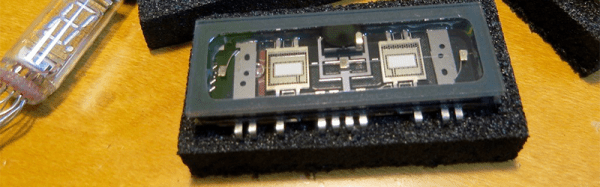
This changed recently with the introduction a strange new tube from Japan. Noritake and Korg recently introduced a triode that uses the same packaging as VFD displays. The Korg Nutube is a vacuum tube that operates at lower voltages, is smaller than the usual preamp tubes, and still has the vacuum tube sound.

For his Hackaday Prize entry, [Kodera] is building a headphone amp with this new tube. Is a tube-based headphone amp particularly novel? No. But this is the first we’ve seen anyone playing around with this new, interesting piece of technology.

The requirements for this Nutube are simple enough, and the minimum anode voltage of this tube is just 8 V. [Kodera]’s circuit is running the tube at 12 V, and the only other circuitry in this preamp are a few coupling caps and an op-amp just before the power stage.

[Kodera] has crammed this circuit into a proper amplifier using a 2 x 15 W class-D chip from TI. It’s really a phenomenally simple circuit that’s also remarkably tiny. These kits are actually available on Tindie. Time will tell if the Nutube is picked up by some big-time manufacturers, but we’re happy to see someone is playing around with the latest advances in tube amp technology.


TEMPEST In A Software Defined Radio

In 1985, [Wim van Eck] published several technical reports on obtaining information the electromagnetic emissions of computer systems. In one analysis, [van Eck] reliably obtained data from a computer system over hundreds of meters using just a handful of components and a TV set. There were obvious security implications, and now computer systems handling highly classified data are TEMPEST shielded – an NSA specification for protection from this van Eck phreaking.

Methods of van Eck phreaking are as numerous as they are awesome. [Craig Ramsay] at Fox It has demonstrated a new method of this interesting side-channel analysis using readily available hardware (PDF warning) that includes the ubiquitous RTL-SDR USB dongle.

The experimental setup for this research involved implementing AES encryption on two FPGA boards, a SmartFusion 2 SOC and a Xilinx Pynq board. After signaling the board to run its encryption routine, analog measurement was performed on various SDRs, recorded, processed, and each byte of the key recovered.

The results from different tests show the AES key can be extracted reliably in any environment, provided the antenna is in direct contact with the device under test. Using an improvised Faraday cage constructed out of mylar space blankets, the key can be reliably extracted at a distance of 30 centimeters. In an anechoic chamber, the key can be extracted over a distance of one meter. While this is a proof of concept, if this attack requires direct, physical access to the device, the attacker is an idiot for using this method; physical access is root access.

However, this is a novel use of software defined radio. As far as the experiment itself is concerned, the same result could be obtained much more quickly with a more relevant side-channel analysis device. The ChipWhisperer, for example, can extract AES keys using power signal analysis. The ChipWhisperer does require a direct, physical access to a device, but if the alternative doesn’t work beyond one meter that shouldn’t be a problem.

Hackaday Links: June 25th, 2017

There will be no special badges for DEFCON. Everyone will still have badges — and our expectations are tempered because of the one year on / one year off schedule for electronic badges — there just won’t be mind-bending puzzles wrapped up in the official badges. What this means: it probably won’t matter if you’re late for linecon, and someone in the DEFCON hive mind still has a Facebook. Also, DEFCON is canceled.

In the past, we have decried the very existence of fidget spinners. It’s what the kids are into, after all. However, an electronic fidget spinner is an interesting engineering challenge. It combines the mechanical fun of bearing science, the exacting precision of balancing stuff, and stuffing electronics where no electronics should be. This Kickstarter is perhaps the best electronic fidget spinner we’ve seen. The electronics are powered by a coin cell and are packed into one of the spaces for the ‘wing’ bearings, and two additional weighted bearings allow the spinner to balance. There’s a small magnet for a hall effect sensor in the ‘stator cap’ so RPM can be measured. This design uses the most common mold for a fidget spinner, making it very manufacturable. Compare this design to the Internet of Fidget Spinners, a POV fidget Spinner, another POV fidget spinner, an educational electronic fidget spinner, or this amazing technique to measure the speed of a fidget spinner that will blow your mind, and you’ll see this Kickstarter project is clearly the superior design.

You kids are spoiled with your programmable drum machines like your 808 and 909. Back in the day, drum machines were attached to organs, and only had a few patterns. You couldn’t change the patterns, you could only change the speed. [Jan] has created one of these prehistoric drum machines in a microcontroller. You get hard rock, disco, reggae, rock, samba, rumba, cha-cha, bossa nova, beguine, synthpop, boogie, waltz, jazz rock, and slow rock. Awesome.

There’s a new electronics magazine. It’s called DIYODE, and we’re all kicking ourselves for not coming up with that name.

Do you need a new password? Humans really aren’t good at coming up with random numbers, and if you need a completely random alphanumeric password, it’s best left to a computer. Have no fear, because there’s now a website that generates the single most secure password on the planet. This password, “H4!b5at+kWls-8yh4Guq”, features upper and lowercase characters, numbers, symbols, and twenty unique characters. This password was developed by security researchers and encryption specialists in Europe, so you know it has absolutely nothing to do with the NSA, CIA, or any other American three-letter agency.

Speaking of three-letter agencies, last Wednesday was International Selfie Day! That doesn’t mean you still can’t get in on the action. Take a selfie right now and upload it to social media! What’s facial recognition?

Looking for a great little ESP32 breakout board with all the bells and whistles? Olimex has a new board out with Ethernet, a MicroSD card slot, and 20 GPIOs broken out.

Hackaday Prize Entry: A 3D Printer Management System

Since the first desktop 3D printers, people have been trying to figure out a way to manage desktop 3D printers and turn them into tiny little automated factories. One of the first efforts was a conveyor belt build plate that was successfully used by MakerBot until it wasn’t anymore. Octoprint has been a boon for anyone who wants to manage a few printers, but that’s only half the solution.

For his Hackaday Prize entry, [Mike] has come up with a solution that turns a desktop 3D printer into a completely automated factory. Not only does this project take care of removing the part from the bed when the print is done, it also manages a web-based print queue. It is the simplest way to manage a printer we’ve ever seen, and it’s a great entry for the Hackaday Prize.

First up, the software stack. [Mike] has developed a web-based queue and slicing software that ingests 3D models and spits out Gcode to a printer. This, really, is nothing new. Octoprint does it, Astroprint does it, and even a few 3D printers have this capability. This is only one part of the project though, although it is geared more as a maker space management software than simply a dedicated 3D printer controller.

You can’t have an automated mini factory without an automated build plate, though, and here [Mike] has come up with something really great. His solution for dispensing prints after they’re completed is brilliant in its simplicity. All you need to do is drop the floor out from underneath the print. [Mike]’s solution is a trap door print bed. At the beginning of the print, an inkjet printer spits out a piece of paper, with a few lines of text, onto the print bed. When the print is finished, a stepper motor unwinds a cable, and a trap door opens up underneath the print. The part drops into a bin, the door closes, and the next print is loaded up in the queue. It’s brilliantly simple.

You can check out [Mike]’s demo of this system after the break. It’s awesome and so sublimely simple we’re shocked no one has thought of this before.

Continue reading “Hackaday Prize Entry: A 3D Printer Management System”

Teaching STEAM With Fidget Spinners

A huge focus of the maker revolution has been a focus on STEAM education, or rather an education in science, technology, engineering, art, and mathematics. We’ve seen innumerable kits and tools designed to introduce children to STEAM apps, ranging from electronic Lego blocks to robotics kits built around interlocking plastic bricks. These are just a passing fad, but finally, we have what looks like a winner: a STEAM education fidget spinner.

Fidget spinners have spun into our hearts like a shuriken over the last few months, and [MakerStorage]’s latest project taps into the popularity of fidget spinners to put an educational — wait for it — spin on the usual STEAM education toolkit. This is exactly what the maker revolution needs.

On board this educational fidget spinner are a few RGB LEDs and an Arduino-compatible microcontroller development board. A coin cell battery powers everything, and in an interesting advancement of fidget spinner science, [MakerStorage] seems to be using a flanged bearing with a PCB. We’re seeing the march of technology right before our eyes, people. Right now there are two versions of the educational fidget spinner, one with an Arduino Pro Micro soldered to the board, and another with an ATMega-derived custom circuit on the board along with a PCB USB connector.

Haven’t gotten enough fidget spinner news? OH BOY does Hackaday have you covered. Here’s the Internet of Fidget Spinners, a fidget spinner with an embedded WiFi microcontroller and a bunch of blinky LEDs. Those LEDs form a Persistence of Vision display. It’s amazing, astonishing, and it’s in fidget spinner format. Bored with your oscilloscope? Turn it into a fidget spinner tachometer. There’s literally nothing that can’t be applied to the world of fidget spinners.

Dumping Synth ROMs And Avoiding Bitrot

Bitrot is setting in, and our digital legacy is slowly turning to dust. Efforts preserve our history are currently being undertaken numerous people around the Internet, and [Jason Scott] just got an automated CD ripper, so everything is kinda okay.

However, there is one medium that’s being overlooked. ROMs, and I don’t mean video game cartridges. In the 80s, mask ROMs were everywhere, found in everything from talking cars to synthesizers.

[Ali] bought a Korg i5m workstation from eBay a few years ago, but this unit had a problem. Luckily, he had a similar synth with the same samples stored on board. There was only one way to find out if bitrot was the cause: desoldering the chips and dumping all the information.

After fiddling around with his broken synth, [Ali] still had a problem with the sound output. Deciding the ROM chips had to be the issue, [Ali] desoldered the chips and ordered a breadboard SOP44 adapter after deciding soldering wires to each lead of the chip was a bad idea. This adapter was connected to an Arduino Mega — still the best tool for weird tasks like this — and the contents of the ROM were dumped to a PC with the help of a helpful Arduino sketch.

Dumping the ROMs took about 15 minutes, and that’s if he was able to maintain a good connection between the chip and Arduino for that long. [Ali] wrote an improved ROM reader after much trial and error, and was eventually able to get the same data out of the same chip eventually.

While the broken synth hasn’t been repaired yet, at least [Ali] has the important bits off of this antique instrument. That’s good enough for now, but [Ali] intends to take this project to completion and get those vintage samples playing out of this great old synth.


Panelizing Boards The Easy Way

For reasons that will remain undisclosed until some time in the future, I recently had a need to panelize a few PCBs. Panelization is the art of taking PCB designs you already have, whether they’re KiCad board files, Eagle board files, or just Gerbers, and turning them into a single collection of PCBs that can be sent off to a fab house.

Now this is panel racing

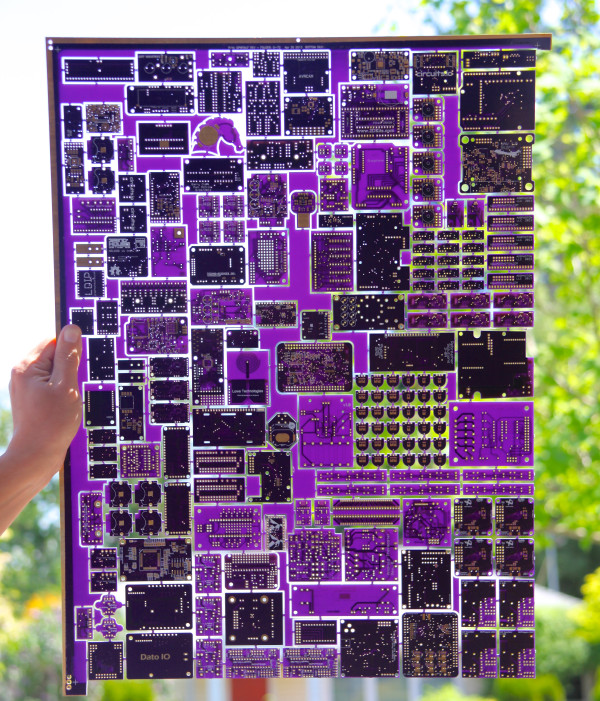
If you’re still wondering what this means, take a look at the last board you got from OSH Park, Seeed, Itead, or Dirty PCBs. Around the perimeter of your board, you’ll find some rough spots. These are ‘mouse bites’ and tabs, places where the boards are strung together to form a gigantic rectangular panel sent off to a manufacturer. You can check out this great interview with [Laen] from OSH Park to get an idea of how this works, but the basic process is to take a bunch of Gerbers, add tabs and mouse bites, solve the knapsack problem, and send the completed panel off to a board house.

Panelizing boards is something most of us won’t have to do often. Really, you only want a panel of boards when you’re manufacturing something. For small-scale production and prototypes, bare boards will do just fine. Simply by virtue of the fact that panelizing boards is far less common than throwing some Gerbers at OSH Park or Seeed, there aren’t many (good) tutorials, and even fewer (good) tools to do so. This is how you panelize boards quickly and easily using Open Source tools.

Continue reading “Panelizing Boards The Easy Way”