Hackaday Prize Entry: Secure Storage On SD Cards

Here’s a puzzler for you: how do you securely send data from one airgapped computer to another? Sending it over a network is right out, because that’s the entire point of an airgap. A sneakernet is inherently insecure, and you shouldn’t overestimate the security of a station wagon filled with tapes. For his Hackaday Prize entry, [Nick Sayer] has a possible solution. It’s the Sankara Stones from Indiana Jones and the Temple of Doom, or a USB card reader that requires two cards. Either way, it’s an interesting experiment in physical security for data.

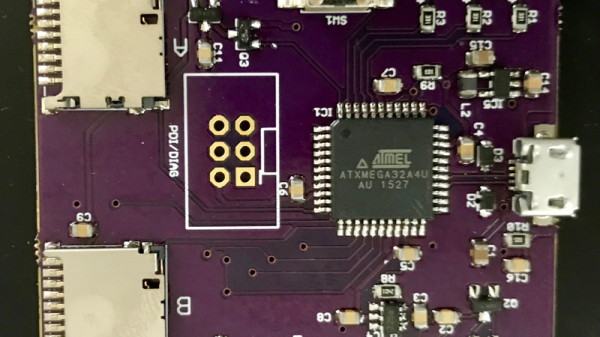
The idea behind the Orthrus, a secure RAID USB storage device for two SD cards, is to pair two SD cards. With both cards, you can read and write to this RAID drive without restriction. With only one, the data is irretrievable so they are safe during transit if shipped separately.

The design for this device is based around the ATXMega32A4U. It’s pretty much what you would expect from an ATMega, but this has a built-in full speed USB interface and hardware AES support. The USB is great for presenting two SD cards as a single drive, and the AES port is used to encrypt the data with a key that is stored in a key storage block on each card.

For the intended use case, it’s a good design. You can only get the data off of these SD cards if you have both of them. However, [Nick] is well aware of Schneier’s Law — anyone can design a cryptosystem that they themselves can’t break. That’s why he’s looking for volunteers to crack the Orthrus. It’s an interesting challenge, and one we’d love to see broken.


These Twenty Designs Just Won $1000 In The Hackaday Prize

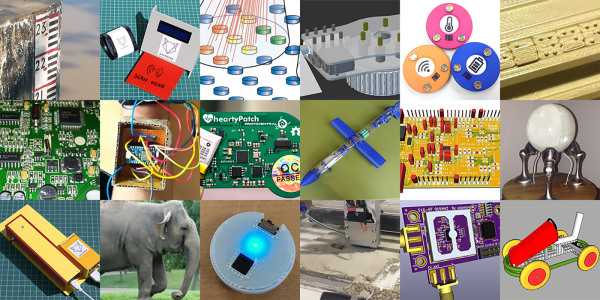
Today we’re excited to announce the winners of the Design Your Concept phase of The Hackaday Prize. These projects just won $1000 USD, and will move on to the final round this fall.

Hackaday is currently hosting the greatest hardware competition on Earth. We’re giving away thousands of dollars to hardware creators to build the next great thing. Last week, we wrapped up the first of five challenges. It was all about showing a design to Build Something That Matters. Hundreds entered and began their quest to build a device to change the world.

There are still four more challenges to explore over the next few months. So far the results have been spectacular. But we’re only a fifth of the way through the Hackaday Prize. So as you celebrate and congratulate the twenty projects below, there’s ample opportunity to get in the game with your own project.

The winners for the Design Your Concept portion of the Hackaday Prize are, in no particular order:

Design Your Concept Hackaday Prize Finalists:

Continue reading “These Twenty Designs Just Won $1000 In The Hackaday Prize”

Hackaday Links Column Banner

Hackaday Links: May 7, 2017

The International Journal of PoC||GTFO is the hacker quarterly we all deserve. It’s Pastor Manul Laphroaig’s publication featuring crazy exploits and builds and neat woodcut illustrations. It’s going to be a freakin’ dead tree book published by No Starch Press. The word on the street is this is a literal bible. No, really. No Starch found a place that publishes (manufactures?) bibles, and they sent over the PDFs. There will probably be a Hackaday review of this book, but since all the content is freely available online, this review will literally only be judging a book by its cover.

Hoverboards are more innovative than a selfie stick. The snuggie is an innovative product. The iPhone came before greek yogurt. These are the findings of an online consumer research poll being held by CB Insights. As of this writing (and it might be updated by the time this is published), the bracket for the ‘Most Innovative Consumer Product Since The iPhone’ is down to two competitors — the Tesla Model S and the Raspberry Pi. That’s more opinion than anything, but check out the bracket. The Amazon Echo is more innovative than the ‘desktop 3D printer’, which as we all know was invented by MakerBot. The Dollar Shave Club — otherwise known as giving away the razor and selling subscriptions for the blades — is innovative. Taco Bell didn’t make it past the first round. What the hell is going on here?

This robot plays tiddlywinks. What’s tiddlywinks? It’s that game where you put your hand down on a table and stab a knife between your fingers. It’s a test of fine motor skills and courage, or in this case, programming. This robot also plays tiddlywinks.

This is a Kickstarter for an FPGA’d ZX Spectrum. With the blessing of Sky UK — the owner of the Amstrad brand — this team is cloning the ZX Spectrum, adding HDMI and SD card storage, creating a new enclosure, and calling this project the Spectrum Next. It’s fully compatible with the original and future proofs the Speccy for another few decades.

The Internet of Things comes to alcohol. This vodka comes with a wrap-around LED display that apparently has Bluetooth and is programmable with an iPhone or Android device. Why does this exist? Because it’ll sell. [Bryan Williams] bought one of these bottles and sent this in on the tip line. He’s currently waiting for the batteries to die so he can bust out the Dremel. If anyone else out there wants to check this out, it’s $11 at Sam’s Club.

Need a Z80 C compiler? Here you go.

Clickspring, the guy who has put far, far too much effort into building a clock is now working on the Antikythera Mechanism. His latest video demonstrates how the main plates of the Antikythera mechanism come together. There’s some interesting stuff here, but we’re really waiting for the main gears.

YouTube is well known for the technical astuteness of its community and the fair and level-headed comment section. This, for a short time, was one of the top trending videos on YouTube. It’s ‘free energy’ from two power strips. All you need to do is coil the leads of the power strips around each other. Free intermittent energy for life!

Hackaday Prize Entry: RepRap Helios

Did you know that most of the current advances in desktop consumer 3D printing can be traced back to a rather unknown project started in 2005? This little-known RepRap project was dedicated to building Open Source hardware that was self-replicating by design. Before the great mindless consumerization of 3D printing began, the RepRap project was the greatest hope for Open Source hardware, and a sea change in what manufacturing could be.

While the RepRap project still lives on in companies like Lulzbot, Prusa, SeeMeCNC, and others, the vast community dedicated to creating Open Hardware for desktop manufacturing has somehow morphed into YouTube channels that feature 3D printed lions, 3D printed Pokemon, and a distinct lack of 3D printed combs. Still, though, there are people out there contributing to the effort.

[Nick Seward] is famous in the world of RepRap. He designed the RepRap GUS Simpson, an experimental 3D printer that is able to print all of its components inside its own build volume. The related LISA Simpson is an elegant machine that is unlike any other delta robot we’ve seen. He’s experimented with Core XZ machines for years now — a design that is only now appearing on AliBaba from random Chinese manufacturers. In short, [Nick Seward] is one of the greats of the RepRap project.

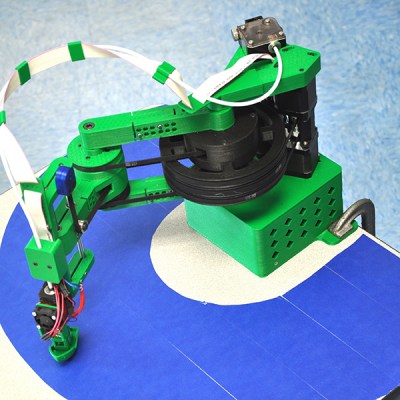
[Nick] is designing a new kind of RepRap, and he’s entered it in the Hackaday Prize. It can print most of its own component parts, it has an enormous build volume, and it’s unlike any 3D printer you’ve seen before. It’s a SCARA — not a, ‘robotic arm’ because SCARA is an acronym for Selective Compliance Articulated Robot Arm — that puts all the motors in the non-moving portion of the base. Its design is inspired by the RepRap Morgan, a printer whose designer won $20,000 in the GADA prize for being mostly self-replicating.
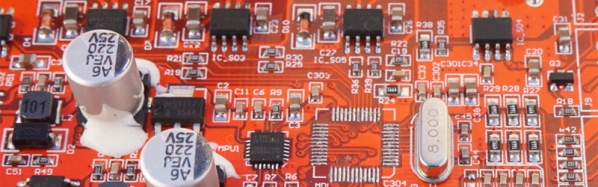
Improvements over the RepRap Morgan include a huge build volume (at least three 200x200mm squares can be placed in this printer’s build volume), a relatively fast print speed, high accuracy and precision, and auto bed leveling. Despite being more capable than some RepRap printers in some areas, the RepRap Helios should wind up being cheaper than most RepRap printers. It can also print most of its component parts, bringing us ever closer to a truly self-replicating machine.

You can check out a few of the videos of this printer in action below.

Continue reading “Hackaday Prize Entry: RepRap Helios”

Open Source Firmware For Hoverboards

2015 was two years ago, and to the surprise of many, we actually had hoverboards at the time. Of course, these weren’t Back to the Future-style hovering skateboards; they were crappy two-wheeled balancing scooters that suffered a few battery explosions and were eventually banned from domestic flights by some carriers. But oh boy, there were some funny Vines of these things.

While the rest of the world moved on from hoverboards, [Casainho] has been working on Open Sourcing the firmware for these interesting bits of electronics and motors. Now, his work is wrapping up and he has new firmware for electric unicycles and hoverboards.

The popular and cheap electric unicycles and hoverboards that have been swimming across the Pacific from the great land of Ali Baba for the past five years are based around a single, cheap controller board. This controller board is built around the STM32F1038T6 microcontroller, and are able to control a pair of three-phase brushless motors. The teardown began on the electric unicycle forum and was completely documented in a GitHub repo.

The Open Source firmware is now mostly complete, although the necessary self-balancing function doesn’t work. We’re thinking that’s alright; with this new firmware, these electric unicycles have a crazy amount of torque and could be the basis for a few very cool builds. You can check out a video of this torque below.

If two wheels seems far too safe, exercise your inner daredevil with a 3D printed unicycle conversion for a hoverboard.

Continue reading “Open Source Firmware For Hoverboards”

Phase Modulation With An FPGA

There are two radio modulation schemes everyone should know. Amplitude modulation changes the amplitude — or ‘volume’, if you will — of a carrier frequency and turns all radio into channels owned and operated by a church. Frequency modulation changes the pitch of a carrier frequency and is completely run by Clear Channel. Amateur radio operators are familiar with dozens of other modulation schemes, but there’s one hardly anyone touches. Phase modulation is weird and almost unheard of, but that doesn’t mean you can’t implement it on an FPGA. [nckm] is transmitting audio using phase modulation on an FPGA (Russian, here’s the Google Translatrix).

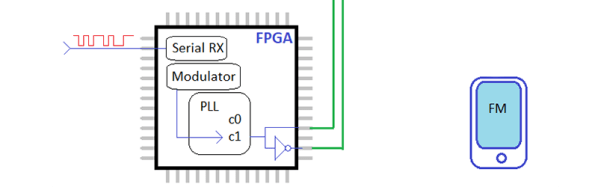
This hardware is just an Altera MAX10 board, with a single input used for serial data of the audio to be transmitted, and two outputs, each connected to a few bits of wire for a quarter-wave antenna. No, there’s no output filter or anything else except for a few bits of wire. It’s an experiment, chillax.

The Verilog for this project receives an audio signal as serial data in mono, 22050 BPS, 8-bit unsigned samples. These samples are fed into a dynamic PLL with phase shift in the FPGA. Shifting the phases also changes the frequency, so [nckm] can receive this audio signal with the FM transmitter on his phone.

Is this really phase modulation if it’s being received by an FM radio? Eh, maybe. PM and FM are closely related, but certainly distinguishable as modulation schemes in their own right. You can grab [nckm]’s code over on the gits, or check out the video demo below.

Continue reading “Phase Modulation With An FPGA”

The Nintendo PlayStation: Finally Working

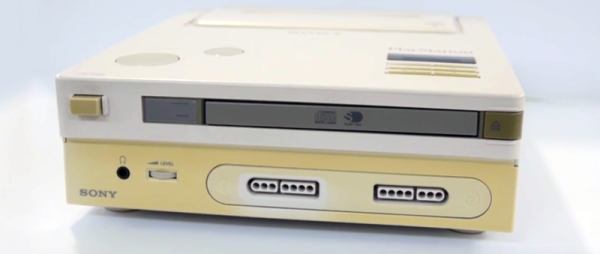
The Nintendo PlayStation is not a misnomer. Before the PS1, Sony teamed up with Nintendo to produce a video game console that used CD-ROMs as a distribution platform. These plans fell through, Sony went on to design the PS1, Nintendo the N64, but a few prototype ‘Nintendo PlayStations’ made it out into the wild. One of these unbelievably rare consoles was shipped to a company that eventually went into bankruptcy. The console was found when the contents of an office building were put up for auction, and last year, [Ben Heck] tore it apart.

It’s taken a year, but now this Nintendo PlayStation is finally working. This console now plays audio CDs and games written by homebrewers. The hardware lives, and a console once forgotten lives once more.

The last time [Ben Heck] took a look at the Nintendo PlayStation, the CD-ROM portion of the console was non-functional. The Super Nintendo was still functional, but for this prototype, the CD-ROM was completely self-contained and required a ‘boot cartridge’ of sorts to access anything on a CD. Somehow or another — [Ben] thinks it was a wonky cable or a dead cap — The CD-ROM came to life. Yes, jiggling a cable was the extent of the repair, after spending an inordinate amount of time reverse engineering the console.

With the CD-ROM working, [Ben] got audio playing and tried out of the few homebrew games for this PlayStation prototype. Super Boss Gaiden didn’t quite work because this game was designed to load in chunks. Another game written for this console, Magic Floor, was small enough to fit in the entirety of the CD-ROM’s buffer and loaded correctly. That doesn’t mean the game worked; there are some slight differences between the Nintendo PlayStation emulator and the actual hardware that now exists. [Ben] emailed the author of Magic Floor, and now, after a quarter-century, the Nintendo PlayStation works.

What’s next for the Nintendo PlayStation? Well, now the emulator for this system can correctly reflect the actual hardware, and hopefully the homebrewers can figure out how to write a game for this system.

Continue reading “The Nintendo PlayStation: Finally Working”