Hackaday Prize Entry: A Double Action Keyboard

Mechanical keyboards are the in thing right now and building your own is at least two extra levels of nerd cred. This project, entered in the Hackaday Prize, is a DIY keyboard unlike you’ve ever seen. It is a fundamental shift in the ideas of how a computer keyboard can work. It’s a double action keyboard. Press a key lightly, and one character will show up on the screen. Press hard, and a different character will show up on the screen. You’ve never seen anything like this before.

[Jaakob] designed this keyboard so that each keycap would have two switches underneath. He did this by taking regular ‘ol Cherry MX switches and modifying them so the ‘plunger’ would stick out of the bottom of the switch when it was fully depressed. These Cherry switches were mounted to a piece of perfboard, and a small tact switch soldered underneath. It’s an idea similar to what’s found in touch-sensitive MIDI controllers or the other type of keyboard. The difference here is that instead of using two switches to sense how hard a key is being pressed, it maps to two different functions.

Once [Jaakob] figured out how to put two switches under one keycap, he wired up a matrix, attached a Teensy, and took a crack at the firmware. The build isn’t quite done yet, but this is one of the most innovative DIY keyboards we’ve seen in recent memory. There’s a lot of potential here, and this method of ganging two switches together still allows for the fantastic clack and great feel of a mechanical switch.


Hackaday Prize Entry: An Automated Still

We’ve seen plenty of Arduinofied home brewing setups, and kegerators are a fairly standard project for the types of people we hang out with. What we haven’t seen a lot of are home stills. There are unfortunate reasons for this. First off, distilling alcohol is illegal in a few parts of the world if you don’t have a license or tax stamp. Second, vapors explode. Third, wood alcohol is poison.

That said, [TegwynTwmffat’s] project for the Hackaday Prize is the coolest and the safest alcohol still we’ve ever seen. It’s fully automated, small, safe, and there are video game noises sprinkled about the user interface.

The boiler for this nano still is constructed out of a keg, but that was just the starting point. [Tegwyn] removed the bottom of the keg, installed a new bottom, and coupled that bottom to a hot plate. The top of the keg was modified to accept a 2 inch brass fitting that was beautifully welded into place. From the boiler, the alcohol vapor goes into an air-cooled condenser, and all this equipment is housed in a welded steel frame. You couldn’t make something out of aluminum extrusion that looks this good.

The electronics include a hydrometer, an electronic alcohol vapor sensor, several temperature sensors an Arduino Mega, and a GPRS module for controlling the entire setup over the Internet. At various points in the distillation process, the Arduino plays audio files of a robot voice saying what’s going on in the still.

Right now, [Tegwyn] is distilling barley wine and cider into alcohol. The volume produced isn’t much — the keg is only 10 liters, after all — but this is one of the best stills we’ve ever seen. You can check out a video of [Tegwyn] walking us through the project below.

Continue reading “Hackaday Prize Entry: An Automated Still”

Friday Hack Chat: The Hackaday Prize

Did you know Hackaday is hosting a fantastic contest to build hardware and software? It’s true! The Hackaday Prize will award hundreds of thousands of dollars to Hackaday community members for building the coolest hardware designed to make a difference in the world.

The Hackaday Prize has many ways to enter, focusing on several themes throughout this year. We’ll be discussing that and opening the floor to questions. Tomorrow, Friday, April 28, at noon, Pacific time, we’re hosting a Hack Chat for the Hackaday Prize over on Hackaday.io.

Our guest host for this chat is [Alberto], creator of the project that won last year’s Hackaday Prize. He’ll be in the Hack Chat telling everyone what he learned from last year’s Hackaday Prize. If we’re lucky, he might even tell us something about what building his project out in the Supply Frame Design Lab is like. It’s all very cool, and it’s going down tomorrow at noon, PDT.

Here’s How To Take Part:

join-hack-chatOur Hack Chats are live community events on the Hackaday.io Hack Chat group messaging.

Log into Hackaday.io, visit that page, and look for the ‘Join this Project’ Button. Once you’re part of the project, the button will change to ‘Team Messaging’, which takes you directly to the Hack Chat.

You don’t have to wait until tomorrow; join whenever you want and you can see what the community is talking about.

And Tindie, Too!

Next Tuesday, we’re going to have another chat geared toward sellers on Tindie, the online marketplace where anyone can buy or sell DIY hardware.

This time around, we’re talking about Kickstarter. We roped [Zach Dunham] into this one. He’s the Design & Technology Outreach Lead at Kickstarter, and by every measure a really cool guy.

[Zach] will discuss the ins and outs of turning a hardware project into a Kickstarter campaign. Surprisingly, there’s a significant overlap between Tindie sellers and Kickstarter — some sellers test their ideas on Tindie and build up to doing a crowd funding campaign. Others complete a campaign and then come over to Tindie to sell excess inventory or second runs. Either way, there’s a great opportunity for market verification or simply getting your gear into the hands of those who want to use it.

If you want to get in on the Kickstarter chat action, head on over to the Tindie Dog Park. Request to join the project and show up in the chat sometime before 1pm Pacific on Tuesday, May 2.

Wherein The Mechanical Keyboard Community Discovers Motorized Linear Potentiometers

Deep in the bowels of the Digikey and Mouser databases, you’ll find the coolest component ever. Motorized linear potentiometers are a rare, exotic, and just plain neat input device most commonly found on gigantic audio mixing boards and other equipment that costs as much as a car. They’re slider potentiometers with a trick up their sleeve: there’s a motor inside that can set the slider to any position.

The mechanical keyboard community has been pushing the boundaries of input devices for the last few years, and it looks like they just discovered motorized linear pots. [Jack] created a motorized sliding keycap for his keyboard. It’s like a scroll wheel, but for a keyboard. It’s beautiful, functional, and awesome.

The hardware for this build is just about what you would expect. A 60 mm motorized linear pot for the side-mount, or 100 mm mounted to the top of the keyboard, is controlled by an Arduino clone and a small motor driver. That’s just the hardware; the real trick here is the software. So far, [Jack] has implemented a plugin system, configuration software, and force feedback. Now, messing with the timeline in any Adobe product is easy and intuitive. This device also has a ‘not quite vibration’ mode for whenever [Jack] gets a notification on his desktop.

Right now, [Jack] is running a group buy for this in a reddit thread, with the cost somewhere between $55 and $75, depending on how many people want one. This is a really awesome product, and we can’t wait for Corsair to come out with a version sporting innumerable RGB LEDs. Until then, we’ll just have to drool over the video [Jack] posted below.

Continue reading “Wherein The Mechanical Keyboard Community Discovers Motorized Linear Potentiometers”

Hackaday Prize Entry: HID Dial

Microsoft has introduced a few interesting bits of hardware recently, and the most drool worthy by far is the Microsoft Surface Dial. What is this magical input device that will revolutionize creative work on a computer? Basically, it’s a Griffin PowerMate — a rotary encoder and button — an interface that really hasn’t changed in a decade and a half.

[K.C. Lee] figures a device this simple would make for a great Hackaday Prize entry, so he built a USB HID multimedia dial. It’s a rotary encoder and a button. This one lights up, though, making this a gamer USB HID multimedia dial.

The electronics for this build are based around the STM8S003, an extraordinarily cheap microcontroller that will work well enough in this application. The mechanical part of this build is a little more interesting; [K.C.] says not everyone has access to fancy CNC or 3D printing equipment, so he built this model out of bits of plastic, metal, and superglue. This enclosure is literally an old superglue bottle cap, an empty dental floss spool, and bits of metal. It works, and took less time to build than it would take to design in a CAD program.

Right now, [K.C.] is working through some USB issues with the STM8 microcontroller. Once those issues are behind him, he’ll have a very cool and very useful input device sitting on his desk. It might look like parts waiting for the recycling bin, but it will be at least as useful as the fancy Microsoft version.

Juicero: A Lesson On When To Engineer Less

Ben Einstein, a product designer and founder at Bolt, a hardware-based VC, recently got his hands on a Juicero press. This desktop juice press that only works with proprietary pouches filled with chopped fruits and vegetables is currently bandied in the tech press as evidence Silicon Valley has gone mad, there is no future in building hardware, and the Internet of Things is a pox on civilization. Hey, at least they got the last one right.

This iFixit-style tear down digs into the Juicero mixer in all its gory details. It’s beautiful, it’s a marvel of technology, and given the engineering that went into this machine, it was doomed to fail. Not because it didn’t accomplish the task at hand, but because it does so with a level of engineering overkill that’s delightful to look at but devastating to the production cost.

Continue reading “Juicero: A Lesson On When To Engineer Less”

Old Part Day: Voltage Controlled Filters

For thirty years, the classic synths of the late 70s and early 80s could not be reproduced. Part of the reason for this is market forces — the synth heads of the 80s didn’t want last year’s gear. The other part for the impossibility to build new versions of these synths was the lack of parts. Synths such as the Prophet 5, Fairlight CMI, and Korg Mono/Poly relied on voltage controlled filter ICs — the SSM2044 — that you can’t buy new anymore. If you can source a used one, be prepared to pay $30. New old stock costs about $100.

Now, these chips are being remade. A new hardware revision for this voltage controlled filter has been taped out by the original hardware designer, and these chips are being produced in huge quantities. Instead of $100 for a new old stock chip, this chip will cost about $1.60 in 1000 unit quantities.

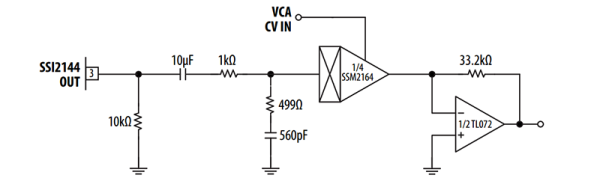
The list of synths and music boxes sporting an SSM2044 reads like a Who’s Who of classic electronic music machines. E-Mu Drumulators, Korg polyphonic synths, Crumars, and even a Doepfer module use this chip in the filter section. The new chip — the SSI2144 — supposedly provides the same classic tone but adds a few improvements such as improved pin layouts, an SSOP package, and more consistent operation from device to device.

This news follows the somewhat recent trend of chip fabs digging into classic analog designs of the 70s, realizing the chips are being sold for big bucks on eBay, and releasing it makes sense to spin up a new production line. Last year, the Curtis CEM3340 voltage controlled oscillator was rereleased, giving the Oberheim OB, Roland SH and Jupiter, and the Memory Moog a new lease on life. These chips aren’t only meant to repair broken, vintage equipment; there are a few builders out there who are making new devices with these rereleased classic synths.