Hackaday Prize Entry: A Very Small Power Grid

If it hasn’t been made readily apparent to you by now, power grids are astonishing marvels of technology and quite possibly one of the greatest engineering feats of history. Learning how these systems work is easy in theory, but in practice you will be shot if you try to screw around with at a power station. [Tim] and [Marissa] figured there must be an easier way to learn about power grids so they made their own. It’s small, but it still has everything you’d find in high voltage power lines, minus a hundred kilovolts or so.

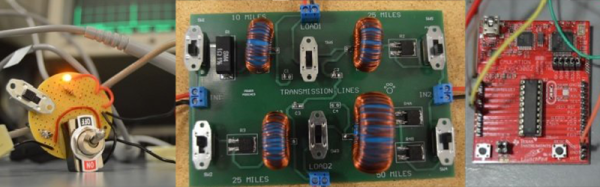
This mockup of a power grid simulates a power plant by taking a normal DC motor and connecting that to an alternator and transformer. This is two of the simulated generation points, with the third AC/AC power supply serving as a reference generator for synchronizing phase and frequency. It’s only 12V at 60Hz, but it gets the job done.

A power grid isn’t power plants – there’s also transmission line theory. For this, [Tim] and [Marissa] have a few boards packed with inductors to simulate power lines. There are boards for simulated loads, and synchronization systems built on the MSP430.

In the video below, [Marissa] goes over all the ins and out of the system. It’s very well made and excellent for teaching something that can’t be demonstrated without a practical example.


The 2015 Hackaday Prize is sponsored by:

Continue reading “Hackaday Prize Entry: A Very Small Power Grid”

Dumping Old PROMs With New Hardware

[ijsf] recently came across a very old synthesizer from a defunct West German company. This was one of the first wavetable synths available, and it’s exceptionally rare. Being so rare, there isn’t much documentation on the machine. In an attempt at reverse engineering, [ijsf] decided to dump the EPROMs and take a peek at what made this synth work. There wasn’t an EPROM programmer around to dump the data, but [ijsf] did have a few ARM boards around. It turns out building a 27-series PROM dumper is pretty easy, giving [ijsf] an easy way to dig into the code on this machine.

The old EPROMs in this machine have 5v logic, so [ijsf] needed to find a board that had a ton of IOs and 5v tolerant inputs. He found the LPC2148, which has a nice USB system that can be programmed to dump the contents of a PROM over serial. Interfacing the PROM is as simple as connecting the power and ground, the address lines, data, and the signal lines. After that, it’s just a matter of stepping through every address according to the timing requirements of the PROM. All the data was dumped over a serial interface, and in just a few seconds, [ijsf] had 32768 bytes of ancient data that made this old synth tick.

Hackaday Prize Entry: A Clock For Alternate Timebases

There is a strange clock in the waiting room of Lord Vetinari, Patrician of Ankh-Morpork. While this clock keeps accurate time overall, the ticks and tocks are out of sync, occasionally missing a tick altogether. The net effect is one of turning one’s brain into a sort of porridge.

Yes, a Vetinari Clock has made its way into The Hackaday Prize. This isn’t a clock that’s random yet accurate over long time spans; this is a complete replacement for run-of-the-mill clock movements you can find at any craft store.

In addition to the Vetinari Clock, [Nick Sayer]’s Crazy Clock can be programmed as a sidereal clock (3m 56s fast per day), a Martian clock (39m 36s slow per day), and a tidal clock (50m 28s slow per day), as well as some ‘novelty’ modes that still have 86400 ticks per day ranging from subtle to ‘clown car’ levels of craziness.

[Nick] is gunning for the ‘best product’ category for the Hackaday Prize, and for that he’s designing a board to be a direct replacement for the board in a Quartex Q80 clock movement. With this new board, [Nick] can replace the electronics in this movement in just a few minutes. Being built around an ATtiny45 means it’s infinitely hackable. A clock with this movement would be a great product, although judging from the video below, not one we would want to be around all day.

The 2015 Hackaday Prize is sponsored by:

Continue reading “Hackaday Prize Entry: A Clock For Alternate Timebases”

Build An Amazon EC2 Gaming Rig

PC gaming is better than console gaming. Now that we’ve said something controversial enough to meet the comment quota for this post, let’s dig into [Larry]’s Amazon EC2 gaming rig.

A while ago, [Larry] bought a MacBook Air. It’s a great machine for what it is, but it’s not exactly the laptop you want for playing modern AAA games on the go. If you have enough bandwidth and a low enough ping, you can replicated just about everything as an EC2 instance.

[Larry] is using a Windows Server 2012 AMI with a single NVIDIA GRID K520 GPU in his instance. After getting all the security, firewall, and other basic stuff configured, it’s just a matter of installing a specific driver for an NVIDIA Titan. With Steam installed and in-home streaming properly configured it’s time to game.

The performance [Larry] is getting out of this setup is pretty impressive. It’s 60fps, but because he’s streaming all his games to a MacBook Air, he’ll never get 1080p.

If you’re wondering how much this costs, it’s actually not too bad. The first version of [Larry]’s cloud-based gaming system was about $0.54 per hour. For the price of a $1000 battle station, that’s about 1900 hours of gaming, and for the price of a $400 potato, that’s 740 hours of gaming.

15 Quadcopters For Hackaday Prize Entries

We’re busy giving away tens of thousands of dollars in prizes for Hackaday Prize entries, and that’s before the contest even ends. Last week, we put a call out for projects with wings, wheels, and propellers, and now we’re doling out some fun Crazyflie 2.0 quadcopters  to the winners. Here’s the lucky winners, in no particular order:

WINNERS OF 15 CRAZYFLYE QUADCOPTERS

Congrats to all the winners.

This week’s contest is for the best human interface, the winners of which will receive laser cutting time through Ponoko. If you need a control panel for all those switches and buttons, this is the contest to get in on. The deadline to enter the Human Interface contest is Thursday, 7/16/15, so:

Good luck, and remember to vote in this week’s round of community voting.


The 2015 Hackaday Prize is sponsored by:

Hackaday Prize Entry: Molded Tracks For Vehicles

There are a lot of robotics platforms out there, and whether for educational use or for robot fightin’ time, two things remain constant: tracks are often the best solution, and there aren’t very many modular track systems that can be used with a variety of designs. There are even fewer that can be built at home. [jupdyke]’s project fixes that. It’s a modular and easy to replicate system for tracked vehicles.

The design for this system of track uses roller chain, chosen because the components of roller chain are mass-produced in incredible quantities, sprockets are available in every imaginable size, and all the parts are available in different materials.

Rolling two chains around a few sprockets isn’t a problem; the hard part of this build is figuring out how to make the actual treads, and then making a lot of them. [jupdyke] is making them by 3D printing a few mold masters and doing a few test prints with silicone and polyurethane rubber. For a one-off project, it’s a lot of work, but if you’re making thousands of tracks, molds are the way to do it.

Continue reading “Hackaday Prize Entry: Molded Tracks For Vehicles”

Hackaday Prize Entry: EyeDrivOMatic

There are a lot of projects in the Hackaday Prize aimed at improving the lives of those of us who are disabled or otherwise handicapped. A good 3D printed prosthetic is a natural idea for the competition, as are projects for the blind and deaf. [Patrick Joyce], [Steve Evans] and [David Hopkinson] are helping a much more debilitating disease: Motor Neuron Disease, or ALS. [Steve] and [Patrick] both have ALS, and they’re working on a project that will use the movement of their eyes to move their wheelchair.

The project began as an idea [Patrick] had a few years ago – why not use commercial eye tracking technology to drive a wheelchair. Eye tracking technology is a reasonably well-solved problem but for some inexplicable reason there are no clear ways to connect this system to a wheelchair.

Over the last few years, [Patrick] taught himself Arduino and Processing to prototype a device that would connect to a computer running an eye tracking tool and to translate this into servo movements. A small 3D printed contraption is connected to the joystick of [Patrick]’s wheelchair, and with just a little bit more code, he can drive his wheelchair around just by looking at a screen. It’s a great use of 3D printing and the humble Arduino, but it’s absolutely impressive this technology hasn’t existed before.

Because [Patrick] can build pretty much whatever hardware he wants, he’s also added a few neat features. The ‘Brain Box’ for this build needs two outputs for servos, but [Patrick] added two more for other purposes. He’ll be mounting a Nerf blaster to the side of his chair, but he also has other ideas of adding a fan, a robot arm, or even IR or RF transmitters; he’ll be able to control his TV with just his eyes.

The 2015 Hackaday Prize is sponsored by: