We Just Gave Away $1000 To A Voter

Last week we issued a challenge to everyone on Hackaday: vote in the Hackaday Prize Community Voting, and someone is going to with a $1000 gift card for the Hackaday Store. How is this going to work? I’m going to find a random person on Hackaday.io, and if they have voted, they win a thousand dollar gift card. If they have not voted, I pick a random person from the set of people who have voted. Too complex? Here’s the video:

The winner of the $1000 Hackaday Prize gift card is [Nolan Moore]. He voted for the most Amazingly Engineered project, and the bits aligned to award him a great gift for participating. The other guy? The other guy should have voted.

A NEW ROUND

Thought this would stop when we finally gave away a thousand dollar gift card? Nope. Right now there’s a new round of community voting. The theme is ‘Best Documented’. All you have to do is choose the project presented to you that is Best Documented. We’re going to let this round stew for a while but on July 17th, at around 2200 UTC, I’m going pick a random person on Hackaday.io. If that person has voted, they get a $1000 gift card. The next time I do this, there won’t be a guaranteed winner; we’re only giving out a gift card if the random person selected has voted. There will, like the other rounds of community voting, be a few consolation prizes distributed to people who have voted if no one snatches the big prize.

So what do you have to do for a chance at winning a $1000 gift card? Click here and vote. Do it now.
Hackaday Prize Entry: Bone Conduction Headphones

Beats headphones are very popular, they’re everywhere, and they sound like trash. That’s a shame, because there’s a century of recorded music out there that sounds really good. [WΛLLTΞCH] forgot about [Dre] and started looking into a better way to listen to music. He came up with bone conduction transducers and started one of the most interesting projects for this year’s Hackaday Prize.

Instead of driving a speaker cone that vibrates the air, passes through the middle ear, and vibrates the eardrum, bone conduction amplifiers bypass the outer and middle ear completely. Not only does this produce a clearer reproduction of sound, but it’s also great for anyone with an abnormality in the ear canal, ear drum, or the tiny bones of the inner ear.

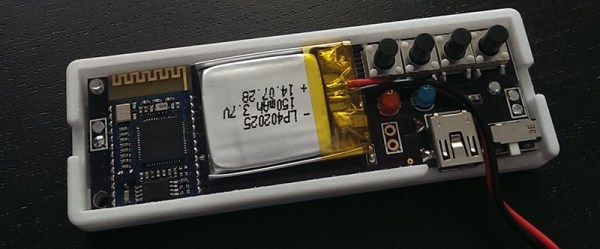
[WΛLLTΞCH]’s first prototype is using a bone conduction amplifier and a cheap Bluetooth module, stuffed into a small 3D printed case. With two 1W transducer modules, it was enough for a proof of concept. The final design is vastly more integrated, with a dedicated Bluetooth audio module. To this, [WΛLLTΞCH] is adding microphones and the ability to take calls over Bluetooth. It’s a great project, and something that could make a great product, something we’re also looking for in this year’s Hackaday Prize.

The 2015 Hackaday Prize is sponsored by:

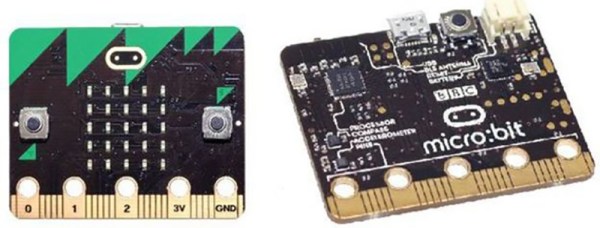
Micro:bit — BBC Gets A Million Kids Into Embedded Dev

In the Early 1980s, the BBC launched a project to teach computer literacy to a generation of British schoolchildren. This project resulted in the BBC Micro, a very capable home computer that showed a generation exactly what a computer could do. These children then went home, turned on their ZX Spectrums, and became a generation of software engineers. Still, the BBC Micro is remembered fondly.

The computer revolution is long over, but today we suffer a sea change of embedded processors and microcontrollers. With Arduinos and Raspberry Pis, the BBC has decided it’s time to put the power of an ARM microcontroller into the hands of a million 11- and 12-year olds. The result is the Micro:bit. It’s a small microcontroller board with an ARM processor, an IMU, buttons, Bluetooth and a 5×5 LED array – exactly what you need if you’re teaching a million kids how to blink an LED.

Although the BBC has finalized the design for the Micro:bit, there are no specs at all. However, a few educated guesses can be made. The USB controller is provided by Freescale, who also provide the digital compass and magnetometer. Programming is done through a web-based, Arduino-like IDE with what appears to be a decent Micro:bit specific library. The board is also mbed compatible. Bluetooth, and apparently the ARM Cortex M0 core, is provided by a Nordic nRF51822. There are only three alligator clip-compatible I/Os, and its doubtful any student will be building anything that would be too complex for an entry level ARM. It’s also 3V logic; finally, the tyranny of 5V has fallen.

The Micro:bit is best seen as a tool that enables the relatively recent addition of a computer science curriculum in UK schools. There is now a requirement for seven-year-olds to understand algorithms and create simple programs. Previously computer education in the UK has consisted of PowerPoint. Now, secondary school students will be learning Boolean logic.

While the Micro:bit is utterly useless as a tool for doing real work, education is not real work. For blinking a few LEDs, having a device react to movement, playing with Bluetooth, and other lesser evils of electronics, the Micro:bit is great. Not everyone will become the digital technologists this initiative is trying to create, but for those who have an inclination towards semicolons and electrons, this is a great introduction to technology.

Hackaday Prize Entry: It’s Like Apple Pay, But For Receipts

There’s Apple Pay, Samsung Pay, Google Wallet, and a host of other ways to pay for stuff with your phone. What about receipts, though? Do you really need to carry around little bits of paper to prove to incredulous friends you have, indeed, bought a donut? The proof is back home, in the file. Under D, for donut.

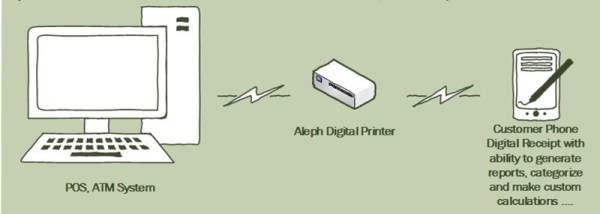
[Hisham] is working on a very interesting system for the Hackaday Prize. It’s effectively the the opposite side of every point of sale transaction that Apple Pay, Samsung Pay, and Google Wallet are working on. Instead of handling payment, [Hisham]’s Aelph handles receipts.

[Hisham]’s project is hardware, with a small device that plugs into a point of sale terminal. This device transmits a receipt to the Aleph app (or a third party app), and uploads a PDF copy of the receipt to a server. Other than a small hardware box, there’s no additional software required for a POS terminal. For retailers, it’s as easy as plugging in a box, and for consumers, it’s as easy as downloading an app.

The hardware was prototyped on a TI LaunchPad featuring a TIVA C microcontroller. This, along with the NFC eval kit give Aleph more than enough power to connect to a company LAN and spit out a few PDFs. You can check out one of [Hisham]’s demo videos below.

There are a lot of benefits to a electronic receipts; if you ever need a receipt, odds are you’ll scan it anyway – a dead tree receipt is just inefficient. There’s also some nasty chemicals in thermal receipt paper. You only need to Google ‘BPA receipt’ for that evidence. Either way, it’s a great idea, and we long for the day that our wallets aren’t stuffed to Costanzaesque proportions, and a time where we won’t need a scanner to complete an expense report.

The 2015 Hackaday Prize is sponsored by:

Continue reading “Hackaday Prize Entry: It’s Like Apple Pay, But For Receipts”

Hackaday Prize Entry: DIY Eye Tracking

Deep in the dark recesses of Internet advertisers and production studios, there’s a very, very strange device. It fits on a user’s head, has a camera pointing out, but also a camera pointing back at the user. That extra camera is aimed right at the eye. This is a gaze tracking system, a wearable robot that looks you in the eye and can tell you exactly what you were looking at. It’s exactly what you need to tell if people are actually looking at ads.

For their Hackaday Prize entry, Makeroni Labs is building an open source eye tracking system. It’s exactly what you want if you want to test how ‘sticky’ a webpage is, or – since we’d like to see people do something useful with their Hackaday Prize projects – for handicapped people that can not control their surroundings.

There are really only a few things you need to build an eye tracking camera – a pair of cameras and a bit of software. The cameras are just webcams, with the IR filters removed and a few IR LEDs aimed at the eye so the eye-facing camera can see the pupil. The second camera is pointed directly ahead, and with a bit of tricky math, the software can figure out where the user is looking.

The electronics are rather interesting, with all the processing running on a VoCore It’s Linux, though, and hopefully it’ll be fast enough to capture two video streams, calculate where the pupil is looking, and send another video stream out. As far as the rest of the build goes, the team is 3D printing everything and plans to make the design available to everyone. That’s great for experimentations in gaze tracking, and an awesome technology for the people who really need it.

The 2015 Hackaday Prize is sponsored by:

Hackaday Links Column Banner

Hackaday Links: July 5, 2015

It’s the fifth of July. What should that mean? Videos on YouTube of quadcopters flying into fireworks displays. Surprisingly, there are none. If you find one, put it up in the comments.

The original PlayStation was a Nintendo/Sony collaboration. This week, some random dude found a prototype in his attic. People were offering him tens of thousands of dollars on the reddit thread, while smarter people said he should lend it to MAME and homebrewer/reverse engineer groups. This was called out as a fake by [Vadu Amka], one of the Internet’s highly skilled console modders. This statement was sort of semi retracted. There’s a lot of bromide staining on that Nintendo PlayStation, though, and if it’s a fake, the faker deserves thousands of dollars. Now just dump the ROMs and reverse engineer the thing.

Remember BattleBots? It’s back. These are my impressions of the first two episodes: Flamethrowers are relatively common now, ‘parasitic bots’ – small, auxilliary bots fighting alongside the ‘main’ bot are now allowed. KOs only count for the ‘main’ bot. Give it a few more seasons and every bot will be a wedge. One of the hosts is an UFC fighter, which is weird, but not as weird as actually knowing some of the people competing.

Ceci n’est pas un Arduino, which means it’s from the SRL camp. No, wait. It’s a crowdfunding campaign for AS200 Industries in Providence, RI.

Wanna look incredibly sketchy? Weld (or braze, or solder) your keys to a screwdriver.

The UK’s National Museum of Computing  is looking for some people to help maintain 80 BBC Micros. The museum has a ‘classroom’ of BBC micro computers still in operation. Caps dry out, switching power supplies fail, and over the years these computers start to die. If you have the skills and want to volunteer, give it a shot.

USA-made Arduinos are now shipping. That’s the Massimo Arduino, by the way.

Win $1000 for pressing a buttonWe’re gauranteed to give away a thousand dollar gift card for the Hackaday store next Wednesday to someone who has participated in the latest round of community voting for the Hackaday Prize.

Hackaday Prize Entry: Controlling Relays Over WiFi

It’s been less than a year since the ESP8266 WiFi Module was released. This is a chip whose original data sheets were only available in Chinese, could only be controlled through AT commands, and was (originally) only sold through Seeed Studio and other various Chinese retailers. It had one thing going for it: it was five dollars. For the price of a crappy sub, you can blink an LED from the Internet. Needless to say, the ESP8266 is now very popular.

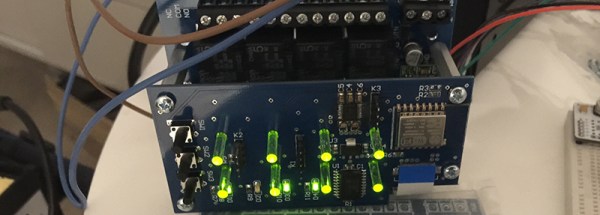
There are a lot of ESP8266 projects in The Hackaday Prize this year, and [David]’s project is making great use of the relatively meager pinout of this module. He’s built an 8-channel relay controller with a WiFi interface to control industrial equipment. It’s a great project, but just of many ESP projects in the prize this year.

The ESP doesn’t have a huge number of pins, but there are enough for some serious work with the right hardware. He’s using the ESP-12 module to get the most pins, and using an SPI port expander to drive an octet of relays. It’s a simple board, but everything you need to control a bunch of relays over WiFi is right there: LEDs, reset buttons, and RS232 level conversion.

You can check out a pair of very satisfying videos of relays clicking below.


The 2015 Hackaday Prize is sponsored by:

Continue reading “Hackaday Prize Entry: Controlling Relays Over WiFi”