Hackaday Prize Entry: Open Source Hydroponic Monitoring System

A few months ago, [Adam] was building a controller system for a small hydroponic system he had set up in his basement. Since then, the Hackaday Prize was announced, and given the theme – saving the world one plant at a time – he’s renvisioning his garden control and monitoring system as a Hackaday Prize entry.

While the mechanical and green part of the build is exactly what you would expect from something designed from hardware store parts, the electronics are rather interesting. All the plants in either a hydroponic or dirt-based setup will have their moisture level and PH monitored by a a set of electronics that push data up to the cloud.

The current hardware setup includes a DyIO, a very cool dev platform with 24 digital I/Os and 24 servo outputs, a Raspberry Pi, and a few module boards loaded up with ARM microcontrollers and an ESP8266. [Adam] is hitting all the hardware on this build.

So far, [Adam] has a few boards sent out to a board fab, including an analog sensor module, a digital sensor module. a WiFi module hub, and a few bits and bobs that make integration into an existing garden or hydroponic setup easier. It’s a great project for this year’s Hackaday Prize, and proof that you don’t need to come up with a new build to submit something.


The 2015 Hackaday Prize is sponsored by:

Hackaday Links Column Banner

Hackaday Links: May 17, 2015

Here’s a worthwhile Kickstarter for once: the Prishtina Hackerspace. Yes, that’s a Kickstarter for a hackerspace in Kosovo. Unlike most hackerspace Kickstarters, they’re already mostly funded, with 20 days to go. If we ever get around to doing the Istanbul to Kaliningrad hackerspace tour, we’ll drop by.

Codebender is a web-based tool that allows you to code and program an Arduino. The Chromebook is a web-based laptop that is popular with a few schools. Now you can uses Codebender on a Chromebook. You might need to update your Chromebook to v42, and there’s a slight bug in the USB programmers, but that should be fixed in a month or so.

Here’s a great way to waste five minutes. It’s called agar.io. It’s a multiplayer online game where you’re a cell, you eat dots that are smaller than you, and bigger cells (other players) can eat you. [Morris] found the missing feature: being able to find the IP of a server so you can play with your friends. This feature is now implemented in a browser script. Here’s the repo.

The FAA currently deciding the fate of unmanned aerial vehicles and systems, and we’re going to live with any screwup they make for the next 50 years. It would be nice if all UAV operators, drone pilots, and everyone involved with flying robots could get together and hash out what the ideal rules would be. That’s happening in late July thanks to the Silicon Valley Chapter of AUVSI (Association for Unmanned Vehicle Systems International).

SOLAR ROADWAYS!! Al Jazeera is reporting a project in the Netherlands that puts solar cells in a road. It’s just a bike path, it’s only 70 meters long, and it can support at least 12 tonnes (in the form of a ‘fire brigade truck’). There’s no plans for the truly dumb solar roadways stuff – heating the roads, or having lanes with LEDs. We’re desperately seeking more information on this one.

Vintage Computers At Maker Faire

It’s no secret that Maker Faire is highly geared toward the younger crowd. This doen’t mean the Faire is completely devoid of the historic; the Bay Area Maker Faire is right in the heart of the beginnings of the computer industry, and a few of the booths are showing off exactly how far computers have come over the last forty years.
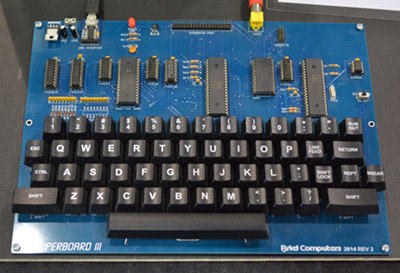
Superboard[Vince Briel] of Briel Computers has a booth showing off his wares, mostly modern reimaginings of vintage computers. His table is loaded up with replica 1s, a board that’s much smaller but still completely compatible with the Apple I. The MicroKIM made an appearance, but the crown jewel is [Vince]’s Superboard III, a replica of the Ohio Scientific Superboard II. It’s your basic 6502 computer with 32k of RAM, but unlike just about every other modern retrocomputer out there, [Vince] put the keyboard right on the main board.

The switches are Cherry MX, the keys are from WASDkeyboards. [Vince] is actually getting a lot of interest in making modern ASCII keyboards to replace the old and busted boards that came in the home computers of the 70s and 80s. That might be a project [Vince] will release sometime in the future.

[Jef Raskin], the Swift Card, and the Canon Cat

[Steve Jobs] may have been the father of the Macintosh, but he was, by no means, solely responsible for the Mac. It was a team of people, and when you talk about the UI of the Mac, the first name that should come up is [Jef Raskin].

One of [Jef Raskin]’s finest works was the Swyft Card, an add-on to the Apple II that was basically just a ROM card that had an OS and Forth interpreter on it. The distinguishing feature of the Swyft card was the use of ‘leap’ keys, a simple way to change contexts when using the computer. We’ve seen replicas of the Swyft card before, courtesy of [Mike Willegal] at the Vintage Computing Festival East.
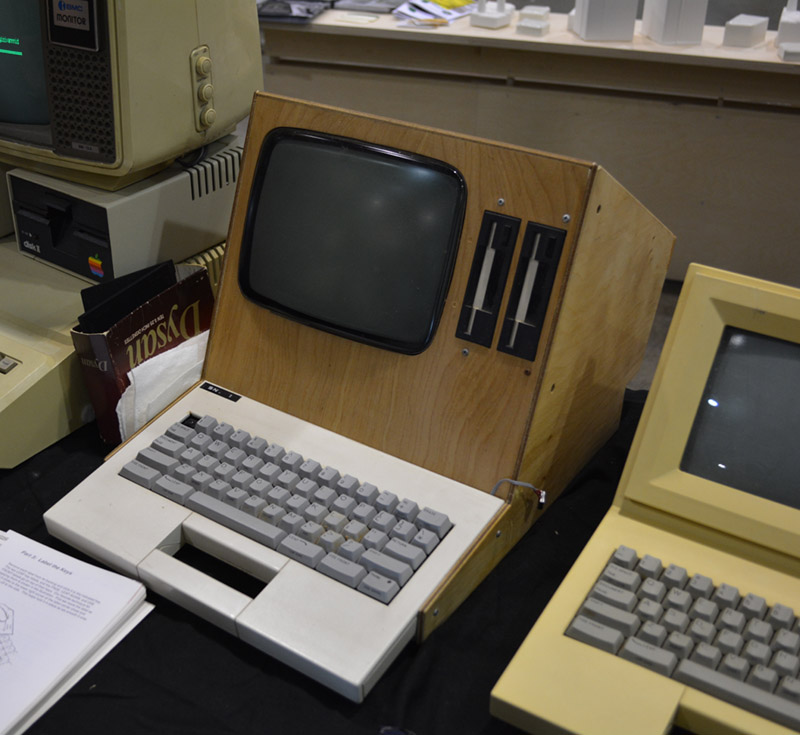
Woodie[Dwight Elvey] of the vintage-computer.com forum brought a few extra special items related to [Raskin] and the Canon Cat. The first was a Swyft card installed in an Apple IIe. The second was a prototype Swyft computer, with SERIAL NUMBER 1 printed on a Dymo label and fixed to the case.

The ‘woodie’, as [Dwight] calls it, has two 1.44 MB disk drives, of which half of the disk is actually usable. [Dwight] didn’t take the machine apart, but I’m 99% sure the CRT in it is the exact same tube found in early 9″ Macs.

Also in [Dwight]’s display is a production Swyft computer and a Canon Cat, the final iteration of [Jef Raskin]’s idea of what a text-based computer should be.

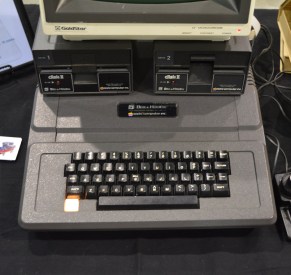
The vintage-computer booth also had a few interesting retrocomputers including a Commodore 128D, the Apple made, Bell & Howell branded Apple II, and an Amiga 2000. Right next door was the Computer History Museum, who brought a very kid-friendly storage medium display. Showing a 10-year-old an 8″ disk is fun.

Hackaday Prize Entry: Multispectral Imaging For A UAV

At least part of the modern agricultural revolution that is now keeping a few billion people from starving to death can be attributed to remote sensing of fields and crops. Images from Landsat and other earth imaging satellites have been used by farmers and anyone interested in agriculture policy for forty years now, and these strange, false-color pictures are an invaluable resource for keeping the world’s population fed.

The temporal resolution of these satellites is poor, however; it may be a few weeks before an area can be imaged a second time. For some uses, that might be enough.

For his Hackaday Prize entry (and his university thesis), [David] is working on attaching the same kinds of multispectral imaging payloads found on Earth sensing satellites to a UAV. Putting a remote control plane up in the air is vastly cheaper than launching a satellite, and being able to download pictures from a thumb drive is much quicker than a downlink to an Earth station.

Right now, [David] is working with a Raspberry Pi and a camera module, but this is just experimental hardware. The real challenge is in the code, and for that, he’s simulating multispectral imaging using Minecraft. Yes, it’s just a simulation, but an extremely clever use of a video game to simulate flying over a terrain. You can see a video of that separated into red, green, and blue channels below.


The 2015 Hackaday Prize is sponsored by:

Continue reading “Hackaday Prize Entry: Multispectral Imaging For A UAV”

Hackaday Wants All Your Bitcoin

Bitcoin, the solution to the two generals’ problem, an economic case study in the history of currency, and the reason AMD graphics cards were so expensive a few years ago, is now accepted in The Hackaday Store.

Yes, we have a store, loaded up with swag, tools, and cool toys. We’re always stocking more  If you have coin sitting around, you can pick up a great little logic analyzer, a 3D printer, an ingenius two channel multimeter, ESP8266 boards, the ever popular Hackaday swag and a ton more. That 3D printer will cost you ฿ 3.75. A Mooshimeter is just ฿ 0.50.

It’s the perfect time to turn magical Internet money into something with real, intrinsic value, before the value of Bitcoin drops even more. Sure, we accept government-backed currency as well… but when will you have the chance to spend those hard-mined dollars hashes?

Live Steam… Chugga Chugga

At Maker Faire this weekend. tucked in between a building full of homegrown foodstuffs and a rock polishing booth is the Bay Area Garden Railway Society (BAGRS). They’re running a few live steam locomotives, and they’re beautiful works of engineering and modeling. None of these trains are electric; they all move by boiling water with either coal or butane. It’s a true, proper locomotive running on 45mm gauge track.

[David Cole] of BAGRS gave me the walkthrough of their booth. It’s a simple oval track that took a solid day to level out. There are technically three sets of tracks, two G-scale, and another O scale sharing a rail with a G-scale track. Each and every one of these locomotives is powered by steam produced when water is heated by either coal or butane. Butane is the fuel of choice because of its ease of acquisition, but BAGRS had a few coal-fired locomotives with tiny shovels shoveling anthracite into tiny fireboxes. After loading up with water and getting the firebox nice and hot, these locomotives will cruise around the oval track for about half an hour, with the speed of the locomotive controlled by a servos and RC gear.

Maker Faire isn’t the headline event for BAGRS; in July 2016 they’ll be hosting the National Garden Railway Convention in San Francisco. If you’re local to the Faire, it will be a cool event to check out.

Hackaday Prize Entry: DC Motor Controller

There are a lot of cheap Chinese CNC machines out there with okay mechanics and terrible electronics. The bearings aren’t complete crap, but the spindle of these CNC machines is a standalone PWM controller with a pot to control the speed. This means you can’t control the spindle speed with LinuxCNC or Mach3.

For his Hackaday Prize entry, [SUF] is building a DC motor controller for a Chinese spindle motor that doesn’t use any kind of encoder. The first part of that project is fairly easy; [SUF] has already built a high current driver. The second bit is a little it harder – because these spindles don’t have an encoder, [SUF] will have to read voltage spikes on the motor poles, giving him the RPM of the spindle. From there, it’s a bit of PID code to get this spindle running at a desired RPM and connecting it to a CNC control box.

So far, [SUF] has a second version of his board waiting for assembly. In the first version of the board, the switching time for the MOSFET was a little slow, but that’s all corrected in the current revision. It’s a great project to extend the capability of these cheap CNC machines, and perfect project for the Hackaday Prize.


The 2015 Hackaday Prize is sponsored by: