Hackaday Links Column Banner

Hackaday Links: May 3, 2015

Everybody loves How It’s Made, right? How about 3D printers? The third greatest thing to come out of Canada featured Lulzbot in their most recent episode. It’s eight minutes of fun, but shame the puns weren’t better. Robertson drives and the Avro Arrow, if you’re wondering.

Speaking of 3D printers, a lot of printers are made of aluminum extrusion. Has anyone tried something like this? It’s an idea that’s been around for a while but we can’t seem to find anyone actually using 3D printed extrusion.

CastARs are shipping out, and someone made a holodeck with retroreflective material. It’s an inflatable dome that’s attached to a regular ‘ol tent that works as a positive pressure airlock. If you’re looking to replicate this, try it with hexagons and pentagons. That should be easier than the orange-slice gores.

For some reason we can’t comprehend, USB ports are now power ports. There’s still a lot of stuff that uses 9 and 12V, and for that there’s the USB 912. It’ll work better with one of those USB battery packs.

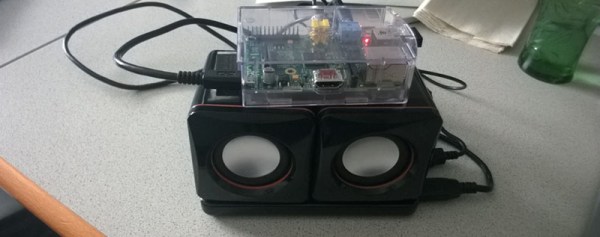
Want to see what the Raspberry Pi 2 looks like with a Flir? NOQ2 has you covered.

Remember the Speccy? In the manual, there was an exercise left to the reader: reproduce [Mahler]’s first symphony with the BEEP command. It took a Raspberry Pi (only for synchronizing several Speccys), but it’s finally done.
ESP8266 WiFi Throwies

A few years ago, someone figured out you can take an LED, a coin cell battery, and a magnet, tape them together, and throw them on every conceivable metallic surface. This was the creation of LED throwies, and the world was much worse off for its invention.

With the ESP-8266 WiFi module, we have a tiny, tiny device with a WiFi radio, and just enough processing power to do something interesting. What does that mean? WiFi throwies.

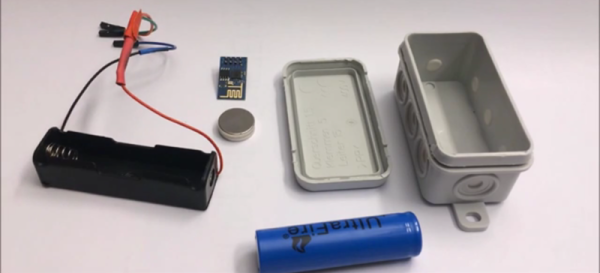
[Andreas Reischle] stuffed an ESP-8266 WiFi module and a lithium cell inside a weatherproof controller loaded up with magnets. On its own, these wouldn’t do much, but with the right combination of software, this little magnetic box can serve as an access point, serving up small JavaScript games to anyone who connects.

The software is based on the NodeMCU firmware and features a web server and a DNS server. The utility of a web server is obvious, and the DNS server redirects all traffic to the device’s index.html file, where a menu of small JavaScript games are presented.

It’s much better than polluting the world with LEDs and lithium; this one has Hunt the Wumpus on it.

Thanks [Oliver] for the tip.

Continue reading “ESP8266 WiFi Throwies”

Hackaday Prize Entry: A Fixation On Nitrogen

The reason we can feed six or seven billion people isn’t GMOs. It’s the massive increase in the use of fertilizers over the past hundred years. Most of the nitrogen-based fertilizers are produced using the Bosch-Haber process, a bit of chemical engineering that consumes one percent of all energy worldwide.

For his entry in the Hackaday Prize this year, [Peter Walsh] is improving the Bosch-Haber process, making the production of nitrogen simpler with less equipment.

The Bosch-Haber process runs at temperatures 400°C and pressures of about 200 atmospheres. Right now, this process is run in huge pressure vessels. [Peter]’s idea is to use ultrasonic cavitation to produce the same environment in equipment that can sit safely on a workbench.

[Peter]’s idea is inspired by sonoluminescence, a phenomenon seen when tiny bubbles in water implode producing light. It’s estimated that pressures and temperatures inside these imploding bubbles reach 2000 atmospheres and 5000°C – more than enough for the Bosch-Haber process. By injecting hydrogen and nitrogen into a machine that creates these sonoluminescent bubbles, ammonia will be created and turned into fertilizers to feed the planet.


The 2015 Hackaday Prize is sponsored by:

An Exceptionally Small UV Sensor

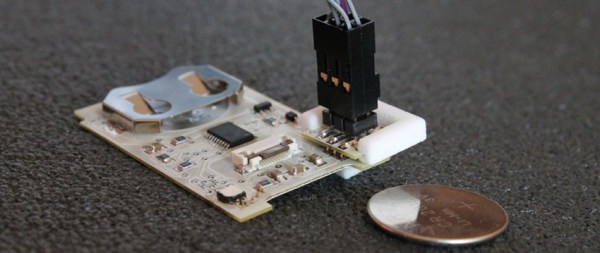
Most of the hacks we see hitting the tip line are exactly that – hacked up hardware projects held together with hot glue and duct tape. [x-labs]’ entry for the 2015 Hackaday Prize, the UV badge, is certainly not one of these projects. It’s a professional one-off, capable of displaying the UV index, temperature, humidity, and pressure in one tiny little enclosure.

The UV badge is designed to be used outdoors. This means any old display ripped from a Nokia phone won’t do; that will wash out in the sun. Instead, [x-labs] is using a very sunlight-readable Sharp Memory LCD. A nice choice, as it’s an exceptionally low-power device.

Inside the 54 x 34 x 7.1 mm 3D printed enclosure is a very thin PCB, and all surface-mount components. The device is powered by a single coin cell battery that should give months of run time.

With a product designed so well, we’re wondering if the UV badge will be in the running for the Best Product category of the Hackaday Prize this year. There aren’t many projects in the running, and the winner gets a enough funding, machinery, and experience to turn their project into a product.


The 2015 Hackaday Prize is sponsored by:

Measuring Temperature On An AVR Without A Sensor

There are a few AVR microcontrollers with onboard temperature sensors. These temperature sensors are neither accurate nor precise, but they do work for a few use cases. [Thomas] came up with a little bit of code that runs on all AVR microcontrollers, and is at least as accurate as the sensors in the rare AVRs that have them.

Although not all AVRs have a temperature sensor, they do all have RC oscillators, and these RC oscillators are temperature sensitive. By combining the RC oscillator and watchdog timer, [Thomas]’ code can get a vague idea if it’s getting hotter or colder.

To prove his code works, [Thomas] took an ATtiny13A chip loaded up with a few bits of code and placed a heated coin on it. The chip was programmed to turn on an LED when it detected a rise in temperature, and predictably, the LED lit up. With a coin chilled in a bowl of ice water, another bit of code ran, flashing the LED.

While we’re sure it’s neither accurate nor precise, it does have its uses – overheating protection or a simple thermostat. You can check out a video of the code in action below.

Continue reading “Measuring Temperature On An AVR Without A Sensor”

Hackaday Prize Entry: BS Free USB

Take a look at some old electronics magazines, or even a few blog posts from 10 years ago, and you’ll notice something strange: parallel ports. Those big ‘ol DB25 were the way to get bits out of a computer and into a microcontroller. There was a reason for this: it was exceptionally easy to do.

Now, we have USB to deal with, and that means VIDs and PIDs, drivers, enumeration, and a whole bunch of cruft that makes blinking an LED a surprisingly complicated process. [Colin O’Flynn]’s project for the 2015 Hackaday Prize aims to fix that with BSU – BS Free USB.

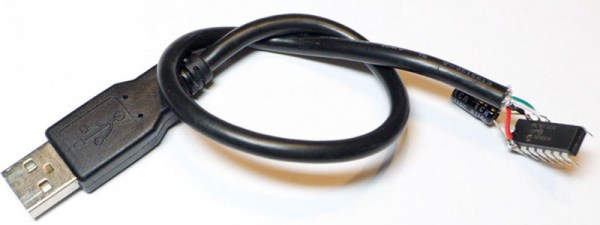
Instead of USB to serial chips attached to another microcontroller, [Colin] is using a few microcontrollers with a built-in USB interfaces. These chips are loaded up with firmware and controlled with a simple API on the computer side. If you want to blink a pin, just add a library to your project and set the pin high. Want some SPI on your computer? That’s just setting a few pins as MOSI, MISO, and SCK and typing in a few bytes. It’s basically a $2 Bus Pirate that you can stick into any project.

If [Colin]’s name sounds familiar in the context of The Hackaday Prize, it’s because he won second place with the ChipWhisperer last year. While a tiny USB thing isn’t quite as cool as a tool to break embedded encryption, the BSU certainly seems more useful to millions of hardware tinkerers around the world.


The 2015 Hackaday Prize is sponsored by:

A Custom, Workshop Squeezebox

Launched over 10 years ago, the Squeezebox was one of the most popular network streaming devices sold. The idea was simple: put some MP3s on a computer, connect the Squeezebox to a LAN, and stream those tunes. Someone at Logitech had the brilliant idea that MP3s and other audio files should be stored in an online service a while back, something that didn’t sit well with [Richard]. He went out and built his own Squeezebox with a Raspberry Pi, out of an ammo box, no less.

Most of the project is based on another Squeezebox Raspi mashup over at Instructables. This was a wall-mounted project, and not encased that keeps 7.62 ammunition secure during transport. It did, however, provide enough information for [Richard] to use in his project.

To make his Squeezebox look a little more industrial and sturdy, he cut a few holes in a NATO ammo can for speakers, a TFT touchscreen display, and a USB charger port. Inside, a pair of powered speakers, a USB hub, and a powerbank were added, making this a portable streaming solution that can take a beating.