The BB-8 Builds Begin

Yes, the new Star Wars film coming out in December has x-wings, dogfights through the engines of star destroyers, space battles, a dead Jar Jar, and [R2D2]. It will also have the coolest droid yet, [BB-8], the rolling sphere protagonist that will surely be sold as a remote control toy by Christmas 2016.

[James] of XRobots doesn’t want to wait until the [BB-8] toys arrive, so he’s building his own. Right now, it’s just a prototype, but it’s the beginnings of the mechanics and control system of a very, very cool droid.

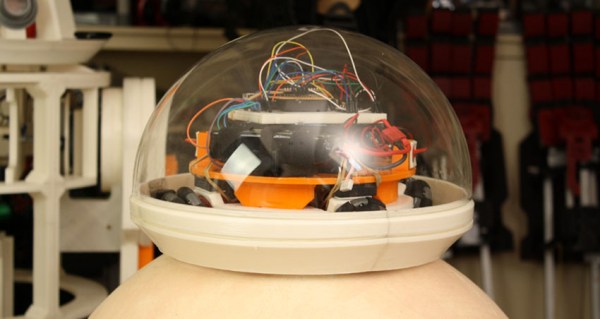
We’ve seen the first BB-8 droid that was basically putting some magnets on a Sphero robot, but this bot doesn’t exactly have the same functionality of the real-life [BB-8]. The real [BB-8] is actually two parts, a remote control ball-body, and a separate remote-controlled head. [James] is focusing on the head for his prototype, replacing the remote-controlled body with a dummy stand in, a big styrofoam ball.

The head of [James]’ [BB-8] is 3D printed, with some especially clever design features. The electronics are just four DC motors, an Arduino, and some motor drivers. In the future [James] will probably be looking at either steppers or servo motors, but for now his [BB-8] bot can stand up straight and serves as a great platform for testing out control schemes.

All the code and parts are available on Github, with some videos below.
Continue reading “The BB-8 Builds Begin”

Tweeting From The NES Expansion Port

[Trapper] is an 80’s kid, and back in the day the Nintendo Entertainment System was his jam. One fateful night, he turned over his favorite gray box, removed a small plastic guard, and revealed the mythical expansion port. What was it for? What would Nintendo do with it?

The expansion port on the NES wasn’t really used for anything, at least in the US market. Even in the homebrew scene, there’s only one stalled project that allows the NES to connect to external devices. To fulfill [Trap]’s childhood dream, he would have to build something for the NES expansion port. Twitter seemed like a good application.

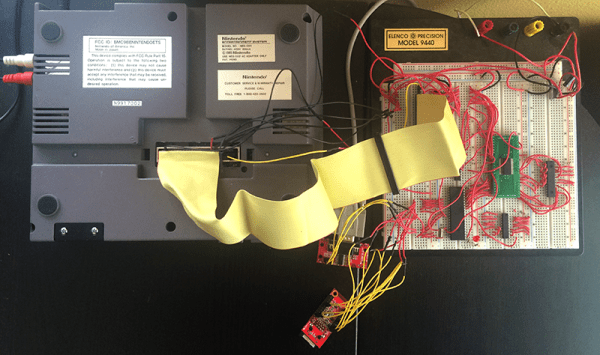
The first step towards creating an NES Expansion Port Twitter thing was to probe the depths of this connector. The entire data bus for the CPU is there, along with some cartridge pass-through pins and a single address line. The design of the system uses a microcontroller and a small bit of shared SRAM with the NES. This SRAM shares messages between the microcontroller and NES, telling the uC to Tweet something, or telling the NES to put something on the screen.

Only a single address pin – A15 – is available on the expansion port, but [Trapper] needed to read and write to a certain section of memory starting at $6000. This meant Addresses A13 and A14 needed to be accessed as well. Fortunately, these pins are available on the cartridge slot, and there are a number of cartridge pass-through pins on the expansion connector. Making a bridge between a few pins of an unused cartridge solved this problem.

From there, it’s just a series of message passing between a microcontroller and the NES. With the help of [Trap]’s brother [Jered] and a Twitter relay app running on a server, this NES can actually Tweet. You can see a video of that below.

Continue reading “Tweeting From The NES Expansion Port”

Strong Little Robots With Gecko Technology

If you need to build a robot to carry something, you need a bit motor, right? Not so with these tiny robots out of Stanford’s Biomimetic Dexterous Manipulation Laboratory. One of these 12g MicroTugs can drag a 600g mug of coffee across a table, or even a 12kg weight. According to the authors, it’s a, ‘capability … comparable to a human dragging a blue whale.’ Square-cube law notwithstanding, of course.

What makes these little robots so strong? It’s not the actuators; it’s their feet. On the bottom of this robot is a material that uses mechanical anisotropic adhesion, a fancy material that only sticks to flat surfaces when it’s being pulled in a specific direction.

The best description of this material inspired by gecko feet would be this video, also from the Stanford BDML lab. It’s a neat material that we’ll probably find in Post-It notes in a decade, and with a single motor, a tiny robot can lift thousands of times its own body weight.

Videos below. Thanks [Adrian] for the tip.

Continue reading “Strong Little Robots With Gecko Technology”

Massive Microsoft Machinations For Makers

If you’re not stuck in the tech news filter bubble, you may not have heard the Microsoft Build Developers Conference is going on right now. Among the topics covered in the keynotes are a new Office API and a goal to have Windows 10 running on a Billion devices in a few years.

There are, however, some interesting things coming out of the Build conference. Windows 10 is designed for hackers, with everything from virtual Arduino shields running on phones, Windows 10 running on Raspberry Pis, and Visual Code Studio running on OS X and Linux.

This is not the first time in recent memory Microsoft has courted the maker market. Microsoft begrudgingly supported the hardware dev scene with the PC version of the Microsoft Kinect, and a year or two ago, Microsoft rolled out drivers for 3D printers that were much more capable than the usual serial interface (read: the ability for printer manufacturers to add DRM). To the true, tie-die wearing, rollerblade-skating, acoustic coupler-sporting, Superman III-watching hackers out there, these efforts appear laughable – the product of managers completely out of touch with their audience.

Depending on your perspective, the new releases for the Arduino, Raspberry Pi, and other ‘maker-themed’ hardware could go one way or the other.

As far as educational efforts go, the Windows Remote Arduino and Windows Virtual Shields for Arduino are especially interesting. Instead of filling a computer lab up with dozens of Arduinos and the related shields, the WVSA uses the sensors on a Windows 10 smartphone with an Arduino. Windows Remote Arduino allows makers to control an Arduino not through the standard USB port, but a Bluetooth module.

If Arduinos aren’t your thing, the Windows 10 IoT preview for the Raspberry Pi 2 and Minnowboard Max is out now. The Win10 IoT distribution does not yet have working WiFi or Bluetooth, making it the single most useless operating system for Internet of Things devices. It was, however, released at the Build conference.

Also announced was a partnership with a fabulous hardware project hosting site, Hackster.io. Microsoft and Hackster.io will be collaborating with hackathons and other events focused on Windows technology. I get why they wouldn’t want another, vastly more popular project hosting site doing this, but I’m a little confused at why Instructables wasn’t the top Microsoft pick.

As always, you may express your infinite derision in the comments below. Spelling Microsoft with a dollar sign will result in a ban.

3D Printering: Laser Cutting 3D Objects

3D printing can create just about any shape imaginable, but ask anyone who has babysat a printer for several hours, and they’ll tell you 3D printing’s biggest problem: it takes forever to produce a print. The HCI lab at Potsdam University has some up with a solution to this problem using the second most common tool found in a hackerspace. They’re using a laser cutter to speed up part production by a factor of twenty or more.

Instead of printing a 3D file directly, this system, Platener, breaks a model down into its component parts. These parts can then be laser cut out of acrylic or plywood, assembled, and iterated on much more quickly.

You might think laser-cut parts would only be good for flat surfaces, but with techniques like kerf bending, and stacking layer upon layer of material on top of each other, just about anything that can be produced with a 3D printer is also possible with Platener.

To test their theory that Platener is faster than 3D printing, the team behind Platener downloaded over two thousand objects from Thingiverse. The print time for these objects can be easily calculated for both traditional 3D printing and the Platener system, and it turns out Platener is more than 20 times faster than printing more than thirty percent of the time.

You can check out the team’s video presentation below, with links to a PDF and slides on the project’s site.

Thanks [Olivier] for the tip.

Continue reading “3D Printering: Laser Cutting 3D Objects”

Hackaday Prize Entry: Building A Car, From Scratch, Out Of Foam

Want an impressive example of what a few people can do in a garage? How about building an electric car, from scratch, starting with a gigantic chunk of foam?

The Luka EV from [MW Motors] had a few project aims: it should be all-electric, naturally, with a top speed of 130km/h or 80mph. It should have a range of over 300km, and it should look good. That last line item is tricky; it’s not too hard to build an electric car, but to make one look good is a challenge.

The design of the car actually started out as a digital file. A large block of foam was acquired and carefully carved into the desired shape. This foam is covered fiberglass, and parts are pulled off this fiberglass mold. This is a great way to do low-volume production – once the molds are complete, it’s a relatively simple matter to build another body for a second Luka EV.

With all the lights, accessories, windows, and trim installed, it’s time to put this body on a chassis. This was welded out of square tube and serves as a test rig that can be independent of the mess of fiberglass. In the chassis are batteries, suspension, motor controllers, and wheels loaded up with hub motors. It works well, even with one motor.

There’s a lot more to this project, including a great guide on building a road legal car in the UK. The team isn’t based in the UK, but it’s a much more friendly environment for ‘small series’ vehicles. The requirements are easy to meet – “have a horn”, for example – but there are a lot of them.

Already the car is beautiful, and that’s just with it sitting on a trailer. We can’t wait to see this thing hit the road.


The 2015 Hackaday Prize is sponsored by:

Teardown: An Electronic Master Lock

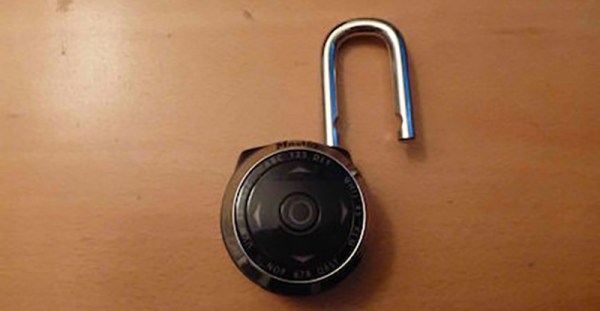
[rohare] has an interesting teardown for us over on the keypicking lock picking forums. It’s a Masterlock combination lock – specifically the Masterlock 1500eXD – and yes, it’s a completely electronic lock with buttons and LEDs. Think that’s the mark of a terrible lock? You might be surprised.

The first impressions of this lock were surprisingly positive. It was heavy, the shackle doesn’t move at all when you pull on it. Even the buttons and LEDs made sense. Once the back of the lock was drilled open, things got even more impressive. This lock might actually be well-built, with a ‘butterfly’ mechanism resembling a legendary padlock, actuated by a small but sufficient motor. Even the electronics are well-designed, with the programming port blocked by the shackle when it’s closed. [rohare] suspects the electronics aren’t made by Masterlock, but they are installed in a very secure enclosure.

The teardown concludes with a fair assessment that could also be interpreted as a challenge: [rohare] couldn’t find any obvious flaws to be exploited, or a simple way to break the lock. He concludes the most probable way of breaking this lock would be, “knowing some trick of logic that bypasses the codes on the electronics”. That sounds like a good enough challenge for us, and we’re eagerly awaiting the first person to digitally unlock this physical lock.