CNC’d And Anodized Ti Engagement Rings

Ti

[Patrick] met someone, and then some stuff happened. Good for him. Because of this, [Patrick] found himself in need of a pair of engagement rings. With a friend, some titanium bar stock, and an awesome lathe, he turned out a few awesome rings and also managed to selectively anodize them with a subtle rainbow of colors.

RingsMaking a ring on a lathe is a relatively simple ordeal, but the two larger rings [Patrick] made (one was for a friend) featured some interesting patterns that aren’t easy to make without a good CNC setup. Luckily, this friend has an awesome CNC with a rotary fourth axis.

With the machining out of the way, [Patrick] then turned to anodization. This was done by constructing a simple power supply with a variac, four diodes, and a big honkin’ cap. He managed to get a good result with a sodium carbonate solution. He doesn’t have any good pictures of it, but by varying the voltage from 20 to 100 Volts, the color of the anodization will change from green, purple, to yellow, to blue.
Blobless Printing With Velocity Extrusion

velocity

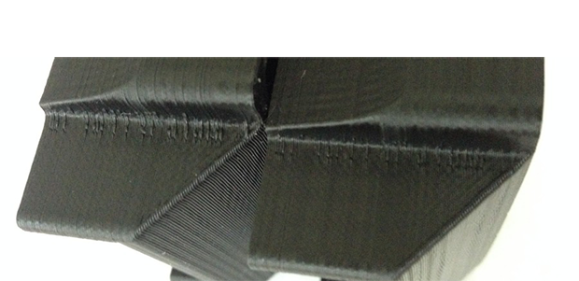
The current crop of 3D printers are technically four-axis machines, with three axes of movement and a fourth for the position of the filament. [Bas] had an entirely different idea – why not link the speed of the extruder to the speed of the nozzle? It turns out this technique gives you more ‘plasticy-looking’ prints and a vast reduction in blobbiness.

[Baz] has been working with LinuxCNC, a BeagleBone Black and the BeBoPr-Bridge cape, and there’s been a lot of development with that system in turning many straight lines into one smooth arc. This led him to adjusting the flow rate of a nozzle while the printer is running, but this is difficult if the extrusion is controlled by position as in a traditional printer setup. A new configuration was in order.

What [Baz] ended up with is a config that calculated the speed of the extruder based on the speed the nozzle is moving over the print surface. This gave him the ability to add live nozzle pressure adjustment, and as a result, a near complete disappearance of the little blobs that appear at the start of each layer.

For a well calibrated machine, it’s only a small difference between the ‘normal’ and ‘velocity’ methods of controlling an extrusion rate. It’s a noticeable difference, though, and one that vastly improves the visual quality of a print.


Reading 2.4GHz Transmitters With An Arduino

QuadThere are a lot of cheap quadcopter kits out there, sold ready to fly with a transmitter and battery for right around $50 USD. One of the more popular of these micro quads is the V2X2 series. They are, unfortunately not compatible with any other radio protocol out there, but [Alexandre] has managed to use the transmitter included with his V202 quad to send data to an Arduino.

Like most quads, the transmitter that came with [Alexandre]’s V202 operates on 2.4GHz. Listening in on that band required a little bit of hardware, in this case a nordic Semiconductors nRF24L01p. Attached to this chip is a regular ‘ol Arduino running a bit of code that includes [Alexandre]’s V202 library.

Right now, the build can detect if the quad is bound or not, and read the current position of the throttle, yaw, pitch, and roll, as well as all the associated trims. It’s just the beginnings of [Alexandre]’s project, but his eventual goal is to build an Arduino bot based on the code, complete with RC servos. Not bad for a transmitter that will be utterly useless when the microquad eventually breaks.

Continue reading “Reading 2.4GHz Transmitters With An Arduino”

Have An Unused DIY Instrument? Send It On Tour With [Imogen Heap]

goofys a dog and plutos a dog but goofy can talk whaaa

[Imogen Heap] is well-known for performing with DIY and cobbled-together instruments, and now she’s teaming up with another famous DIY instrument musician for a world tour. That’s the cool part, now here’s the awesome part: they want to take your DIY musical instrument on tour for a scrapyard symphony.

Both [Imogen] and [Leafcutter] are semi-regular Hackaday features, with [Leafcutter] building hydrophones and [Imogen] doing some crazy stuff turning gestures into music. They’re both known for their strange and esoteric sounds that sends Rolling Stone writers scrambling for a thesaurus, and now they want your disused or discarded music machines to use live on their world tour.

The team is looking for video submissions of any musical creatures you’d like to send around the world. The only real guideline on what they’re looking for is, ‘the weirder the better’, with an apparent slight emphasis on physical machines over the purely electronic.

Video of the duo below.

Continue reading “Have An Unused DIY Instrument? Send It On Tour With [Imogen Heap]”

Barduino, Now With Facebook Integration

Bar

We’ve seen BarBots that will automagically pour you a drink, but how about one with RFID? How about one with Facebook integration, so your friends know how much of a lush you are? Wait. Facebook already tells them that. Huh.

[Andy] and [Daniel]’s latest build follows on the heels of a lot of similar cocktail bots; an Arduino controls a few solenoid valves connected to a CO2 supply and a few bottles of liquor and mixers that allow drinks to be dispensed at the push of the button. Where this project gets interesting is its use of RFID and Facebook.

The user interface was coded for Windows 7, with an RFID tag (ostensibly issued to each guest) allowing a unique login that checks an SQL server to see what privileges the user has. The app pulls the user’s Facebook profile photo down and displays it in the corner of the screen, and with the server keeping track of how many drinks (and of what kind) they had, with the right permissions it should be possible to post that info to their wall. Because we all know what you did last night, even if you don’t.

First Responder Call-In Using Google Voice

fire

Firefighters and firehouses are not as glamorous as your kindergarten self would lead you to believe. Most firefighters in the US are volunteers, and most firefighters don’t live in the firehouse. Instead of hanging out at the fire house all the time, they use a call-in system that displays a list on a web page saying, ‘Joe is coming to the fire house’ or ‘Jack will meet you at the scene’. It’s highly efficient given the budgets they’re working with, but as [Andy] discovered, this same system can be replicated with Google Voice.

The system relies on a Google Voice account that’s set to have all calls go straight to voicemail. The missed call sends off a voicemail notification to the Gmail inbox, effectively turning the Gmail inbox into a call-in system for free.

In testing, [Andy] noticed the Gmail inbox doesn’t quite refresh fast enough for his purposes, so he whipped up a simple webpage with a little bit of PHP to parse the emails and display everything automatically. The idea being that this webpage could just be displayed on a monitor in the station, waiting for the next call.

Another improvement [Andy] points out could be setting up several numbers, each for different status codes. It’s an astonishing simple system, and now something that can be replicated for free.

[Bunnie]’s Laptop Gets A 900MHz Scope Addon

Scope

Now that [Bunnie]’s open hardware laptop – the Novena – is wrapping up its crowdfunding campaign, it only makes sense that development around the Novena project would move over to the more interesting aspects of a completely hackable laptop. The Novena has a huge FPGA on board, with 2 Gbit of very fast memory hanging off it. Also, every single signal pin of the FPGA is broken out on high-speed connectors, making for some very, very interesting possible add-on boards. [Bunnie] has always wanted a portable, high-end oscilloscope to carry with him, and with the new oscope module, he has something that blows out of the water every scope priced below a thousand dollars.

The oscilloscope module [Bunnie] is working on has either two 8-bit channels at 1 GSPS or one 8-bit channel at 2 GSPS with an analog bandwidth of up to 900MHz. The module also has 10 digital channels, so if you need a logic analyzer, there you go.

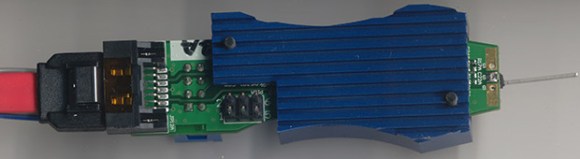
Being a fairly high-end scope, the hardest part of engineering this scope is the probes. The probes for fast, high-end scopes cost hundreds of dollars by themselves, so [Bunnie] looked for a clean-sheet redesign of the lowly oscope probe. To connect the probe to the module, [Bunnie] realized a SATA cable would be a great solution; they’re high bandwidth, support signals in the GHz range, and are rated for thousands of insertions. These active probes can be combined with a number of front ends for application specific probes – digital probes, ones for power signature analysis, and ones for capturing signals across small loops of wire.

The module itself isn’t quite ready for production yet, but by the time the Novena crowdfunding campaign starts shipping, [Bunnie] will probably be working on the next add-on module for his crazy awesome laptop.