Building A Software Defined Radio With A Teensy

[Rich, VE3MKC] has been wanting to get into Software Defined Radio for a while now, but didn’t want to go the usual PC route. He initially thought the Raspberry Pi would be the best platform for a small, embedded device that could manipulate audio, but after discovering the ARM-powered Teensy 3.0, had an entirely different project in mind.

[Rich] is using a SoftRock SDR to take RF from an antenna and downconvert it into the audio range. Doing DSP for SDR is fairly computationally intensive, but he found a Teensy 3.0 with the audio adapter board was more than up to the task.

So far, [Rich] is running the audio from the SoftRock to the Teensy where the audio is digitized and multiplied with a VFO, sent through a filter and then sent to the output of the headphone jack to a speaker. The volume pot on the audio adapter board is used to tune the VFO, something [Rich] be replacing with a proper encoder sometime in the future.

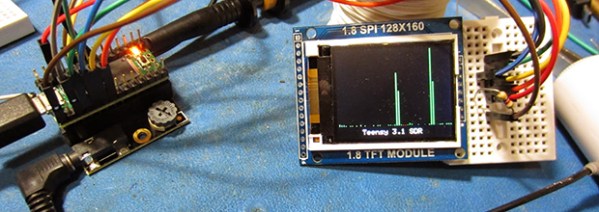
In the videos below, you can see [Rich] listening in on a contest with a tiny TFT display showing everybody on the air. It’s a very cool build, and even though it’s still very early in development, there’s still a whole lot of CPU cycles for the Teensy to do some very cool stuff.

Continue reading “Building A Software Defined Radio With A Teensy”

Sci-Fi Contest Roundup: I Am Iron Man

Back when Iron Man 2 and The Avengers were out in theaters, the Hackaday tip line couldn’t go a week without an arc reactor build being submitted. In keeping with the Internet’s fascination with blinkey glowey things, we expected a huge influx of arc reactors for our Sci-Fi contest. We were pleasantly surprised: all the submissions from the Marvel universe are top-notch, and the two Iron Man entries we have are simply amazing.

Motorized Helmet

1[James Bruton] is working on a replica of the Iron Man movie helmet, complete with a motorized face plate, light up eyes, and an OLED display for a reasonable facsimile of the horribly unrealistic on-screen heads-up display.
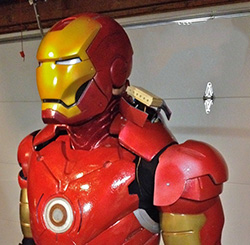
While a few bits and bobs of the mechanics were 3D printed, [James] is making the majority of the helmet just as how the on-screen version was made. The helmet was first carved out of sheet foam, then molded and cast into very strong rigid fiberglass. [James] put up a great tutorial series on how he did this and other parts of his Iron Man costume.

Anamatronic

2The other Iron Man costume from [jeromekelty] and [Greg Hatter] doesn’t stop at just the helmet. They’re doing everything: shoulder-mounted rocket pods, hip pods, forearm missiles, back flaps, and boots with a satisfying electronic kerthunk sounding with every step.

Inside the custom molded suit are at least four Arduinos, four XBees, an Adafruit WaveShield, and at least 20 servos for all of the Iron Man suit components. The mechanics are actuated via RFID with a tag in a glove; when the wearer waves their hand over some part of the suit, one of the mechanical features are activated.

It’s impressive to say the least, and one of the best documented projects we’ve seen in the Sci-Fi contest.

There’s still time to put together your own Sci-Fi project for the contest. Grab your soldering iron and fiberglass resin, because there’s some seriously great prizes up for grabs.


Building EL Displays On A PCB

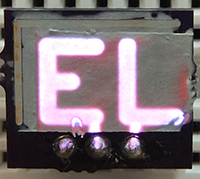
ELElecrolumiscent displays have seen a huge swing in popularity recently, but only in limited forms like EL wire or flat EL panels. You can, of course, cut and bend these wires and panels to suit any purpose, but custom shaped EL displays are just the bee’s knees. They’re not hard to fabricate, either: with cheap custom PCBs, all it takes to make custom EL panels is just a few chemicals.
[Nick]’s method of fabricating custom EL displays uses an exposed copper layer on a PCB you’d pick up from OSHpark or any of the random board houses in China. The process consists of designing a display – be it a few letters, pixels, or a seven-segment arrangement. The display ‘stack’ is a layer of painted-on dialectric, a phospor, and finally a translucent conductive ink that connects the display segments to ground. It looks like an extremely easy process, and from the pictures it looks like [Nick] is making some EL displays of reasonable quality.

[Nick]’s work was inspired by the grand poobah of homebrew electrolumiscent displays, [Jeri Ellsworth], who managed to make a similar EL pixel on a PCB. [Nick]’s display looks great, though, and with a little work some custom segment displays should be very possible.

Digispark Pro, The Bigger Smaller Dev Board

digi

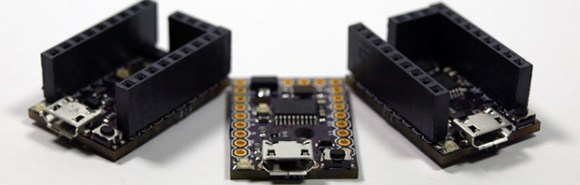
There has recently been a huge influx of extremely small dev board based on the ATtiny85. This small 8-pin microcontroller is able to run most Arduino sketches,  and the small size and low price of these dev boards means they have been extremely popular. The Digispark was among the first of these small boards, and now the creator is releasing a newer, bigger version dubbed the Digispark Pro.

The new board isn’t based on the ‘tiny85, but rather the ATtiny167. This larger, 20-pin chip adds 10 more I/O pins, and a real hardware SPI interface, but the best features come with the Digispark Pro package. There’s real USB programming, device emulation, and serial over USB this time, and the ability to use the Arduino serial monitor, something not found in the original Digispark.

There are also a few more shields this time around, with WiFi and Bluetooth shields available as additional rewards. Without the shields, the Digi Pro is cheap, and only $2 more per board than the original Digispark.


TherMOFOrmer

Mofo

3D printers are the tool of choice for all the hackerspaces we’ve been to, and laser cutters take a close second. There’s another class of plastic manipulating machines that doesn’t get enough credit with the hackerspace crowd – the vacuum thermoformer. Surprisingly, there haven’t been many – if any – vacuum formers on Kickstarter. Until now, that is.

[Ben] and [Calvin] are the guys behind the MOFO, and built their machine around ease of use and reliability. After a few prototypes, they settled on their design of aluminum extrusion for the frame, a ceramic heating element for the heater, and an off-the-shelf PID controller for the electronics.

The MOFO has so far been tested with polycarbonate, acrylic, PETG and styrene with good results. The Kickstarter has reward levels of $500 for a 12″x12″ work area, and $1000 for a 24″x24″ work area. That’s not too bad, and building your own similar thermoformer would probably cost just as much. Just the thing if you need to print out a few dozen sets of storm trooper armor.


Sci-Fi Contest Roundup: Science Nonfiction

Yep, we have a Sci-Fi contest on our hands, with a week to go until entries are due. There are amazing prizes for the best Sci-Fi build, but in the spirit of the Internet, a few teams have elected to put together a science nonfiction project. We won’t hold that against them, because these builds are really, really cool.

Rockin’ bogie, man

rockerFirst up in the ‘real life science fiction’ category is an adorable little rocker bogie robot designed and built by a team at MADspace, the Eindhoven Hackerspace.
A rocker bogie suspension is rather unique in that it can be used to drive over obstacles twice the size of the wheels, has a zero turning radius, and is found on every rover that has ever gone to Mars. The suspension system has articulated rockers on each side of the chassis , with pivoting wheels at each of the four corners of the robot. While this type of suspension can’t go very fast, it can go just about anywhere.

The team loaded up their bot with a Raspberry Pi, a pair of webcams, 20Ah of batteries, gyro, and a web interface. The suspension works beautifully, and most of the parts are 3D printable. Very cool. There’s a pair of videos with this bot in action below.

Spider bot. Just add two more legs.

Hex

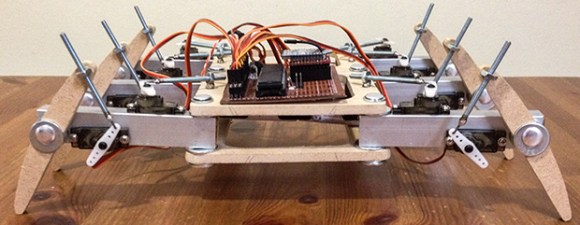
Continuing on with the science nonfiction theme of this post is a cute little hexapod walker reminiscent of designs that have been proposed to visit the moon and asteroids.

This is a rather unique hexapod, controlled entirely with 12 PWM channels on an ATMega1284. Although each leg only has two degrees of freedom (the software has support for 3 DOF, though) the movement is surprisingly smooth. It’s an inexpensive build, too, with 5 gram servos providing all the power to the legs. Video below.

Continue reading “Sci-Fi Contest Roundup: Science Nonfiction”

Need An Idea For Your Next Kickstarter? Check Out This Kickstarter!

META

Kickstarter has become the most powerful force in kickstarting new hardware projects, video games, documentaries, and board games, and now everyone wants a piece of the action. The problem obviously isn’t product development and engineering; you can just conjure that up with a little bit of Photoshop and some good PR. The only you really need for a good Kickstarter is an idea, and META is just the tool for the job. It’s the Arduino-powered Motivational Electronic Text Adviser, the perfect device to generate the next big idea in the world of crowdfunding.

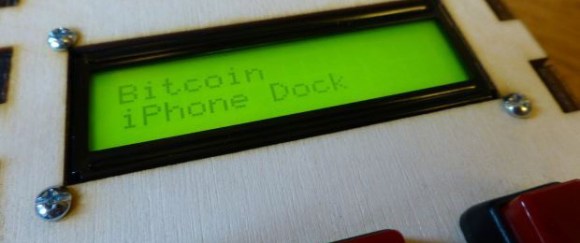
The Arduino-powered META includes three buttons and an Arduino-controlled LCD display. Press a button, and the next big hardware project to wash across the blogs faster than the announcement of a campaign for a $300 3D printer will appear on the screen.

Because META is Arduino-compatible, it’s compatible with existing Arduino sketches. This makes turning the META into the next home automated Bluetooth low energy 4.0 internet of things a snap. Because this is open hardware the laser cut enclosure can easily be upgraded to an RGB LED 3D printer robotic drone bluetooth boombox.

If Kickstarters aren’t your thing, there’s also a cloud-based META that will generate ideas in the mobile app browser cloud. Bitcoin.