I2S Audio And SPI Display With An Ethernet Module

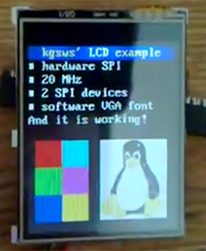
LCD[kgsws] is working on a small project that requires some audio and a display of some sort. While this project can be easily completed with a bigish microcontroller or ARM board, he’s taking a much simpler route: the entire project is built around a cheap router module, giving this project amazing expandability for a very meager price.

The router module in question is the HLK-RM04 from Hi-Link, commonly found via the usual Chinese resellers for about $25. On board this module is a UART, Ethernet, and a WiFi adapter along with a few GPIO pins for interfacing with the outside world.

[kgsws] is using the native SPI pins on this module to control the clock and data lines for the tiny LCD, with a GPIO pin toggling the chip select. I2S audio is also implemented, decoded with an 8-bit DAC, the MCP4801.

It’s an extremely inexpensive solution for putting audio and video in a project, and since this board has Ethernet, WiFi, and a few more GPIO pins, it’s can do much more than whatever [kgsws] is planning next.
HummingBoard, The Vastly More Powerful Raspi

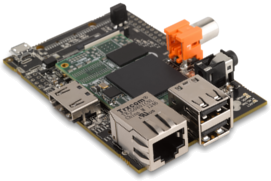
The Raspberry Pi has been around for a while now, and while many boards that hope to take the Pi’s place at the top of the single board ARM Linux food chain, not one has yet succeeded. Finally, there may be a true contender to the throne. It’s called the HummingBoard, and packs a surprising amount of power and connectivity into the same size and shape as the venerable Raspberry Pi.

The HummingBoard uses a Freescale i.MX6 quad core processor running at 1GHz with a Vivante GC2000 GPU. There’s 2GB of RAM, microSD card slot, mSATA connector, Gigabit Ethernet, a BCM4329 WiFi and Bluetooth module, a real-time clock, and IR receiver. There’s also all the usual Raspberry Pi flair, with a 26 pin GPIO connector, CSI camera connector, DSI LCD connector,  stereo out, as well as the usual HDMI and analog video.

The company behind the HummingBoard, SolidRun, hasn’t put a retail price on the board, nor have they set a launch date. You can, however, enter a contest to win a HummingBoard with the deadline this Friday. Winners will be announced in early May, so maybe the HummingBoard will be officially launched sometime around then.

It’s an amazing board with more than enough power to rival the extremely powerful BeagleBone Black, with the added bonus of being compatible with so many of those Raspberry Pi accessories we all love dearly.

[Balint]’s GNU Radio Tutorials

Waterfall

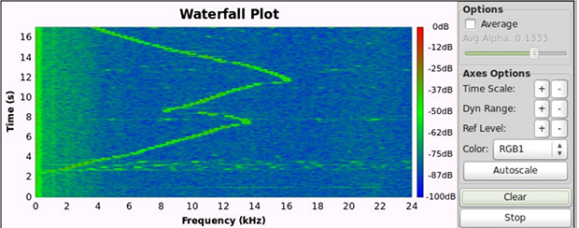
[Balint] has a bit of history in dealing with software defined radios and cheap USB TV tuners turned into what would have been very expensive hardware a few years ago. Now [Balint] is finally posting a few really great GNU Radio tutorials, aimed at getting software defined radio beginners up and running with some of the coolest hardware around today.

[Balint] is well-known around these parts for being the first person to create a GNU Radio source block for the implausibly inexpensive USB TV tuners, allowing anyone with $20 and enough patience to wait for a package from China to listen in on everything from 22 to 2200 MHz. There’s a lot of interesting stuff happening in that band, including the ACARS messages between airliners and traffic control, something that allowed [Balint] to play air traffic controller with a minimal amount of hardware.

Right now the tutorials are geared towards the absolute beginner, starting at the beginning with getting GNU Radio up and running. From there the tutorials continue to receiving FM radio, and with a small hardware investment, even transmitting over multiple frequencies.

It’s not much of an understatement to say software defined radio is one of the most versatile and fun projects out there. [Balint] even demonstrated triggering restaurant pagers with a simple SDR project, a fun project that is sure to annoy his coworkers.

Continue reading “[Balint]’s GNU Radio Tutorials”

Sci-Fi Contest Roundup: The Valve Universe

653px-Source_engine_logo_and_wordmark.svg

While most of the entries to our Sci-Fi contest come from movies and TV shows, a select few are based on the Valve universe, including a few builds based on Portal and Team Fortress 2.

Deadly neurotoxinGLADOS

Who wouldn’t want a gigantic articulated sociopathic robot hanging around? Two groups are building a clone of GLaDOs from the Portal series. and already the builds look really great.

[AmarOk], developed an open-source personal assistant called RORI that intends to be a more helpful version of GLaDOs, without all the testing and killing. He, along with [Peterb0y] and [n0m1s] are turning this personal assistant software into a GLaDOs replica.

Taking a slightly different tack, [Eric] and [jjyacovelli] built a GLaDOs-like robot with a camera in the ‘face’. This camera connects to a Google Glass and tracks the user’s head movements. There’s also a Nerf gun attached to the end of the robot body, triggered by double winking. Yep, it’s a heads-up display GLaDOs, perfect for punishing your test subjects.

Heavy load comin’ through!

Sentry

Not to be out done by a malevolent, hyper-intelligent artificial intelligence, [Tyler] and [Ryan] are building the cutest gat’ dern weapon in all of west Texas. It’s the level one sentry from Team Fortress 2, and the guys are turning one into a paintball sentry.

The TF2 sentry is a cute little bugger capable of motion tracking and perimeter defense, filling enemies with lead should they ever come too close.

While the end result probably won’t be as large or as heavy as the “official” real-life turret, a smaller table-top sized model is probably a little more practical. Even if it doesn’t live up to expectations, upgrading the sentry is simply a matter of whacking it with a wrench a few times.


There’s still time for you to cobble together an awesome Sci-Fi project and have a chance to win some awesome prizes.

Sniping 2.4GHz

A long time ago when WiFi and Bluetooth were new and ‘wardriving’ was still a word, a few guys put a big antenna on a rifle and brought it to DefCon. Times have changed, technology has improved, and now [Hunter] has built his own improved version.

The original sniper Yagi was a simple device with a 2.4 GHz directional antenna taped onto the barrel, but without any real computational power. Now that displays, ARM boards, and the software to put this project all together are cheap and readily available, [Hunter] looked towards ubiquitous computing platforms to make his Sniper Yagi a little more useful.

This version uses a high gain (25dBi) antenna, a slick fold-out screen, and a Raspberry Pi loaded up with Raspberry Pwn, the pentesting Raspi distro, to run the gun. There’s a button connected to the trigger that will automatically search the WiFi spectrum for the best candidate for cracking and… get cracking.

[Hunter] says he hasn’t taken this highly modified airsoft rifle outside, nor has he pointed out a window. This leaves us with the question of how he’s actually testing it, but at least it looks really, really cool.

Sci-Fi Contest Roundup: Stargate

stargate

The 90s were a remarkable time for Sci-Fi movies, in that there actually were sci-fi movies, and not sequels to a reboot of yet another comic book movie. One of the breakout hits from this era was Stargate, the film and three syndicated television series. With a corpus this large, a few Stargate builds made it into our Sci Fi contest, and from the looks of things, they’re pretty cool.

The Ma’Tok Staff

546381397503980641The Ma’Tok staff is an energy weapon used by Jaffa warriors that fires a concentrated plasma bust over 70 yards. While we question the utility of a weapon that’s only accurate to 70 yards on the battlefield (like, arrows are better, man) [frankstripod] is making his own version. Instead of plasma bolts, it’ll be a hairspray-powered PVC potato cannon.
It’s totally not a tricorder

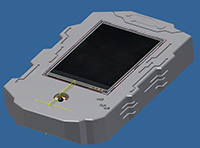
scannerThe Ancients in Stargate Atlantis had a multifunction handheld device capable of detecting life signs, observing multiple frequencies of the electromagnetic spectrum, and finding power sources.  Basically, it’s a smartphone that’s not from Star Trek. This scanner became an important piece of commandeered technology, and these guys are building their own. Qi wireless charging, touch screen, IR transceiver, and everything a real tricorder should be.

Wait. Where did he get Naquadah?

Stargate

What good would a post on Stargate builds be without an actual Stargate? [shlonkin] and [dkopta] are doing just that, complete with a rotating right and light-up chevrons. Here’s a video. Video below, of course.

The Sci-Fi contest runs until the end of the month, so there’s still time for you to get in on the action and get your hands on some really great prizes. We’re giving away O’scopes, soldering stations, dev boards, some sweet Sci-Fi prizes, and awesome Hackaday T-shirts.

Continue reading “Sci-Fi Contest Roundup: Stargate”

The Computer Without A CPU

1bit

[Jeff Laughton] was contacted by a customer that was interested in adding some automated functions to a printing press. Before eventually settling on a microcontroller for the job, [Jeff] went old school and started looking at logic gates, counters, and flip-flops. This lead him to the Motorola 14500 industrial control unit, a minimal processor with only 16 instructions. After a few ‘back of the napkin’ sketches, he came up with an extremely minimal computer that doesn’t use a microprocessor. It’s an interesting design notable not only for its electronic brevity, but also because it only uses one instruction.

The only instruction this computer will ever execute is an input test, the result of which controls a two-way branch. Instructions consist of an input address, output address, and a single bit of data. If the data bit is true, the computer jumps to one location in ROM, and if the data bit is false, a jump to another location is executed.

A computer really isn’t a computer without some form of memory, and this design is no exception. [Jeff] managed to add two bits of data between the 8-bit latch and 8-bit multiplexer in the design. This is enough to call a few subroutines which test the I/O-mapped memory to decide what the next instruction should be.

It’s a truly bizarre design, but actually much closer to a true Turing machine than the computers in your pocket, on your wrist, on your desk, and in your car.

Thanks [James] for the tip!