Giving Toys An Electronic Voice

sound

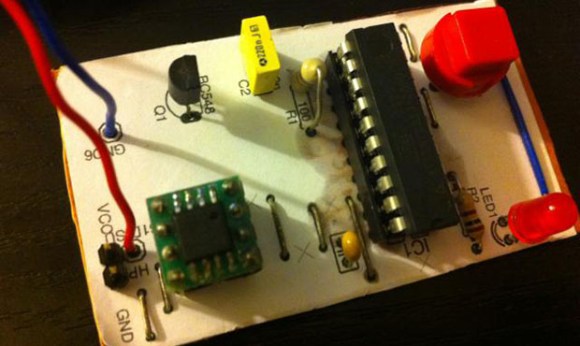
Whether it’s a Furby or Buzz Lightyear’s button that plays, ‘To infinity and beyond’, most digital audio applications inside toys are actually simple affairs. There’s no Arduino and wave shield, and there’s certainly no Raspi streaming audio from the Internet. No, the audio inside most toys are one or two chip devices capable of storing about a minute or so of audio. [makapuf] built an electronic board game for his kids, and in the process decided to add some digital audio. The result is very similar to what you would find in an actual engineered product, and is simple enough to be replicated by just about anyone.

[makapuf]’s game is based on Game of the Goose, only brought into the modern world with electronic talking dice. An ATtiny2313 was chosen for the microcontroller and an AT45D 4 Megabit Flash module provided the storage for 8 bit/8khz audio.

The electronic portion of the game has a few functions. The first is calling out numbers, which is done by playing recordings of [makapuf] reading, ‘one’, ‘two’, ‘three’, … ‘twelve’, ‘thir-‘, ‘teen’ and so on. This data is pumped out over a pin on the ATtiny through a small amplifier and into a speaker. After that, the code is a simple matter of keeping track of where the players are on the board, keeping score, and generating randomish numbers.

It’s an exceptional exercise in engineering, making a quite complicated game with a bare minimum of parts. [makapuf] estimated he spent under $4 in parts, so if you’re looking to add digital audio to a project on the cheap, we can’t imagine doing better.

You can see a video of [makapuf]’s project after the break.

Continue reading “Giving Toys An Electronic Voice”

Learning Letters, Particularly R, F, I, & D

8993376562_55ff3846b3

After [yohanes] picked up a toy at a yard sale – a Leap Frog Letter Factory Phonics – he thought he could do better. The toy originally asked a child to find a letter, and after digging one of 26 plastic characters out of a plastic tub and placing them on the Letter Factory’s sensor, would play a short musical ditty. [yohanes]’ version does the same, but because he made it himself it is infinitely more expandable.

The letters for [yohanes]’ version are RFID tagged. This, combined with a cheap RFID module and a bluetooth module means a Raspberry Pi can read RFID cards from across the room. From there, it’s a simple matter of writing up some Python to ask his toddler for a letter, reading the bits coming from a bluetooth, and keeping score.

The build isn’t over by a long shot. [yohanes] still needs to make his build multilingual by adding Indonesian and Thai. There’s also a possibility of adding a spelling game to make it more interesting.

Open Source PLC

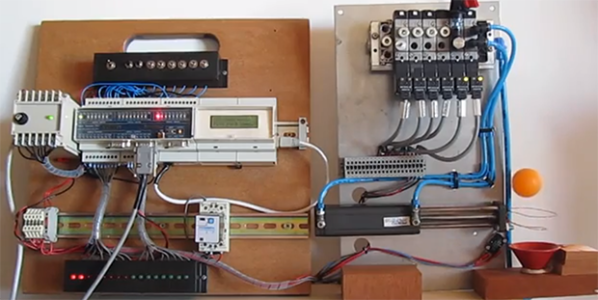
In industrial applications, controlling relays, servos, solenoids, and the like isn’t just a matter of wiring in an Arduino and plugging in some code. No, for reliable operation you’ll need a PLC – a programmable logic controller – to automate all your hardware. PLCs are usually pretty expensive pieces of hardware, which led [Warwick] to come up with his own. He built two versions, one large and one small that can handle just about any task thrown at them.

Both devices are powered by an ATMEL SAM7S ARM chip running at 48 MHz. The smaller of the two devices has 10 digital inputs, 4 analog inputs, and 8 digital outputs able to sink 200 mA each. The larger PLC has 22 digital ins, 6 analog ins, and 16 digital outputs. Both of these devices have a ton of connectivity with USB, RS-232 and RS-485 ports

Below you can see the large PLC being used as a barcode scanner and as a strange device using compressed air to levitate a ping-pong ball. There’s also a demo of the smaller PLC lighting up some LEDs.

Continue reading “Open Source PLC”

Ask Hackaday: Can You Steal A Car With A Mini Tesla Coil?

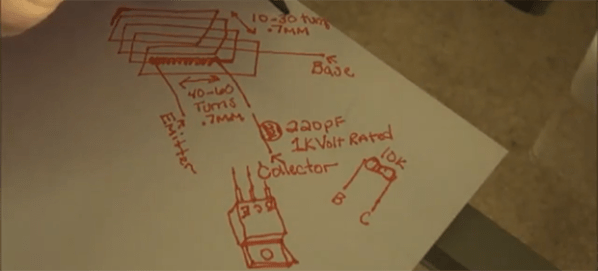
Last week we caught wind of a piece from the Today Show that shows very technically minded thieves stealing cars with a small device. Cops don’t know how they’re doing it, and of course the Today show (and the Hackaday comments) were full of speculation. The top three theories for how these thieves are unlocking car doors are jamming a keyless entry’s ‘lock signal’, a radio transmitter to send an ‘unlock’ code, or a small EMP device touched to the passenger side door to make it unlock.

That last theory – using a small EMP device to unlock a car’s door – got the attention of someone who builds mini EMP devices and has used them to get credits on slot machines. He emailed us under a condition of anonymity, but he says it’s highly unlikely a mini EMP device would be able to activate the solenoid on a car door.

This anonymous electromagnetic wizard would like to open up a challenge to Hackaday readers, though: demonstrate a miniature EMP device able to unlock an unmodified car door, and you’ll earn the respect of high voltage tinkerers the world over. If you’re successful you could always sell your device to a few criminal interests, but let’s keep things above board here.

Wireless Unread Email Counter Tells You How Busy You’re Not

counter

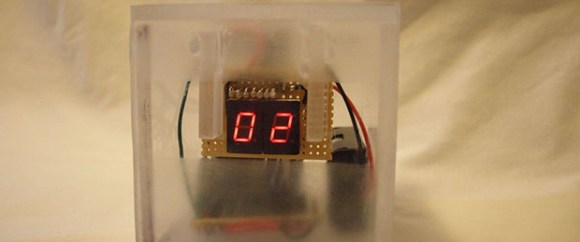
One of the marks of how busy you are – or how well your spam filters are set up – is how many unread emails you have in your inbox. [trumpkin] over on Instructables posted a great tutorial for making a wireless counter that displays the number of unread emails in your Gmail account.

[trumpkin] used a tiny and inexpensive 419 MHz transmitter and receiver combo to make this project work. On his desktop, he wired up a USB to UART bridge attached to the transmitter. For the receiver side, an ATMega328 reads the data coming off the receiver and displays the number of unread emails on two seven-segment displays.

The wireless device runs off of two AA batteries and should provide enough power to keep the email monitor running for a long time. More than enough time for your inbox to fill up and for you to become overwhelmed with the work you should be doing.

3D Mapping Of Rooms, Again

Last year we saw what may be the coolest application of a Kinect ever. It was called Kintinuous, and it’s back again, this time as Kintinuous 2.0, with new and improved features.

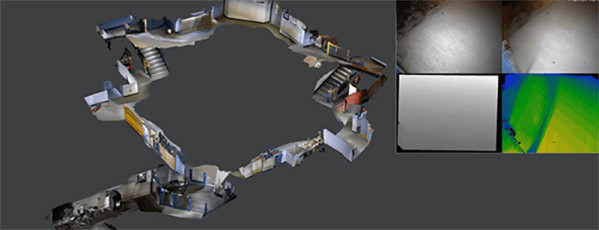
When we first learned of Kintinuous, we were blown away. The ability for a computer with a Kinect to map large-scale areas has applications as diverse as Google Street View, creating custom Counter-Strike maps, to archeological excavations. There was one problem with the Kintinuous 1.0, though: scanning a loop would create a disjointed map, where the beginning and end of a loop would be in a different place.

In the video for Kintinuous 2.0, you can see a huge scan over 300 meters in length with two loops automatically stitched back into a continuous scan. An amazing feat, especially considering the computer is processing seven million vertices in just a few seconds.

Unfortunately, it doesn’t look like there will be an official distribution of Kintinuous 2.0 anytime soon. The paper for this Kintinuous is still under review, and there are ‘issues’ surrounding the software that don’t allow an answer to the if and when question of release. Once the paper is out, though, anyone is free to reimplement it, and we’ll gladly leave that as an open challenge to our readers.

Continue reading “3D Mapping Of Rooms, Again”

No Space In The Garage? Build A Lamborghini In The Basement

lambo


It took 17 years, but [Ken Imhoff] finally got the car of his dreams. This isn’t a, ‘go down to the dealership’ situation. No, [Ken] built a Lamborghini Countach by himself in his basement.

The build process started off by fabricating a wooden frame to which hand-crafted aluminum panels were attached. The frame of the car was welded out of tubular steel, and slowly, over the course of 17 years, a custom Lamborghini Countach took shape.

When the car was complete, there was one problem left to solve – how do you get a car out of a basement? Rent a backhoe and knock out a wall, of course. Replacing a few cinder blocks in a properly reinforced wall is a lot easier than cutting a Lambo chassis in half, it seems.

It’s an amazing piece of artistry that is a testament to [Ken]’s skill in metalworking, welding, and pretty much any other skill we can think of.