Smoothing PLA Printed Parts

We’ve seen a few advances in the finishing processes of 3D prints over the last few months that result in some very attractive parts that look like they were injection molded. Smoothing ABS prints is now a necessary skill for anyone looking to produce professional parts, but those of us using PLA for our RepRaps have been left in the cold. After some experimentation, the guys over at protoparadigm have come up with a way to smooth out those PLA prints, using the same technique and a chemical that’s just as safe as acetone.

Instead of acetone, the guys at protoparadigm are using tetrahydrofuran, or THF, as a solvent for PLA. Other PLA solvents aren’t friendly to living organisms or are somewhat hard to obtain. THF has neither of these qualities; you still need to use it in a well ventilated area with nitrile gloves, but the same precautions when using acetone or MEK still apply. It’s also easy to obtain, as well: you can grab some on Amazon, even.

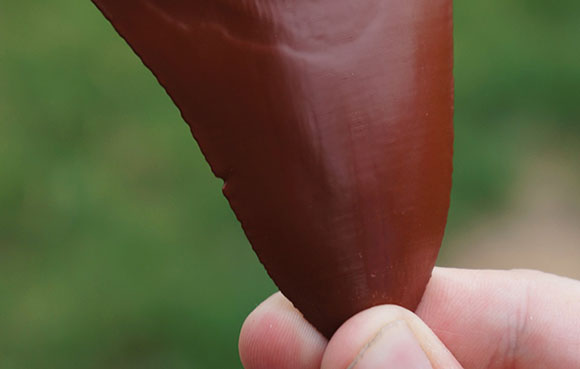
The process for smoothing PLA prints with THF is the same as smoothing ABS prints with acetone. Just suspend the print in a glass container, pour in a tiny amount of the solvent, and (gently) heat it. The evaporated solvent will smooth all the ridges out of the print, leaving a shiny and smooth surface. You can, of course, hand polish it by dedicating a lint-free cloth and a pair of gloves to the task.


Making A Bow From Scratch

bow

With Hackaday’s new handmade category we have the option of covering a wide range of builds – everything from jet engines designed on paper and built on manual machines, to old-world crafts made with the most primitive tools. This time, we’ll be looking at making a longbow from scratch, the work of [Billy Berger], a project that covers everything from selecting a tree to tillering a bow to make the best possible weapon.

European-inspired longbows are usually constructed out of yew, but in [Billy]’s native east Texas yew is a little hard to come by. He eventually selected a small Osage orange tree for his bow, stripped the bark, split the log, and started crafting his handmade bow.

The most important part of making a bow is ensuring the back of the bow consists of only one growth ring. With a drawknife, [Billy] carefully planed down the back of the bow so only one of the tree’s growth rings was visible, then began shaping the belly and sides of the bow.

Wood is a natural material, and when freshly cut contains a lot of moisture. As [Billy] was working on his bow, some of the moisture left his piece of Osage, leading to some twists and turns in the lumber. There’s a solution to this that mankind has been doing for millennia – fire bending the wood. By covering the wood in some sort of animal fat ([Billy] used olive oil), you can hold a piece of wood over a small frame without scorching. Using the crook of a tree as a vice, [Billy] twisted the wood, giving him a perfectly straight bow.

There’s an amazing amount of work that went into this bow, not surprising given that [Billy] is only using hand tools and primitive woodworking methods. Still, the completed bow is a work of art and a masterpiece of craftsmanship. You can check out all four parts of [Billy]’s demo below.

Continue reading “Making A Bow From Scratch”

Hacking High School Exams And Foiling Them With Statistics

graph

A few weeks ago, [Debarghya Das] had two friends eagerly awaiting the results of their High School exit exams, the ISC national examination, taken by 65,000 12th graders in India. This exam is vitally important for each student’s future; a few points determines which university will accept you and which will reject you. One of [Debraghya]’s friends was a little anxious about his grade and asked if it was possible to hack into the board of education’s servers to see the grades before they were posted. [Debraghya] did just that, and was able to download the exam records of nearly every student that took the test.. Looking even closer at the data, he also found evidence these grades were changed in some way.

Getting the grades off the CISCE board of education’s servers was very simple; each school has a separate code, and each student is given an individual number. With the simplest javascript magic, [Debraghya] discovered that individual grades could be accessed by pointing a script to /[4 digit school ID]/[3 digit student ID] on the CISCE server. There was absolutely no security here, an impressive oversight indeed.

After writing a small script and running it on a few machines, [Debraghya] had the exam results, names, and national IDs of 65,000 students. Taking a closer look at the data, he plotted all the scores and came up with a very strange-looking graph (seen above). It looked like a hedgehog, when nearly any test with a population this large should be a continuous curve.

[Debraghya] is convinced he’s discovered evidence of grade tampering. Nearly a third of all possible scores aren’t represented in the data, but scores from 94 to 100 are accounted for, making the hedgehog shape of the graph statistically impossible. Of course [Debraghya] only has the raw scores, and doesn’t know exactly how the tests were scored or how they were manipulated. He does know the scores were altered, though, either through normalizing the raw scores or something stranger and more sinister.

While scraping data off an unencrypted server isn’t much of a hack, despite what the news will tell you, we’re awfully impressed with [Debraghya]’s analysis of the data and his ability to blow the whistle and put this data out in the open. Without any information on how these scores were changed, it doesn’t really change anything, and we’ll welcome any speculation in the comments.

Hackaday Retro Edition Roundup

Retro

The Hackaday retro edition hasn’t been updated in a while, and for that I am very sorry. Still, digging through my email reveals quite a lot of very cool retro computers that were able to load the retro edition over the Internet, and it would be a terrible shame to let these awesome submissions die in my inbox. Without further adieu, here are the best retro computers that have been sent in over the last few months:

[Scott] got his Mac SE to load up the retro edition. This was a chore; after getting a serial connection from his SE to the outside world, [Scott] realized he didn’t have a browser on his retro mac. 800k drives are a pain, it seems. He eventually got everything running in a terminal session, and the retro edition loaded beautifully.

How about another Mac? This one is [Raymond]’s Mac II, the first not-all-in-one Macintosh. NuBus Ethernet card, Netscape 2.02, and 26 years of history behind this machine.

Here’s a weird one: it’s a Siemens interactive display originally used for a building management display. It has a 10 inch touch screen display at 640×480 resolution and runs Windows CE 5.0. After fiddling with some files, [Nick] managed to get the networking running on this machine and tried to load Google. Anyone who has played around with the class of machines we seen for retro submissions knows what happened next (nothing), but luckily [Nick] remembered Hackaday has a retro site. The rest is history.

[Kyle] has a really cool box on his hands. It’s a Compaq 486SX overclocked from 25MHz to 33MHz. 20 Megabytes of RAM, network card, and a Soundblaster 16 make this computer from 1993 a very respectable box for old DOS gaming. It can also browse the web with Arachne.

Finally, [cnlohr], the guy who made his own electron microscope  never mind, he’s still awesome and can manufacture glass PCBs at home, found an old green screen CRT while cleaning out a friend’s place. He hooked it up to one of his glass PCB AVR microcontroller things and did the usual text terminal fare; ASCII Star Wars with telnet and using lynx to load up the retro site. It’s only a 48-column display, but the retro edition is surprisingly readable. Very cool.

Raspi Internet Radio With Google Music

SAMSUNG

It’s not his first Internet radio, but [Matthias]’ modernization of a classic Bakelite radio is a real, functional piece of art. Not only does it retain the look of an old radio, it also has the capability to listen to streams and his entire MP3 collection through the Internet.

For the software, [Matthias] used jquery to pull down web radio streams and soon figured out how to play all his MP3s through Google Music. This, and a web-based remote for his mobile device, allows the new old-school Internet radio to play everything [Matthias] would ever want to listen to.

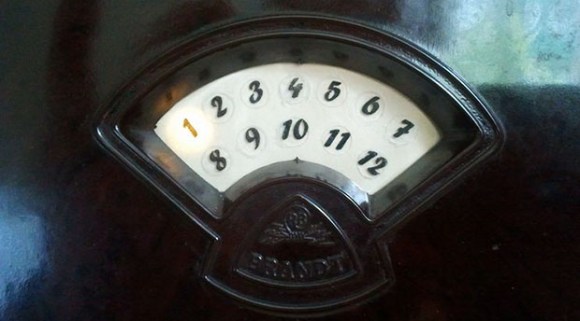
The controls for the radio are rotary encoders, with indication provided by a really fabulous numbered LED display (seen above) replacing the 70-year-old tuning dial. These numbers indicate both the current Google Music playlist or the currently playing Internet stream, depending on what mode the selector knob is at.

It’s a beautiful piece of work, and the knobs and dials look like something that could have come from a real 70-year-old radio. That’s a win in our book.

A Very Tiny Gamma Ray Detector

gamma

When you think of a radiation detector, you’re probably thinking of a Geiger tube and its high voltage circuitry. That isn’t the only way to measure gamma radiation, though, and [Alan] has a great circuit to measure even relatively weak radiation sources. It uses a very small photodiode, and draws so little power it’s perfect for projects with the smallest power budgets.

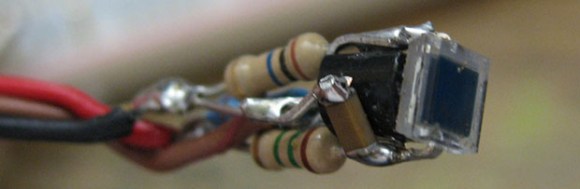
The detector circuit uses a miniature solar cell and a JFET wired up in a small brass tube to block most of the light and to offer some EM shielding. This, in turn, is attached to a small amplifier circuit with a LED, Piezo clicker, and in [Alan]’s case a small counter module. The photodiode is actually sensitive enough to detect the small amounts of gamma radiation produced from a smoke alarm americium source, and also registers [Alan]’s other more powerful radioactive sources.

The circuit only draws about 1mA, but [Alan] says he can probably get that down to a few micoAmps. A perfect radiation sensor for lightweight and low power applications, and gives us the inspiration to put a high altitude balloon project together.

The Thinnest Xbox Laptop Yet

box

With every generation of consoles, there comes a time when the price of a new box is cheap enough, and used machines are plentiful enough, that console hackers pull out all the stops before the next generation arrives. For the Xbox 360, that time is now, and with no PS1-like hardware revision on the horizon, it looks like [jhax01]’s custom Xbox 360 laptop might be the smallest Xbox casemod we’ll see for a very long time.

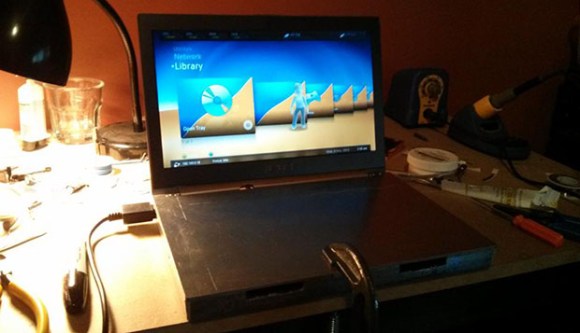
[jhax01] was inspired by the work of [Yung Jeezus] and [AllYourXboxNeeds]’ YouTube channels and decided to craft his own custom enclosure for an Xbox 360 slim. The case was made out of aluminum plate cut with a simple angle grinder and bent on a cheap 18″ Harbor Freight brake. Despite these extremely simple tools, [jhax01] managed to fabricate a case that’s right up there with the masters of Xbox laptop craftsmanship.

The CD drive was ditched along with plans for a second hard drive. The display’s enclosure and hinge comes from an ASUS Zenbook, hence this project’s eponym, the ZenBox. The panel from the display was discarded and replaced with one that would work with the LVDS converter [jhax] found, giving the laptop a resolution of 1366×768.

It’s an amazing piece of craftsmanship, and an impressively thin gaming console to boot. Throw in a battery, and we’d be more than happy to carry this one around with us.