Adventures In Mold Making And Making Your Own Enclosures

case

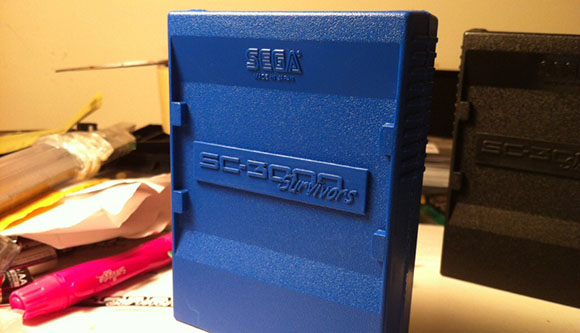
The folks at SC-3000 survivors have been working on a cartridge capable of storing dozens of games for the ancient Sega SC-3000 computer. The PCB works beautifully, but making a case for their cartridge left them with few options. They could use a 3D printer or simply collect a whole bunch of used cartridge cases, but making their own mold for a cartridge case was the best solution.

To create the mold for their multicart enclosure, the SC-3000 survivors first took an old, used case and made a silicone mold. While the first attempt at mold making was encouraging, several problems began to crop up due to the lack of vent holes and wiggling the mold before the resin had set. Before long, a proper technique to make resin casts was developed: use lots of resin, and don’t apply pressure or rubber bands to a curing mold.

We’re always impressed by what can be done with a few sheets of plastic, some Bondo, and the inordinate amounts of patience and sandpaper we see with other case mods and enclosure builds. the SC-3000 survivors put together an enclosure that rivals any Bondo build, and we’re happy they put out this tutorial.
A Thermal Imaging Camera For Your Phone

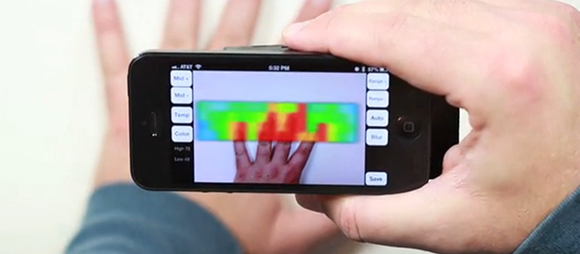
When last we heard of a cheap thermal imaging camera accessory for any smart phone, we were blown away at how easily a very expensive electronic device could be replicated with an Arduino and enough know how. Now, that thermal imaging camera is a kickstarter project and provides a cheap way to put a thermal imaging camera in the tool chest of makers the world over.

It’s called the IR-Blue, and simply by connecting your phone to the IR-Blue with Bluetooth, you can overlay the output of a thermal imaging camera on the output of your camera’s phone.

The thermal imaging sensor is basically a low-resolution camera (16 x 4 pixels) for infrared radiation. This sensor is factory calibrated to detect heat in a range between -20 and 300 ˚C. This range allows anyone to easily see where drafts in a house are coming from, where heat in a computer is being generated, or figuring out how to cook a steak.

It’s an awesome and well designed product, so we’ve got to hand it to [Andy] and the IR-Blue team for putting very expensive tools in everyone’s hands.

IFF System Keeps You From Shooting Your Friends

IMU

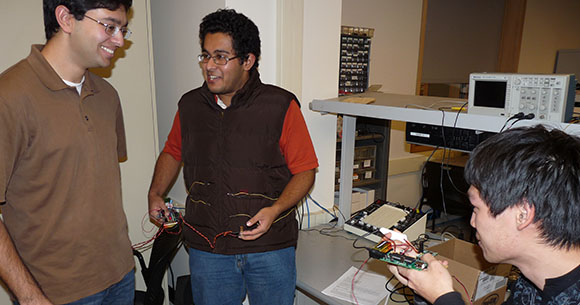
An IFF system – Identification of Friend or Foe – are used by military aircraft in battle situations to determine if another aircraft is being piloted by a fellow aviator or an enemy. For the boots on the ground, friendly fire is generally regarded as a very bad thing, so a few students in [Bruce Land]’s ECE 4760 class at Cornell decided to make a wearable version of an IFF for their final project.

[Wen Hao Lui] and [Aadeetya Shreedhar] broke their project down into two parts: an initiator unit and a receiver unit. The initiator unit sends an encryption key to the receiver unit which, in turn, replies back to say, ‘don’t shoot.’ [Wen] and [Aadeetya] needed to choose between using RF or laser-based communications for the initiator, but the difficulty in acquiring or building a radio antenna with the requisite directionality made a laser the obvious choice.

The receiver unit has eight phototransistors attached to a vest and will reply to the initiator unit via a Wi.232 radio module when the laser illuminates the phototransistors. In the event of an enemy acquiring one of these vests, the project includes a pulse detection circuit that will erase the encryption keys when the wearer’s pulse drops to zero. A bit morbid, but the video after the break sure makes it look cool.

Continue reading “IFF System Keeps You From Shooting Your Friends”

Almost Building An Engine From Hardware Store Parts

engine

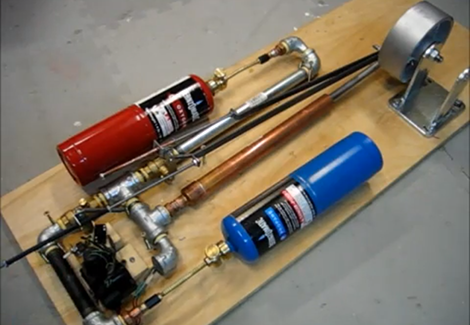
You can build a surprising amount of stuff from parts you can pick up at a hardware store. Sometimes, though, getting a project built from sections of pipe is very, very difficult. That’s the case with [Lou]’s hardware store engine: despite an inordinate amount of cleverness, he just can’t seem to get an engine made from pipe fitting to work and is now asking for some ideas from other ingenious makers.

The engine uses regular oxygen and propane tanks you can pick up at Home Depot with torch heads soldered onto half inch pipe. The fuel and oxygen are mixed in a T fitting until a grill igniter sets the gas mixture ablaze pushing a cylinder down the length of a copper pipe. The cylinder is attached to an aluminum flywheel that also controls the opening and closing of the oxygen and propane valves as well as switching the grill igniter on and off.

Right now, [Lou] can get the engine running, but only for one stroke of the cylinder. He’s having a bit of a problem turning this into a working motor. If you’ve got any idea on how to make [Lou]’s engine work, drop a line in the comments. We’ll throw our two cents in and say he needs a valve on the exhaust, but other suggestions are always welcome.

A Pair Of N64 Portables

portables

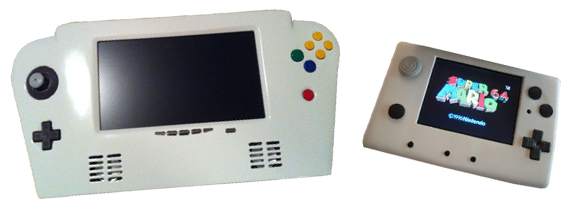
Casemodding has moved far beyond the old portabalized Ataris and NESes of only a few years ago. Now, the new hotness is more modern consoles including the GameCube, Dreamcast, and the venerable N64. Two N64 case mods rolled into our tip line over the past few days, and we can’t think of a better display of case fabrication and console modification than these two.

First up is [Travis]’s N64 handheld. The case was constructed out of a sheet of ABS plastic with Bondo used to make everything sleek and smooth. There’s a 7″ display in this handheld as well as two LiIon batteries able to provide up to three hours of play time. The fit and finish on this build is spectacular, a testament to [Travis]’ patience and Bondo skills.

Next up is a very very tiny build claiming to be the smallest N64 portable. It’s the work of [bud] and is barely larger than an N64 cartridge. Inside is a 3.5 inch screen and enough LiPos to provide about 2 hours of gaming time. Unlike other (larger) builds, [bud] put the cartridge slot on the outside of the case allowing the cartridge to stick out at a 90 degree angle.

Both very awesome builds that really show off what can be done with a lot of sanding and body filler. You can check out the videos for each casemod after the break.

Continue reading “A Pair Of N64 Portables”

Converting A Chinese Laser Cutter To Work With Mach3

laser

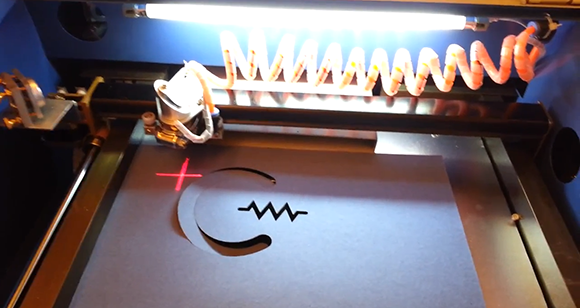
Like most of us, [Chris] has pined over the very, very inexpensive Chinese laser cutters available on eBay for a while now. When most of us disregarded these machines due to their inability to work with the file formats commonly used with laser cutters, [Chris] took the plunge. He was a might disappointed the included software didn’t allow him to use his machine with Mach3 CNC software, so he replaced the included electronics board with one of his own design, giving him all the features of a more expensive laser cutter at a low, low Chinese eBay auction price.

The laser cutter [Chris] bought came with the moshidraw software and controller board that according to one auction can only use BMP, JPEG, WMF, EMF, and PLT files.Wanting a board that can use more common file formats such as PDF and DWG, [Chris] built his own board to communicate with his Mach3 software.

From what we can tell, the new board works with off-the-shelf Pololu stepper drivers and is a complete drop in replacement for the moshidraw board. He’s still finalizing the design, but when the layout, BOM, and schematic are finalized, [Chris] will be putting the files up for everyone to copy. Wonderful piece of work, [Chris].

Continue reading “Converting A Chinese Laser Cutter To Work With Mach3”

Arduino Esplora Makes A Great Controller

duino

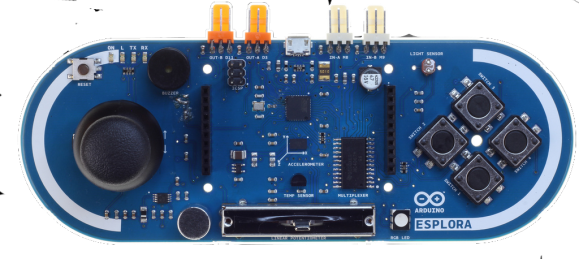
The folks at Arduino seem to be stepping up their game. With the new Arduino Leonardo board able to emulate USB keyboards and mice right out of the box, it seems the perfect time for Arduino designers to come up with a proper video game controller. This new board is called the Arduino Esplora and packs enough buttons and sensors inside to capture just about any user input you can imagine.

On board the Esplora is the same ATMega 32U4 microcontroller found in the newest Arduino boards. For input, the designers included an analog joystick, four tact switches, a linear pot, a microphone, and light sensor. The Esplora also includes a three-axis accelerometer, RGB LED, buzzer, and a breakout for an SPI-controlled TFT LCD display, lest you would want to recreate something like the new Wii U controller on your own.

You can check out everything the Esplora can do over on the official Arduino site for the Esplora library.