Electromagnetic Harp With Home Made Ebows

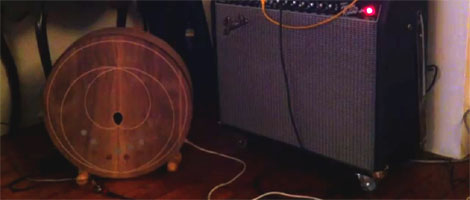
Fresh from the Arduino subreddit comes [dataplex]’s 26 string electromagnetic harp. It’s a very cool, ambient instrument that sounds simply phenomenal through the Space Echo and Fender Twin rig [dataplex] has.

There’s not much in the way of build details, but judging from this post [dataplex] made several months ago the instrument works on the same principles as an Ebow. There’s a great prototype video showing the hardware and software. One small voice coil reads each string. A tiny op-amp sends this to another voice coil and back into the string. There’s tons of feedback, but it’s great for an ethereal ambiance.

The prototype is controlled by an Arduino via a computer, but for the final build [dataplex] moved on to a copper/zinc touch interface on the front of the harp.

It’s a very, very cool instrument and we’re waiting patiently for the build details to be released. You can check out the videos of [dataplex]’s work after the break.

Continue reading “Electromagnetic Harp With Home Made Ebows”

Music Visualization Generator With A Propeller

The folks over at Gadget Gangster have been working on a music visualization system using a Parallax Propeller. The visualizations are awesome in their early-90s demoscene way, and of course we love anything using the oft under-appreciated Propeller.

The project is called Video Beats and it generates music visualizations in the style of a blocky but very complex Atari 2600 game. There’s really not much to the build – just two RCA jacks for the audio input and video output along with a couple of resistors – but we do appreciate how nicely this project would fit in at a chiptunes show.

The Gadget Gangster team says the input isn’t limited to just audio – a potentiometer, accelerometer, or even a light sensor can be added to the build for a more dynamic output. After the break, you can see the demo of Video Beats, and a [Family Sohn] music video that used an early version of this circuit.

Continue reading “Music Visualization Generator With A Propeller”

Robotic Light Painting In 3D

For the last few months, [Ben] has been building a 3D light painting robot. Instead of a couple Arduino-controlled LEDs that a person moves around the Lightplot, as [Ben] calls it, uses a robotic arm to move a LED in 3D space.

The build started with [Ben] testing his idea by putting a laser pointer on an altitude and azimuth mount made out of LEGO. Eventually [Ben] decided to build a 3D plotter rig for a more impressive show. The 3D plotter sits in on a tripod with three axes of motion – up and down, clockwise and counterclockwise, and ‘in’ and ‘out’. A small RGB LED at the end of the robotic arm is controlled along with the servos and motors, making it possible to plot vector lines in 3D space.

There are a whole bunch of demo videos after the break. They look fantastic, but we’d really like to see the Lightplot be used outside on a dark, starry night.

Continue reading “Robotic Light Painting In 3D”

An Excellent Introduction To Transmission Lines

[Bertho] sent in a great tutorial on terminating transmission lines. If you’ve ever tried to send a high frequency signal a long way down a wire, you know the problems that can crop up due to electronic strangeness. Luckily [Bertho]’s tutorial explains just about everything, from where and when to terminate a cable and why signals get screwed up in long wires.

[Bertho] begins his lesson by taking two oscilloscopes and 20 m of CAT5 cable with the twisted pairs wired in series to make an 80 meter long transmission line. A ~100kHz square wave was sent down the cable after being displayed on the first oscilloscope, and picked up on the other end by the second oscilloscope. It’s a great way to show the changes in a signal over a long cable run, and how small changes in the circuit (just adding a simple resistor) can affect the signal coming out of a cable.

It’s a great post that demystifies the strange electrical gremlins that pop up when you’re running a length of wire. Great job, [Bertho].

Building Main Street, USA In A Coffee Table

[Alex George] has been collecting miniatures of Main Street, USA in Disney Land hand crafted by artist [Robert Olszewski]. These models are incredibly accurate, but sadly static. [Alex] has some of the floats from the Main Street Electrical Parade that light up with the help of a few LEDs. One day, [Alex] found himself wishing he could watch a miniature parade circling around his diorama and did what any of us would do: make a tiny electrical parade move around his miniature town.

[Alex] began his build by designing a system of chains and sprockets underneath his miniature Main Street. When not on display, the parade floats are hidden underneath the town. At night, though, the parade ascends to the surface to put on a show.

It’s not an electrical parade if there aren’t any lights, so [Alex] grabbed a couple Blinkms to attach to the underside of each float. These are small programmable RGB LEDs that can repeat the same sequence of lights for the entire time the parade is visible. A very excellent job and a masterwork of craftsmanship for both [Alex] and [Robert Olszewski].

[Alex]’s ‘making of’ video and a full demo of the float are available after the break.

via boingboing

Continue reading “Building Main Street, USA In A Coffee Table”

Two Saxophone Synthesizer Builds For The Price Of One

[Bruce Land] has been sending in student projects from the electronic design course he taught at Cornell last semester. By a curious coincidence, two groups build saxophone synthesizers with the same key arrangement as a real sax.

First up is [Brian Wang]’s digital sax. There’s a small microphone in the mouthpiece and a series of buttons down the body of the sax telling the ATMega664 what note to play. The data for the saxophone synthesis was created by looking at a frequency plot of a sax, bassoon, harp, and pipe organ. [Brian] has the synthesis part down pat; there’s definitely a baritone sax in that little microcontroller.

Next up is [Suryansh] and [Chris]’s PVC pipe saxophone. It’s the same general principle as [Brian]’s project – the musician blows into the sax (we really like the kazoo mouthpiece) and a small mic picks up the sound of the wind. If the microphone output is above a certain threshold, the buttons are read and a note come out of the sax. We’re picking up a whiff of alto sax here; shame there wasn’t a duet with the two teams.

After the break you can see both saxophone projects in all their glory.

Continue reading “Two Saxophone Synthesizer Builds For The Price Of One”

Turning Anything Into A Touch Sensor

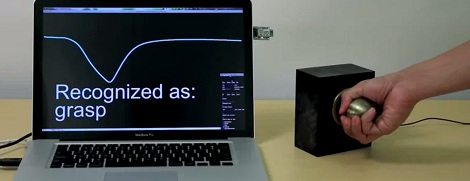
This year at the CHI conference in Austin, [Munehiko Sato], [Ivan Poupyrev], and [Chris Harrison] out of the Disney research lab in Pittsburgh demonstrated their way to make touch sensors out of anything. Not only to they suggest using the surface of your skin to control cell phones and MP3 players, they’re also able to recognize touch gestures, like poking or grasping an object. That sounds a little heady, so check out the video of the Touché tech in action.

Like the capacitive touch sensors in our phones and tablets, Touché measures the rise and fall of a capacitor’s charge over time. Unlike  other touch sensors, Touché scans the capacitor at different rates, allowing for a ‘capacitive profile’ that is used to recognized touch gestures.

The applications for this tech are nearly innumerable; the team demonstrated scolding someone for eating cereal with chopsticks (yeah, we know…), an on-body music player interface, and gestures for an office doorknob that notifies passersby if you’ve stepped out for a minute or are gone for the day.

It’s a very interesting build, and we give it two weeks until someone replicates this build. We’ll be sure to post it then.

Continue reading “Turning Anything Into A Touch Sensor”