Improving A Freestyle Kayak

When [Andrea] was looking for a freestyle kayak, he bought the cheap version of a high-end kayak. The hull is exactly the same as the high-end model, but to differentiate between product lines, Pyranha chose to use less expensive fittings. [Andrea] decided to bring his new kayak up to spec (Italian, here’s a Google translation) by fixing the problems in the cheaper model by bringing it up to more professional standards.

When [Andrea] got a hold of his kayak, the back rest was held on by a piece of nylon webbing secured with a plastic clamp. This was bound to fail after just a few outings, so he fixed this with a few steel nuts and bolts. The eyelets used to tie ropes to the kayak were terrible, so with a little bit of nylon webbing and a pair of buckles these were replaced.

Now, [Andrea] has a very nice kayak indeed, for less than the price of the more expensive version. Good job, [Andrea].
Do Anything With The Help Of Lucid Dreaming Goggles

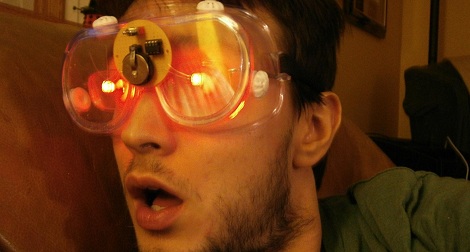
In the world of your dreams, you can build an entire world, an entire universe, an entire society governed by your every whim. While lucid dreaming you are a god in your own mind, free to create or destroy at will. You can train yourself to recognize when you are dreaming, but sometimes a little technological help can speed you towards the path of becoming an old testament god. [Will] over at revolt lab built a set of lucid dreaming goggles so he could take control of his own dreams.

To induce a lucid dream, [Will] took a pair of safety goggles and attached red LEDs to shine into his closed eyes. A simple circuit was constructed out of an ATtiny85 that blinks the LEDs two hours after being turned on. The idea is these LEDs will be noticed by the user during REM sleep and they will realize they’re still sleeping. After that, it’s basically Inception.

It is possible to induce lucid dreaming through psychological and not technological hacks; just asking yourself, ‘am I dreaming’ throughout the day may be enough to make a holodeck in your mind while you’re sleeping. You can check out a video of [Will] wearing his goggles after the break.

Continue reading “Do Anything With The Help Of Lucid Dreaming Goggles”

Building The Mind Of A Robot Overlord

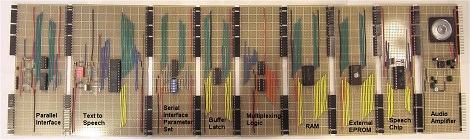
The folks at the Louisville hackerspace LVL1 now have a fabulous piece of wall art that is also a speech synthesizer. The speech synthesizer is over two feet long and is made of nine panels of stripboard connected with right angle headers. An awesome piece of art if there ever was one.

This speech synthesizer is actually 30 years in the making. In the early 1980s, one of the members of LVL1 across a few text-to-speech ICs in a bin in Radio Shack. These ICs sat in a drawer while college got in the way, and in 1990, the project was resurrected. The speech synth chips sat in a drawer for another decade, and it was finally decided to build a wall-mounted speech synth for LVL1.

This speech synthesizer is intended to be the voice box for FATHER, LVL1’s second hackerspace AI. Already the first AI – MOTHER – is already telling people to take out the trash and generally trying to become the AI-gone-amok we all deserve. FATHER will be implemented in a robotic monkey, so right now the only question we have is who has been messing with the Louisville water supply.

Controlling Blinkenlights With Modern Computers

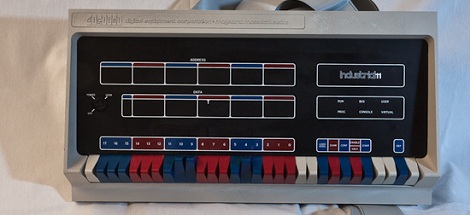
A few old timers may remember that once, long ago, computers didn’t require keyboards. The earliest personal computers such as the Altair 8800 and the server rack-sized minicomputers like the PDP-11 could be controlled with a panel filled with switches and lights, giving us the term blinkenlights. Today, most of these machines have been thrown away or locked up in museums and private collections; even if you were to get your hands on one of these control panels, you’ll have a heck of a time doing something useful with one.

Fear not, because [Jörg] has come up with a great way to control these blinkenlights and simulate the computers of yesteryear. He calls his build BlinkenBone, and it’s able to control the blinkenlight panels from dozens of historical computers and simulate every thrown switch and tiny light bulb.

BlinkenBone is a BeagleBone single board Linux computer running the SimH simulator for antique computers. Right now the BlinkenBone is able to simulate the PDP-1, PDP-8, PDP-11, a lot of old IBM machines, the Altair 8800, and even some HP boxes.

Without a BlinkenBone or similar simulation device, the still-surviving control panels for these computers are just pieces of art to hang on a wall. When they’re running a simulation of their original hardware that was long-lost to the scrap yard, they become the useful devices they once were. Also, it’s much easier to appreciate how far technology has come in the last 40 years.

You can check out a short demo of [Jörg] using his BlinkenBone on a PDP-11/40 after the break. Look at those lights go.

Continue reading “Controlling Blinkenlights With Modern Computers”

Chess Board Step Sequencer

[tinkartank] wrote in to tell us about the chess board step sequencer he built. It’s a great piece of work that combines the wonderful classical erudition a set of chess pieces confers with modern technological musical equipment such as a monome.

The build began by routing small holes underneath each square and fitting very small and fragile reed switches. Sixty four of these switches are wired into rows and columns then attached to the digital inputs of an Arduino Mega. To close these reed switches, magnets are implanted into the base of each chess piece so whenever a piece is on the board is moved a circuit closes.

On the control side of things, [tinkartank] built a very nice control panel to change the key being played*, the tempo, an ‘arpeggio dial,’ number of steps, and if there is a whole or half step in between notes. With this control panel, [tinkartank] can play just about any scale.

How does it sound? Well, the Arduino Mega outputs MIDI so realistically it can sound like anything imaginable. From the video demo (available after the break), we really like the interface and a reed switch array chess board is slowly climbing up our ‘to build’ list, if only for all the cool stuff you can do with one.

Continue reading “Chess Board Step Sequencer”

Reading Credit Cards With A Tape Head

A company called Square is giving out free credit card readers that turn any iPhone or iPad into a Point of Sale terminal. [Steve] got a hold of one of these tiny peripherals and did what any sane person would do: tear it apart and learn how it works. This bit of hardware is a little unimpressive; unsurprising because Square is giving them away. With simplicity comes an ease in understanding, and [Steve] was able to successfully read his own credit card with this tiny and free credit card reader.

[Steve]’s work in decoding credit card data builds off [Count Zero]’s article from the bbs days. Basically, each credit card has two or three tracks. Track three is mostly unused, whereas track one contains the card holder name, account number, cvc code and other ancillary data. Track two only contains the credit card number and expiration date.

The only components in the Square card reader are a head from a tape player and a 1/8″ microphone jack. The magnetic head in the Square card reader is positioned to only read track two. With a small shim, it’s possible to re-align the head to get the data from track one. After recording an audio file of him sliding his card though the Square reader, [Steve] looked at the number of times the waveform flipped from positive to negative. From this, he was able to get the 1s and 0s on the card and converted them to alphanumeric using the 6-bit ANSI/ISO alpha format.

[Steve] isn’t going to share the code he wrote for Android just yet, but it should be relatively easy to replicate his work with the Android tutorial he used. Also, yes, we did just pose the question of how these Square credit card readers work just hours ago. Good job being on the ball, [Steve]. Tips ‘o the hat go out to [Bobby], [Leif], [Derek] and anyone else we might have missed.

EDIT: [Stephen] sent in his teardown minutes after this post went live. Hackaday readers are too fast at this stuff.

Hackaday Links: April 18, 2012

Sandcasting at the beach

[mkb] sent in a video he found of [Max Lamb] sandcasting a stool at a beach in England. The material is pewter, or >90% tin with a little bit copper and antimony thrown in for good measure. While we’re sure there will be a few complaints from environmentalists, it’s still a cool video to see.

Your project needs an OLED display

Here’s a Kickstarter for a tiny 96×16 OLED display. Connect this thing to any I2C bus and you get a 15×2 character display (or a graphic display if that’s your inclination) very easily. Thanks to [Chris] for sending this one in.

Here’s one for a larf

[Ryan Inman] is suing 20 companies because he got mercury poisoning from vacuum tubes. Read that last line again. Most of the companies that sell antique/repro/hard-to-find components like Angela Instruments, Antique Electronic Supply, and even eBay are listed as defendants in the case. This might put at least one company out of business even though they never sold [Ryan] a vacuum tube edit: they did sell him a neon bulb, and courts are generally idiotic when it comes to technological issues. It’s hilarious and sad, so we’ll keep you updated if we get more info.

Nostalgia, the pain from an old wound

The Adafruit blog posted an excellent piece on the Apple ][ game Rocky’s Boots, an educational game from 1982 that teaches kids how to connect logic gates. You can play this game in your browser, but we’d like to hear our stories of ancient video games that teach you engineering concepts like The Incredible Machine or Widget Workshop. Leave a note in the comments if we’re leaving any out.

A question posed to the community

A company is giving away credit card readers that plug into the headphone jack of an iDevice. [J Smith] writes in to ask us if anyone has gotten one of these and opened them up. Like [J Smith] we’re expecting something a repeat of the CueCat where free hardware is opened up to everybody. If you’ve done a teardown of one of these card readers, send it in.

3DS homebrew

[Mike] sent us a link to [neimod]’s Flickr photostream. It looks like we’re on the cusp of tearing open the Nintendo 3DS for homebrew apps. Someone who uses this much hot glue must know what they’re doing, right?