Simulated Dashboard For A Simulated Race

Simulators might have lost their cool for a lot of gamers, but [Fergo] is trying for a comeback. He built an electronic dashboard for a car racing simulator.

[Fergo] spends most of his track time on iRacing, an MMO racing simulator. Possibly due to a little bit of influence from Formula 1 steering wheels, he wanted to add to his dashboard that included Microsoft racing wheel. The dashboard includes RPM lights, a gear indicator, five general buttons, a rotary encoder, and a pit limiter, rev limiter and low fuel indicators.

The build is powered a VB.NET app that connects the iRacing API to an Arduino. To get all those buttons and LEDs talking to the Arduino, [Fergo] used an IO expander that communicates over an I2C bus. It’s a surprisingly simple design that should scale well if [Fergo] ever decides to expand his cockpit. We’re not sure if it could handle controlling a 737, but it would be more than sufficient for a Cessna 172 or Mercury capsule.

Check out [Fergo] tearing around the track with his buttonbox dashboard after the break.

Continue reading “Simulated Dashboard For A Simulated Race”

LiPo Charging Circuit Tutorial

As far as battery technology goes, Lithium Polymer cells are the bee’s knees. They’re powerful enough to handle very demanding applications and come in a multitude of sizes for any conceivable application. There’s a problem with LiPos, though – they have the tendency to explode when charged incorrectly. Luckily, [Paul] sent in a great tutorial on building a LiPo charger that works over USB.

In the original design of [Paul]’s board, he chose a Maxim MAX1551 Lithium battery charger. Confounded by the expense and/or unavailability of this IC (although Sparkfun has a few), he moved onto the similar Microchip MCP7813. This IC supports charging from a power source from 3.5 to 6 Volts as would be found in a USB hub.

The board [Paul] came up with is incredibly small – just barely larger than the USB plug itself. The layout is fairly simple as well. We’re thinking this could be a highly useful application of some home board fabrication. If you have a simpler way to charge LiPos that don’t require a specialized chip, send it into the tip line.

Followup: Troll Physics Solved

A month ago, we saw a marvelous demonstration of troll physics from YouTube user [Fredzislaw100]. In his video, we saw a circuit of three switches and three LEDs wired in series and but not acting like the should. A lot of the comments for this post elicited reasonable explanations like modifying the battery or pure camera wizardry via After Effects. Thankfully, [Alan] stepped in and showed us how it was done. The solution uses two AC power sources with diodes in two of the switches and LEDs and inductors in the third pair. [Alan]’s build was rather large compared to the original video, so we were wondering how this circuit could be made invisible.

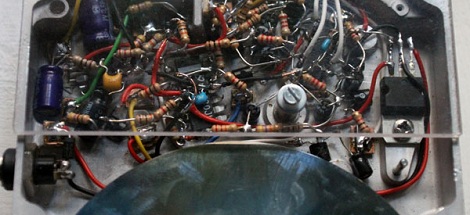
[Fredzislaw100] just posted a video on how he did it. Like [Alan]’s build, it uses two AC power sources, diodes, and inductors. In contrast to every single guess about where the circuit is hidden, the majority of the build is inside the battery connector. [Fredzislaw] did some amazing work hiding a 74LV132 quad NAND Schmitt trigger inside the battery connector. The diodes were easily hidden on LEDs 1 and 3 with some red nail polish, but we’re amazed by the inductor built into the LED seen in the title pic.

So there you go. With a ton of electronics know-how and an extremely steady hand (and a microscope), you too can build your own troll circuit. Check out the video after the break.

Continue reading “Followup: Troll Physics Solved”

[Jackson Pollock] Is Now A Robot

Even though abstract expressionism died out several decades ago, robots are still chugging along dripping nihilistic pigment onto a cold, uncaring canvas. [Liat] and [Assaf] created a robot named The Originals Factory to create paintings in the style of abstract expressionism, a style of painting that is arguably best represented by [Jackson Pollock] and his ‘drip paintings.’

The build is surprisingly simple – there are four containers filled with C,M,Y, and K pigments. Pumps transport these paints to a print head mounted on an aluminum rail above a canvas. The software portion of the build is rather interesting. Instead of pixels, the image is rendered in ‘vixels’ – vertical lines of a specific length and color. Although we don’t see any examples of more precise work, [Liat] tells us The Originals Factory can be used to plot graphs on the canvas.

Check out a video of The Originals Factory squirting paint down a canvas after the break.

Continue reading “[Jackson Pollock] Is Now A Robot”

Synthesize With A Hard Drive

If you’d like a pseudo-mechanical way of producing a droning synthesizer sound, [gijs] is your man. He made a small synthesizer out of nothing but an old hard drive and a few components.

Whenever a disk platter is spun manually, the spindle motor inside the drive produces a few out of phase sine waves on its connections. [gijs]’ synthesizer compares and amplifies these sine waves and sends them out to a speaker. The result is a strange droning chiptune-esque arpeggio.

The circuit for the build is soldered directly to the hard drive enclosure Manhattan style. Because the output of the spindle motor produces out of phase sine waves, [gijs] thought it would be a good idea if he could capitalize on some phase interference to alter the timbre of his synth. The entire build is mounted to a wall with hinges to one side so the speaker can be moved around. It isn’t much of a change, but we can here some wave forms cancelling each other out.

Check out the video of the build after the break. There’s also a few audio samples available on the project page.

Continue reading “Synthesize With A Hard Drive”

@publictextbox Is A Twitter Enabled Phone Booth

In the interests of open communication in shared spaces, [dan] made a public text box that serves as a terminal to the @publictextbox twitter account. We could see something like this being useful in a hackerspace or other hang out to announce to the world the happenings of the resident makers and builders.

The software setup is very simple and can run on just about any old computer you might have lying disused in a corner. The app is built with Processing, and the code is extremely simple and easily modifiable. Even though the case is a lovely cardboard number, the Twitter Box can be dressed up as any imaginable form. We’d love to see a nice TARDIS blue, but we’ll leave that up to [dan].

You can check out the demo of the Twitter phone box after the break. Alternatively, you could re-tweet this post and take part in a load test for the @publictextbox.

Continue reading “@publictextbox Is A Twitter Enabled Phone Booth”

Program A Microcontroller Over The Internet

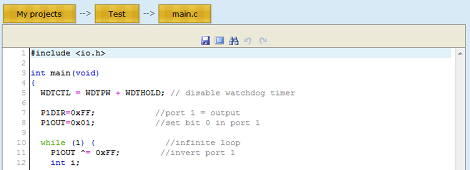
If you’ve ever wanted to program a microcontroller “in the cloud,” you might want to head over to Inventor Town, an online IDE that allows you to write and compile firmware for the MSP430 series of microcontrollers.

After logging in with your Google account, you’re presented with a ‘My Projects’ page. From there, you can make as many projects as you like for the MSP430x2231 or ~x2211 microcontrollers. The online editor has the vital keyword highlighting feature, but sadly not many of the more advanced text editor features, like a red underlined syntax errors. After you’ve written your code, press the compile button, download your .HEX file and upload to your board.

We’re surprised we haven’t seen something like this before. To us, this seems like the ideal basis for a github-style microcontroller code-sharing website. Any enterprising ATtiny fans want to take a crack at this one?

Thanks [Rob] for sending this one in.