[Sprite_tm]’s Three-component FM Transmitter

When the Regency TR-1 transistor radio came out onto the market in the 1950s, it was hailed as a modern marvel of microelectronics. With only four transistors and a handful of other components, the TR-1 was a wonder of modern engineering. [Sprite_tm] may have those old-timers beat, though. He built an FM transmitter with the lowest parts count of any transmitter ever.

Like most of [Sprite_tm]’s builds, it’s an unimaginably clever piece of work. [Sprite] overclocked the internal RC oscillator of an ATtiny45 to 24 MHz. After realizing the PLL running at four times the frequency of the oscillator was right in the middle of the FM band, he set about designing a tiny FM transmitter.

[Sprite_tm] remembered his work on MONOTONE and made a short song for hit ATtiny. The firmware for the build takes the notes from his song and varies the 96 MHz PLL frequency a tiny bit, thereby serving as a tiny FM transmitter.

Does it work? Well, if you want to compare it to a Mister Microphone, the range is incredibly limited. That being said it works. It’s an FM transmitter built out of a microcontroller and a battery, and that’s very impressive. Check out [Sprite_tm]’s demo after the break.

Continue reading “[Sprite_tm]’s Three-component FM Transmitter”
Tutorial: Build A Manifold Clock For $10

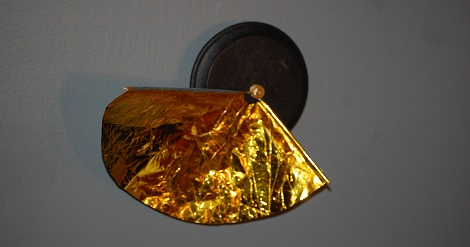
Every once in a while, the Hack a Day tip line gets a submission that is cool, but screams to be built in a few hours, possibly while consuming adult beverages. When [Shay] and [Ben] sent in their Manifold Clock Kickstarter, I knew what I had to do. To make a long story short, there’s a manifold clock hanging on my wall right now. Check out my manifold clock how-to guide after the break.

Continue reading “Tutorial: Build A Manifold Clock For $10”

Control Android With A Projector And Kinect

If you’re going to build a giant touch screen, why not use an OS that is designed for touch interfaces, like Android? [Colin] had the same idea, so he connected his phone to a projector and a Kinect.

Video is carried from [Colin]’s Galaxy Nexus to the projector via an MHL connection. Getting the Kinect to work was a little more challenging, though. The Kinect is connected to a PC running Simple Kinect Touch. The PC converts the data from the Kinect into TUIO commands that are received using TUIO for Android.

In order for the TUIO commands to be recognized as user input, [Colin] had to compile his own version of Android. It was a lot of work, but using an OS designed for touch interface seems much better than all the other touch screen hacks that start from the ground up.

You can check out [Colin]’s demo after the break. Sadly, there are no Angry Birds.

Continue reading “Control Android With A Projector And Kinect”

Converting A Mill To CNC

For most of the past year, [Joel] has been working on converting a manual mill to a CNC mill with the addition of a computer, brackets and stepper motors. He’s put an amazing amount of effort into his project, and the result is awesome and much less expensive than buying and shipping an old Bridgeport mill.

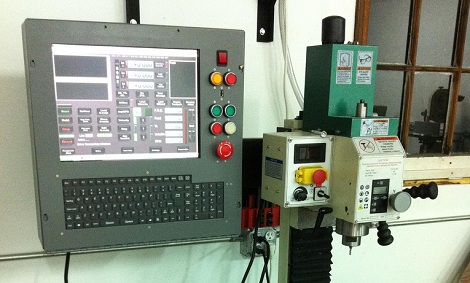
The project started with this mill from Grizzly. It’s a step above the small ‘hobby mills,’ but still very affordable at $1200 shipped to [Joel]’s driveway. The work began by fabricating an enclosure for the PC and motor drivers out of an electrical panel box. The controller box includes a touch screen, keyboard and computer running Mach3 CNC software. The computer connects to a breakout board with a trio of motor drivers providing power for the stepper motors on each axis.

After a few months (good things take time), [Joel] was ready to attach the stepper motors to the axes of the mill. He’s just put up a few videos of milling copper-clad board for PCBs and surface machining ABS, viewable after the break. For a total investment that is less than finding, buying, and repairing an old industrial mill, we’ll call [Joel]’s project a success.

Continue reading “Converting A Mill To CNC”

Hackaday Links: January 24, 2012

Open source engraving

[Scott] wanted to do some v-carving with a CNC router, but couldn’t find software to generate GCode that didn’t cost hundreds of dollars. He ended up doing the sensible thing and wrote his own that will generate tool paths from CXF fonts. We’ll be bookmarking this for when our router project is done.

Improving Genesis sound output

Dissatisfied with the sound output on his Sega Genesis, [Drakon] installed a few mods into his console. How much could it really affect the sound? Listen to the video. The changeover happens at 0:50. Impressive. Now if only the chiptune scene would get into Segas.

Yes, we did, and now we’re seeding

Here’s an alternative to Thingiverse: The Pirate Bay has a new category for 3D-printable objects. The best file so far? A 1970 Chevelle. US Copyright law does not protect (most) physical objects, so it’s not illegal. Honestly, we can’t wait for somebody to take this to the courts; It’s sure to be an interesting case. Somebody upload a ship hull design and give the EFF a buzz.

Just be glad it’s not a QFN

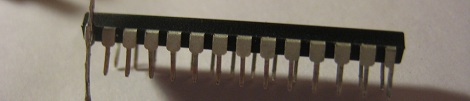
[Mikey] was pulling a PDIP ATMega8 out of a socket with pliers and a screwdriver and broke the RESET pin. Ouch. He fixed it by soldering on a lead from a resistor. We’ve all done this before, but [Mikey]’s results look really good. Here’s the gallery.

This might be fake

If you want a second analog stick for your 3DS, you could wait a month and buy a Circle Pad Pro, or install a PSP analog stick. We’re not sure how this would work – the Circle Pad Pro works over IR, and we’re not seeing an IR transmitter on this build. Here’s the source if anyone wants to give this a shot.

Whac-A-Banker To Relieve Your Frustration

[Tim Hunkin], builder extraordinaire and host of The Secret Life of Machines is a bit frustrated with the current economic climate and decided to take out his frustrations with a game of Whac-A-Banker.

[Tim]’s version of the classic Whac-A-Mole game uses tiny air cylinders to actuate five banker figurines up and down. The figures were cast with polyurethane and are reportedly holding up well. The cabinet is really interesting. When the game isn’t being played, a really boring front panel is displayed. After inserting a few coins, the panel drops into the machine to show the fun and exciting scoreboard.

If you’re ever around Suffolk, England, you can check out the Whac-A-Banker and a lot of other [Tim Hunkin] creations at the Southwold Pier. Thanks [John] for sending this one in. Yes, we did get The Secret Life of Machines in the states on the Discovery Channel, but it has been replaced with shows about trucking. Here’s an archive of the entire series for your viewing pleasure. Kiss your evening goodbye.

Controlling An LED Matrix With An Android Phone

Even though everyone with a smart phone has a small, powerful computer in their pocket, we haven’t seen many applications of this portable processing power that use the built-in camera. [Michael] decided to change this and built an LED matrix that displays the data coming from the phone’s camera.

For the build, [Michael] used two 32×32 LED panels from Adafruit along with an IOIO and an Arduino. To build the Android app, [Michael] used the Android OpenCV computer vision library that grabs an image from the Android camera and downsamples it to 64×32 pixels. This data is transferred over a serial connection from the phone to the IOIO and again from the IOIO to the Arduino. Even though each frame is 1024 bytes, [Michael] still gets around four frames per second on his LED matrix display.

After the break you can check out the results of [Michael]’s build. The video is a little choppy because of the frame rate issue, but it’s still an interesting build in the Android software development category.

Continue reading “Controlling An LED Matrix With An Android Phone”