Beating The Wrong Amateur Balloon Record

Friday, we covered a little project that attempted to beat the UK altitude record for an amateur balloon launch. Things don’t always go as planned, but the APEX team did manage to beat the several other UK records, including ones for the longest distance and flight duration for a latex balloon.

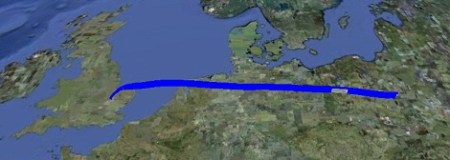
The APEX team was originally trying to beat the altitude record set by [Darkside] and his Horus 15.5 payload that made it to 40,575 meters. The APEX balloon was launched and slowly climbed over the North Sea to the expected burst point. Unfortunately for the trackers, the balloon leveled off at about 36km and just kept going.

The total Great Circle distance of the APEX Alpha flight was 1347km, with a total flight time of 12 hours, 20 minutes. The balloon eventually drifted out the radio range of anyone aware of the project. Despite the valiant efforts of HAMs across Europe, APEX Alpha was lost in the “HAM wastelands of Eastern Europe,” somewhere over Poland.

Even though the APEX team lost contact with their balloon, Alpha was still transmitting at the time. The balloon surely burst at this point, so it could have landed anywhere from Poland to Ukraine to Russia. The APEX team is offering a reward for finding Alpha, so if you see a small styrofoam box in Eastern Europe, drop the APEX boys a line.

Of course this flight couldn’t have taken place without the efforts of HAMs across Europe. [Darkside], [2E0UPU], and so many others helped out with the tracking as Alpha passed over the Netherlands and continued towards Berlin. The last contact was made by the awesome [OZ1SKY], who was very gracious to stay up until the wee hours of Sunday morning.

Not a bad flight for something that was supposed to take a swim in the North Sea. If you’d like to see the raw data from the flight, the APEX team posted everything they pulled down.

Medusa: A Proximity-aware Tabletop

Finally [Michelle Annett] can talk about her super secret project she did at Autodesk Research.

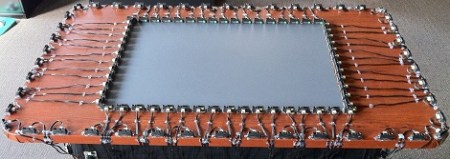
Medusa, as [Michelle]’s project is called, is a Microsoft Surface that has been fitted with 138 proximity sensors. This allows the Surface to sense users walking up to it, and detect users hands and arms above the table top. Multiple users can be detected at the same time, and the left and right hands of two users can be mapped to specific users.

The proximity sensors [Michelle] used are inexpensive, so we’re wondering when someone with a crazy multitouch setup will add proximity sensors to their build. We’d like to play with Medusa, even if just for a virtual game of Settlers of Catan. It seems like the perfect setup…

[Michelle] built Medusa last January during her internship at Autodesk. Now that UIST 2011 is over, she can finally talk about it. There’s also a video demonstrating the possibilities of Medusa, check it out after the break.

Thanks [Fraser] for sending this one in.

Continue reading “Medusa: A Proximity-aware Tabletop”

Halloween Hacks: Flickering Jack-o’-lantern

The dollar store is always a great place to find some weird stuff, so when [jethomson] found a flickering Jack-o’-lantern, he thought it would make a great project for the 74xx logic competition.

Instead of using the flickering incandescent lightbulb that came with the blinking pumpkin, [jethomson] decided to rebuild a blinking circuit around a 74HC14 Hex inverting Schmitt trigger IC. The chip was used as a relaxation oscillator by adding a resistor and cap from the input to the ground. After a bit of component selection and some calculation, he had a red and blue LED blinking at 2,6,9, and 15 Hz.

The result is a seemingly random pattern of light that looks like a ghostly blue after image of the handheld Jack-o’-lantern. While it may not be one of the most complex builds for the 74xx competition, it gets points in our book for originality.

Although [jethomson] says his camera doesn’t pick up his project very well, he did post a video of the Jack-o’-Lantern in action. Check it out after the break.

Continue reading “Halloween Hacks: Flickering Jack-o’-lantern”

Going RGB With 7 Segment Displays

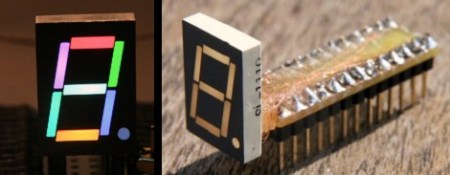
We can order seven segment displays in red, green, yellow, or blue all day long. One thing we haven’t seen is an RGB segmented display, so [Markus]’ project is really interesting. He took a stock seven segment display and modded it into an RGB display.

After taking a Dremel to the back of the stock display, [Markus] was left with a seven segment light mask. A few SMD LEDs were purchased through the usual channels. The RGB LEDs were epoxied into place on the back of the light mask one at a time. Thankfully, the LEDs came with magnet wire already attached – helpful, since these LEDs are only 1.6mm x 1.2mm big.

With 32 pieces of magnet wire, [Markus] needed some sort of socket. A small piece of perfboard and some .100″ headers handled the job very nicely. [Markus] still has to work on some way to drive the 24 cathode lines his LED display. He’d like an I2C interface, but with something like an individual seven segment display, the footprint of the circuit should be pretty small. If you’ve got any tips, drop them in the comments section. [Markus] is sure to catch them there.

Hydrocrystallophone Probably Won’t Make You Insane

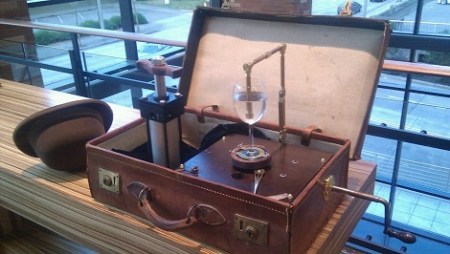
[Fish] is really proud of his newest creation, the Hydrocrystallophone. This new instrument reminds us of an even more steampunk version of [Benny Franklin]’s glass armonica – an instrument that reportedly plunged the player into a, “dark and melancholy mood.”

The build is based around a 1920s hand-cranked phonograph motor. The phonograph motor spins a wine glass filled with water. The water level (and thus tone produced by the wine glass) is varied by a brass tube inside the glass connected to a hydraulic cylinder. Pushing and pushing on the handle of the hydraulic cylinder causes the water level in the glass to change.

We’ve all seen wine glass music before, but this is the first time we’ve seen it with just one glass. [Fish] is working on modifying the phonograph’s governor to get rid of the effects of 78 RPM on the water. He hasn’t quite mastered his new musical invention yet, but we can’t wait to see what [Fish] is able to play with some practice.

In case you’re keeping track of the musical instruments featured on Hack A Day that fall into the “why didn’t I think of that” bin, The Hydrocrystallophone would be the second such instrument in as many months. It’s a very simple but really ingenious device. Check out the video of the Hydrocrystallophone after the break.

Continue reading “Hydrocrystallophone Probably Won’t Make You Insane”

Going For The Amateur Balloon Altitude Record

At 11 AM London time, October 22, the Sutton grammar school for boys is going to be launching Apex Alpha, a high altitude amateur balloon for an attempt at the UK altitude record. Unlike a few other balloons we’ve seen, the Apex team is doing it right and giving everyone the downlink details for the balloon.

The payload for the balloon was built entirely by student of the Sutton grammar school and weighs less than 300 grams. While it’s not carrying a camera for the all-important pretty pictures, the payload does have a GPS module and a transmitter; it’s just enough to do the required testing on the lead up to Apex III.

Right now, the UK amateur balloon record stands shy of 130,000 feet. The team gained a lot of experience with their Apex I and Apex II launches, and they’re pretty confident they have the experience to pull this one off. You can check out the progress of the Apex Alpha flight on the spacenear.us tracker. For us Yanks, the launch should start October 22nd at 6:00 am Eastern time and 3:00 in the morning for the West coast. The team says they’ll be updating that throughout the flight.

UPDATE: Apex Alpha just won’t burst. Any HAMs near Berlin in Eastern Europe are sorely needed. Head over to the IRC chat if you can help.

A Very Simple Android Recon Vehicle

Desperately in need of a graduation paper, [Andrei] decided to build a few computer controlled recon vehicles (PDF warning), and we’re really impressed with the minimalist approach [Andrei] took.

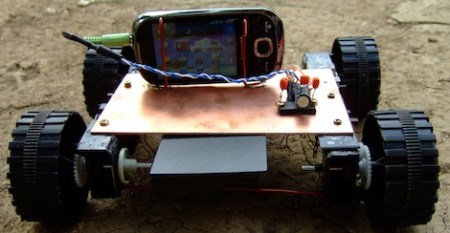
The Computer Operated Recon Entity (C.O.R.E.) mk. I is based around a laptop. Instead of an Arduino, [Andrei] used a car stereo amp to control the motors. The two channel amp [Andrei] picked out has four outputs. Tying a motor to each output gives a four-wheel drive robot that’s really clever in its simplicity. With an onboard webcam, [Andrei] can do live video streaming from his remote vehicle. Outputting a specific tone with the sound card allows for full control of the robot.

The C.O.R.E. mk. II uses a Samsung Galaxy I5500 phone – the cheapest Android phone [Andrei] could find. The setup is similar to the mk. I C.O.R.E. with a WiFi connection sending video back to a base station. Control of the two motors is still handled by playing sound files and sending that to a stereo amp connected to the motors.

Check out the C.O.R.E. mk. II going Bach and forth after the break.

Continue reading “A Very Simple Android Recon Vehicle”