Hackaday Podcast 187: The Sound Of Gleeful Gerbils, The Song Of The Hard Drive, And A Lipstick Pickup Lullaby

This week, Editor-in-Chief Elliot Williams and Assignments Editor Kristina Panos gushed about NASA’s live obliteration of minor planet Dimorphos using a probe outfitted with a camera. Spoiler alert: the probe reaches its rock-dappled rocky target just fine, and the final transmitted image has a decidedly human tinge.

Kristina brought the mystery sound again this week, much to Elliot’s sonic delight. Did he get it? Did he figure it out? Well, no. The important thing is one of you is bound to get it.

We kick off the hacks with a really neat 3D printed linkage that acts as an elevator for a marble run, and then we discuss a mid-century hack that helps you decide whether it’s time to emerge from the fallout shelter using the contents of your typical 1950s pockets. We spent a few minutes comparing our recent radiation exposure levelsĀ  — Kristina wins with about a dozen x-rays so far this year, but no full-body CT scans. Then we talk guitars for a bit, remember a forgotten CPU from TI, and spend a few cycles talking about a tone-wheel organ that sounds like a chorus of gleeful gerbils.

Finally, we talk toner transfer for 3D prints, argue in defense of small teams versus large committees, and get all tangled up in cursive.

Direct download.

Check out the links below if you want to follow along, and as always, tell us what you think about this episode in the comments!

Continue reading “Hackaday Podcast 187: The Sound Of Gleeful Gerbils, The Song Of The Hard Drive, And A Lipstick Pickup Lullaby”

2022 Hackaday Prize: Congratulations To The Winners Of The Climate-Resilient Communities Challenge

Holy humanitarian hacking, Batman! We asked you to come up with your best climate-forward ideas, and you knocked it out of the ionosphere! Once again, the judges had a hard time narrowing down the field to just ten winners, but they ultimately pulled it off — and here are the prize-winning projects without much further ado.

In the Climate-Resilient Challenge, we asked you to design devices that help build communities’ resilience to severe weather and the increasing frequency of natural disasters due to climate change, and/or devices that collect environmental data that serves as hard evidence in the fight for changes in local infrastructure. While several people focused on air quality, which is something we tend to think of as a human need, plenty others thought of the flora and fauna with which we share this planet.

Continue reading “2022 Hackaday Prize: Congratulations To The Winners Of The Climate-Resilient Communities Challenge”

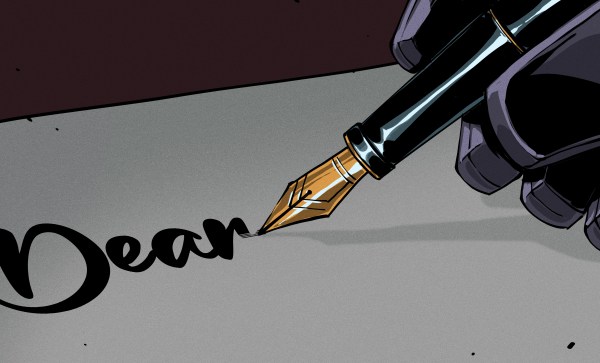
Cursing The Curse Of Cursive

Unlike probably most people, I enjoy the act of writing by hand — but I’ve always disliked signing my name. Why is that? I think it’s because signatures are supposed to be in cursive, or else they don’t count. At least, that’s what I was taught growing up. (And I’m really not that old, I swear!)

Having the exact same name as my mother meant that it was important to adolescent me to be different, and that included making sure our signatures looked nothing alike. Whereas her gentle, looping hand spoke to her sensitive and friendly nature, my heavy-handed block print was just another way of letting out my teen angst. Sometime in the last couple of decades, my signature became K-squiggle P-squiggle, which is really just a sped-up, screw-you version of my modern handwriting, which is a combination of print and cursive.

But let’s back up a bit. I started learning to write in kindergarten, but that of course was in script, with separate letters. Me and my fellow Xennial zeigeistians learned a specific printing method called D’Nealian, which was designed to ease the transition from printing to cursive with its curly tails on every letter.

We practiced our D’Nealian (So fancy! So grown-up!) on something called Zaner-Bloser paper, which is still used today, and by probably second grade were making that transition from easy Zorro-like lowercase Zs to the quite mature-looking double-squiggle of the cursive version. It was as though our handwriting was moving from day to night, changing and moving as fast as we were. You’d think we would have appreciated learning a way of writing that was more like us — a blur of activity, everything connected, an oddly-modular alphabet that was supposed to serve us well in adulthood. But we didn’t. We hated it. And you probably did, too.

Continue reading “Cursing The Curse Of Cursive”

Empty Spools Make Useful Tools, Like Counters

What’s the deal with getting things done? There’s a Seinfeld anecdote that boils down to this: get a calendar, do a thing, and make a big X on each day that you do the thing. Pretty soon, you’ll thirst for chains of Xs, then you’ll want to black out the month. It’s solid advice.

[3D Printy] likes streaks as well, and made several resolutions at the beginning of 2022. As the first of 30 videos to be made throughout the year, they featured this giant 3D printed counting mechanism (video, embedded below) that uses empty filament spools, some 3D prints, and not much else. These are all Hatchbox spools, and it won’t work for every type, but the design should scale up and down to fit other flavors.

This isn’t [3D Printy]’s first counter rodeo — he’s made several more normal-sized ones and perfected a clever carryover mechanism in the process, which is of course open-source. So each spool represents a single digit, and there are printed parts in the core that make the count carry over to the next spool. Whereas the early counters used threaded rod, this giant version rides on 2.5 mm smooth rod, so the spools can slide apart easily. But how does everything stay together? A giant elastic band made of TPU filament, of course — because the answer is always in the room.

Check out the video after the break, and stay for the 900%-sped-up assembly at the end.

Continue reading “Empty Spools Make Useful Tools, Like Counters”

Floppy Disk Sales Are Higher-Density Than You Might Think

Floppies may be big in Japan, but nostalgic and/or needful Stateside floppy enthusiasts needn’t fret — just use AOL keyword point that browser toward floppydisk.com. There, you can buy new floppies of all sizes, both new and old, recycle your disks, or send them in to get all that precious vintage stuff transferred off of them.

That delightfully Web 1.0 site is owned by Tom Persky, who fancies himself the ‘last man standing in the floppy disk business’. Who are we to argue? By the way, Tom has owned that address since approximately 1990 — evidently that’s when a cyber-squatter offered up the domain for $1,000, and although Tom scoffed at paying so much as $1 for any URL, his wife got the checkbook out, and he has had her to thank for it ever since.

My business, which used to be 90% CD and DVD duplication, is now 90% selling blank floppy disks. It’s shocking to me. — Tom Persky

In the course of writing a book all about yours-truly’s favorite less-than-rigid medium, authors Niek Hilkmann and Thomas Walskaar sat down to talk with Tom about what it’s like to basically sell buggy whips in the age of the electric car.

Tom also owns diskduper.com, which is where he got his start with floppies — by duplicating them. In the 80s and 90s, being in this business was a bit like cranking out legal tender in the basement. As time wore on and more companies stopped selling floppies or simply went under, the focus of Tom’s company shifted away from duplication and toward sales. Whereas the business was once 90% duplication and 10% floppy sales, in 2022, those percentages have flopped places, if you will.

Continue reading “Floppy Disk Sales Are Higher-Density Than You Might Think”

Walkmp3rson Is An MP3 Player Like Sony Never Made

If you weren’t already well aware, the 90s are like, so hot right now, and that includes cassette tapes for some reason. (Even though we personally didn’t have a CD player until 1998, they were around as early as 1982.) But if you don’t dig the quality of cassettes, or if you’d just rather carry around more than 45-120 minutes worth of music, than [John Edgar Park]’s Walkmp3rson is definitely the build for you. That’s pronounced ‘Walkperson’, as in a 21st century MP3-based update of the classic Walkman.

Inside this amazing 3D printed enclosure, you’ll find an Adafruit Feather RP2040 controlling the screen, handling input from the rotary encoder and those sweet mechanical keyswitches, and of course, playing audio files from SD cards through the amplifier breakout board. And no, this isn’t just another MP3 player — well, it kind of is, but the presentation really goes a long way here.

There are tons of retro-modern nods, like the cassette reel animation that plays on the TFT screen, the boxy enclosure, and the fact it involves physical media. Oh yes — you get to insert an SD card whenever you want to change albums/discographies/genres/whatever. In fact, this would be a great use of older, smaller SD cards. You could go all out and make tiny album art to slip inside those milky plastic cases. Check out the brief demo video after the break.

Looking to play your tunes on a microcontroller, but not a fan of the Walkman aesthetic? In June we covered a similar audio player powered by the ESP32 that does an uncanny impersonation of a portable tape deck that you might be interested in.

Continue reading “Walkmp3rson Is An MP3 Player Like Sony Never Made”

Banana Split Macropad Is Dessert For Your Desk

Once again, [Dan Bostian] is ahead of the curve when it comes to bringing bunches of banana puns to the table, but we think you’ll find this banana split macropad quite appealing nonetheless. Does this tasty thing look familiar? It ought to — we discovered, plucked, and uncovered the one-piece version last summer, and this time, [Dan] simply made our two-piece, wireless dreams come true.
Peel back the — oh, forget it. Inside, you’ll find a nice!nano running the show from the right-hand board using ZMK firmware, and a banana-shaped chalk outline on the left-hand silkscreen that represents how completely [Dan] killed it with this build. You can use any switches you want, as long as they’re Cherry MX-compatible in the shoe footprint department.
The PCBs are open source, of course, and so are the printed parts — it’s all there in the repo. As for the stickers, well, you’ll have to produce those yourself.