The Clock, Another Way To Modify The Sound Of A Synth Chip

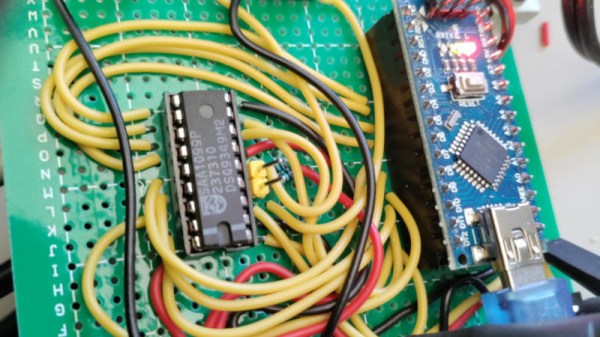
The Philips SAA1099 is perhaps one of the lesser-known among the crop of 1980s-era 8-bit sound generator chips, but with three stereo voices onboard it makes a capable instrument for chiptune experimentation. It’s attracted the attention of [Folkert van Heusden], who’s tried the novel experiment of seeing what happens when a sound chip’s clock is varied.

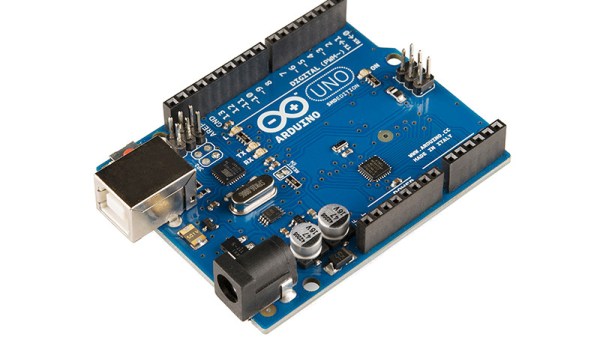
A quick search of the internet reveals that the chip, which appeared in early Sound Blaster cards, is intended to have an 8 MHz clock. He’s hooked it up to an Arduino as a variable clock source, which surprised us but it seems an ATmega328’s timer is faster than we expected.

There are a couple of WAV files, and as expected the clock frequency has a significant effect on the pitch. The samples just sweep up and down without much attempt at making a sound you’d want to hear, but it does raise an interesting possibility of adding a further pitch bending ability to the capabilities already in the chip. When these circuits were new we couldn’t control a clock on a whim with the 8-bit processors of the day, so of course none of us thought to try this at the time. He’s tried it, so you don’t have to.

The SAA1099 has been mentioned in these pages only once, as a chip used in peripherals for 1980s Czech computers.

Why The RP1 Is The Most Important Product Raspberry Pi Have Ever Made

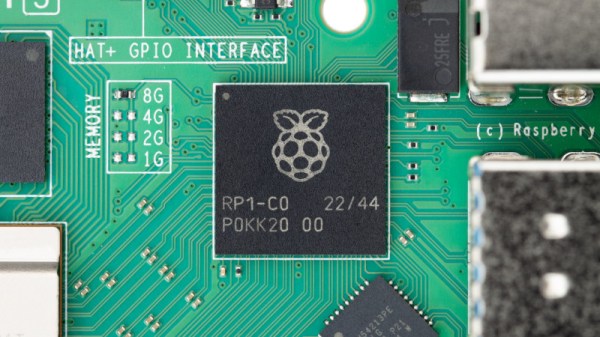
We’ve had about a week to digest the pending arrival of the Raspberry Pi 5, and it’s safe to say that the new board from Cambridge has produced quite some excitement with its enhanced specifications and a few new capabilities not seen in its predecessors. When it goes on general sale we expect that it will power a slew of impressive projects in these pages, and we look forward with keen anticipation to its companion Compute Module 5, and we sincerely hope eventually a Raspberry Pi 500 all-in-one. It’s the latest in a line of incrementally-upgraded single board computers from the company, but we think it conceals something of much greater importance than the improvements that marked previous generations. Where do we think the secret sauce lies in the Pi 5? In the RP1 all-in-one PCIe peripheral chip of course, the chip which provides most of the interfacing on the new board. Continue reading “Why The RP1 Is The Most Important Product Raspberry Pi Have Ever Made”

Can A $3200 Kit Convert Your Car To Electric Power?

Whether hardcore petrolheads like it or not, we appear to be living through the final years of the internal combustion engine. In many countries there are legislative timetables in place for their eventual phasing out, and even those which remain in production are subject to ever more stringent emissions legislation. If there’s a problem with the EVs with which we’re expected to replace our fossil fuel vehicles it’s the cost, those things are still very expensive. An Aussie student has an interesting idea that’s won the James Dyson Prize: a low cost conversion for existing vehicles that bolts onto their rear wheel hubs.

Electric conversion of fossil fuel cars is nothing new, indeed we’ve brought you news of units designed to replace the original engine and transmission. Neither are wheel hub motors new, but the difference with this system is that it doesn’t require significant mechanical modification to the vehicle. It retains the old engine, and this motor sits inside each rear wheel.

It almost seems too good to be true, but a closer reading shows the rotor bolted on one side to the old wheel hub and on the other side to the wheel. The stator meanwhile is bolted to the existing brake caliper mountings. This would lead to a slightly wider track and a greater unsprung weight, but we can see that it would work. Besides the motor there’s a battery pack for the spare wheel well and a set of electrically-powered systems to supply the brake servo vacuum and other services. The idea is that this whole kit could be fitted for 5000 Australian dollars, which is somewhere south of $3200 USD. It’s not perfect and it still involves hauling around the dead weight of an unused engine, but we can see it might still have a niche. If, and that’s a big if, it ever makes it to market, that is.

Making A Concrete Sign

While paging through the feed a few days ago our attention was caught by something a little away from the ordinary in Hackaday terms, a DIY video about creating cast concrete signage from [Proper DIY] which we’ve placed below the break. A deceptively easy-looking mould-making process has a few tricks that  will make the difference between a hard-wearing sign that lasts for years, and a lump of concrete.

So, to make a cast concrete sign, you throw together a mould with some letters, and chuck in some concrete? Not so fast, because the key appears to be preparation, and ensuring that there are no 90-degree corners on the mould parts. The letters are carefully shaped and sealed with varnish before being attached to the mould with silicone adhesive, and all the corners are beveled. Finally a light oil is used as a release agent, and hefty vibration takes care of any air bubbles.

The result is a set of signs, but we can see these techniques finding uses outside signage. For example, how about casting using a 3D printed mould?

Continue reading “Making A Concrete Sign”

Because You Can: Linux On An Arduino Uno

There are a few “Will it run” tropes when it comes to microcontrollers, one for example is “Will it run Doom?“, while another is “Will it run Linux?”. In one of the lowest spec examples of the last one, [gvl610] has got an up-to-date Linux kernel to boot on a vanilla Arduino Uno. And your eyes didn’t deceive you, that’s a full-fat kernel rather than the cut-down μClinux for microcontrollers.

Those of you who’ve been around a while will probably have guessed how this was done, as the ATmega328 in the Uno has no MMU and is in to way powerful enough for the job. It’s running an emulator, in this case just enough RISC-V to be capable, and as you’d imagine it’s extremely slow. You’ll be waiting many hours for a shell with this machine.

The code is written in pure AVR C, and full instructions for compilation are provided. Storage comes from an SD card, as the ATmega’s meagre 32k is nowhere near enough. If you’re having a bit of deja vu here we wouldn’t blame you, but this one is reputed to be worse than the famous 2012 “Worst PC Ever“, which emulated ARM instead of RISC-V.

Thanks [Electronics Boy] for the tip!

Teletext In Ireland, Another Broadcasting Leftover Bites The Dust

Over the years we’ve reported on the passing of a few of the broadcasting technologies of yesteryear, such as analogue TV in America, or AM radio in Europe. Now it’s the turn of an early digital contender, as one of the few remaining holdouts of old-style teletext is to shut down its service. The Irish broadcaster RTÉ is to turn off its teletext service Aertel, which has been live in some form continuously since 1986.

Like all European countries, Ireland has had only digital TV for quite a few years now. The linked RTÉ piece implies that the Aertel service has been carried as the old-style data in the frame blanking period even when part of a digital multiplex rather than the newer digital teletext system, so we’d be really grateful if some of our Irish readers could flick on their TVs and confirm that.

In an internet-connected world it seems quaint that a limited set of curated pages could once have been such a big deal, but it’s easy to forget that for many the teletext system provided their first ever taste of online information. As it shuffles away almost unnoticed we won’t miss counting through the page numbers cycling by in the top corner as we waited for our page to load, but it’s worth marking its final passing from one of the few places it could still be found.

Teletext does pop up in a few projects here, most recently as the display engine for a game of DOOM.

Debian Bookworm Comes To The Raspberry Pi, And Wayland Is Now Default

It must have been a busy week for the PR department at Raspberry Pi, with the launch of their latest single-board computer, the Pi 5. Alongside the new board comes something else, an updated Raspberry Pi OS version.

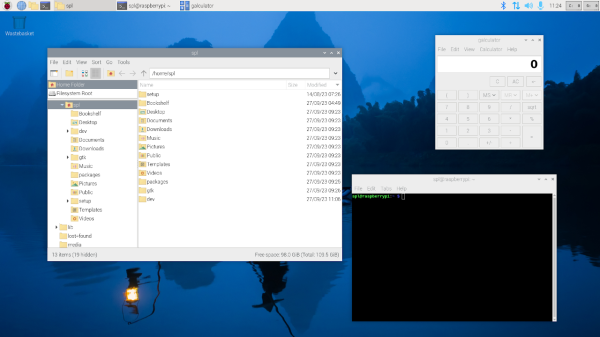
This is built from Debian 12 “Bookworm”, and supplants the previous “Bullseye” version. As well as the new OS base it comes with a pile of Pi-specific upgrades including an optimsied version of Mozilla Firefox. Probably most important is that henceforth (at least on 64-bit boards) its desktop will use the Wayland compositor rather than X11 to draw and manipulate windows. This is a development that has been in the works for a very long time — it must be almost a decade since the first Raspberry Pi blog entry about Wayland — so it’s welcome at last to see it.

The new tweaks as well as Wayland are supposed to deliver a much faster Pi experience, so we thought we’d break out the stopwatch and do some rough real-world tests. The bench 8GB Pi 4 here has a vanilla 64-bit Bullseye installed, so off we went to measure boot time, Chromium browser opening time, and Hackaday load time. It was time to download the new 64-bit Bookworm image and do the same. Have we just downloaded a power-up?

Both tests were done with an everyday boot, after the first-time OS set-up, and with all browser caches emptied. First up was a significant boost, with Bookworm booting in 37.14 seconds to Bullseye’s 53.5, but the Chromium opening was a little more disappointing. On Bullseye it took 7.15s, while Bookworm’s Chromium managed a more pedestrian 9.13s. The new Firefox takes only 7.95s to open. Both Chromium browsers load Hackaday in about 1.8s, while the new Firefox did the same job in a shade over 3s.

So allowing for our stopwatch reaction time and the ad-hoc nature of the test, this is a faster-booting OS, but the underlying hardware is still the limiting factor. We’re disappointed to see that there’s no update for the x86 version of the Raspberry Pi Desktop, and we hope they’ll be able to rectify this in the future.