Pit Your Wits Against British Spooks

The festive season is upon us, and for Brits of a technical bent that means it’s time for the GCHQ Christmas Challenge. Sent out annually as part of the Christmas card from the UK’s intelligence centre, this is a chance for would-be spooks to pit their wits against some of the nation’s cleverest cryptologists whose work you’ll never have heard of.

This year the puzzle is aimed at those with a secondary school education, in the hope of fostering an interest in maths and science in younger people. It’s a series of puzzles of ascending difficulty, but don’t be lulled into a false sense of security by the earlier ones being easy, to complete the set will still require some brain power.

We’re guessing that as in previous years, this puzzle will garner a significant quantity of entries. It’s a successful public relations exercise from the agency which like all such organisations has felt its fair share of controversy in its time. There may thus be readers who regard it with some suspicion, but it’s fair to say it’s not the only such popular exercise from a govenment agency. If meanwhile you fancy a bit of GCHQ history, we caught their Science Museum exhibition back in 2019.

An NFC Antenna Ring With A Chip As Its Jewel

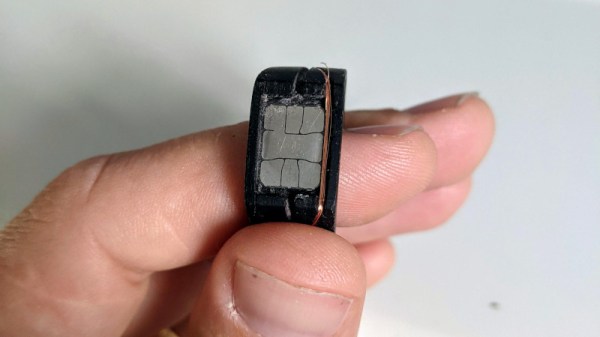
Contactless payment by means of NFC-enabled bank cards has made our everyday transactions far more convenient over the last decade, but there still remains the tedious task of finding the card and waving it over the reader. Maybe embedded chips are a step too far for many of us, but how about a bank card in a wearable such as a ring? [Jonathan Limén] shows us how, by taking the NFC chip module from a bank card and mounting it on a ring with a wire coil antenna embedded within it.

The chip in a bank card comes mounted on a small thin PCB with contacts on one side and a coil on the other that serves as its antenna. It’s not sensitive enough to work reliably with most card readers, so the card incorporates a separate printed circuit layer that forms a large-sized tuned circuit which couples to the chip antenna. After taking us through the removal of the chip from the card with some acetone, he proceeds to create a replacement for the card antenna by winding a wire coil round the ring. This becomes a trial-and-error process, but in the end, the result is a working NFC payment ring.

We quite like this idea, but would be tempted to both take away some of the trial and error with a vector network analyzer, and run a couple of turns of the wire as a closer coupling coil for the chip. This is a subject we’ve looked at before here at Hackaday, and we wouldn’t mind having another go at it.

Could India Be The Crucial Battleground For Open Access To Scientific Research?

One of the hottest topics in the world of scientific publishing over the last couple of decades has been the growing pressure to release the fruits of public-funded scientific research from the paywalled clutches of commercial publishers. This week comes news of a new front in this ongoing battle, as a group of Indian researchers have filed an intervention application with the help of the Indian Internet Freedom Foundation in a case that involves the publishers Elsevier, Wiley, and the American Chemical Society who have filed a copyright infringement suit against in the Delhi High Court against the LibGen & Sci-Hub shadow library websites.

The researchers all come from the field of social sciences, and they hope to halt moves to block the websites by demonstrating their importance to research in India in the light of unsustainable pricing for Indian researchers. Furthermore they intend to demonstrate a right of access for researchers and teachers under Indian law, thus undermining the legal standing of the original claim.

We’re not qualified to pass comment on matters of Indian law here at Hackaday, but we feel this will be a case worth watching for anyone worldwide with an interest in open access to research papers. If it can be established that open access shadow libraries can be legal in a country the size of India, then it may bring to an end the somewhat absurd game of legal whack-a-mole that has raged over the last decade between the sites on their untouchable Russian servers and heavy-handed academic publishers who perhaps haven’t moved on from their paper publishing past. It’s time for a fresh start with the way academic publishing works, and maybe this will provide the impetus for that to happen.

For those wondering what the fuss is about, we’ve looked at the issue in the past.

Indian flag image: © Yann Forget / Wikimedia Commons / CC-BY-SA.

Rubber Tyres Before There Were Tyres

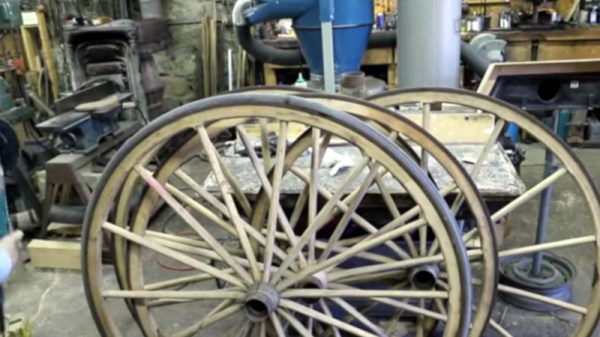
Sometimes there is pleasure in watching an expert demonstrating his craft, particularly so when the craft is unusual or disappearing. A video came our way of just such a thing, and it’s of a craft so rare that it’s possible few of us will have considered it. We’re used to buying tyres for our motor vehicles that come pre-made in a mould for the size of our wheels, but how many of us have considered where the origins of the rubber tyre lie? How did a 19th-century horse-drawn buggy get its tyres? [EngelsCoachShop] take us through the process, putting rubber on a set of wooden carriage wheels.

These wheels would originally have had iron rims, that must have provided a jarring ride on cobbled roads of the day. English coach-builders of the mid 19th century were the first to fit solid rubber tyres, and it’s this type of tyre that’s being fitted in the video. Instead of the rubber ring we might expect the tyre is cut from a length of vulcanised rubber extrusion with a significant overlap, then a pair of high-tensile wires are fed through holes in the extrusion. The impressive part is the jig for creating the tyre, in which the rubber is compressed to a tight fit on the wheel before the wires are cut and their ends brazed together. Once the wheel is released from the jig  the compressed tyre expands to the point at which its ends meet, making a perfect circular tyre held tightly on the rim. Few of us will ever see this for real, but we’re privileged to see it on the screen.

We may not deal with wooden wheels very often, but this isn’t the first set we’ve seen.

Continue reading “Rubber Tyres Before There Were Tyres”

Spacing Out: Telescopes, Politics, And Spacecraft Design

Let’s launch into a round-up of stories that are out of this world, as we take a look at what’s happening in the realm of space exploration.

Ten Billion Dollars For A Telescope? Don’t Drop It!

Perhaps the most highly anticipated space mission of the moment is the James Webb Space Telescope, an infra-red telescope that will be placed in an orbit around the Earth-Sun L2 Lagrange point from which it will serve as the successor to the now long-in-the-tooth Hubble telescope. After many years of development the craft has been assembled and shipped to French Guiana for a scheduled Ariane 5 launch on the 22nd of December. We can only imagine what must have gone through the minds of the engineers and technicians working on the telescope when an unplanned release of a clamp band securing it to the launch vehicle adapter sent a vibration throughout the craft. Given the fragility of some of its components this could have jeopardised the mission, however after inspection it was found that no damage had occurred and that space-watchers and astronomers alike can breathe easy.

Continue reading “Spacing Out: Telescopes, Politics, And Spacecraft Design”

Is The Game Up For Baofeng In Europe?

For radio enthusiasts worldwide, the inexpensive Chinese handheld radios produced by the likes of Baofeng and other brands have been a welcome addition to their arsenal. They make an ideal first transceiver for a new licensee, a handy portable for any radio amateur, and an inexpensive basis for UHF or VHF experimentation. Unfortunately with the low cost comes something of a reputation for not having the cleanest spectral output, and it seems that this has caught the attention of regulators in Germany and Poland. In Germany this has resulted in the announcement of a sales prohibition (PDF in German) which seems likely to be repeated across the rest of the EU.

It seems what has happened is that the quality of the Baofeng radios on sale doesn’t match that claimed in their conformity documents, which should honestly come as a surprise to nobody. It is interesting that the paperwork mentions the Baofeng UV-5R specifically, as it seems likely to us that an inevitable game of whack-a-mole will ensue with the same radios appearing under ever more brand names and part numbers. The basic UV-5R already appears under a number of variants, for example the one where this is being written is a near-identical but slightly more powerful BF-F8, so this should again come as no surprise.

If you live in Europe should you panic buy a Baofeng while you still can? Probably not, unless you really need one. Something tells us they will remain readily available from the usual overseas sources for years to come. Meanwhile this isn’t the first time a regulator has raised questions about this type of radio.

Thanks [2ftg] for the tip.

Header image: Варвара Каминская, CC BY-SA 4.0.

The Medieval History Of Your Favourite Dev Board

It’s become something of a trope in our community, that the simplest way to bestow a level of automation or smarts to a project is to reach for an Arduino. The genesis of the popular ecosystem of boards and associated bootloader and IDE combination is well known, coming from the work of a team at the Interaction Design Institute Ivrea, in Northern Italy. The name “Arduino” comes from their favourite watering hole, the Bar di Re Arduino, in turn named for Arduin of Ivrea, an early-mediaeval king.

As far as we can see the bar no longer exists and has been replaced by a café, which appears on the left in this Google Street View link. The bar named for Arduin of Ivrea is always mentioned as a side note in the Arduino microcontroller story, but for the curious electronics enthusiast it spawns the question: who was Arduin, and why was there a bar named after him in the first place?

The short answer is that Arduin was the Margrave of Ivrea, an Italian nobleman who became king of Italy in 1002 and abdicated in 1014. The longer answer requires a bit of background knowledge of European politics around the end of the first millennium, so if you’re ready we’ll take Hackaday into a rare tour of medieval history.

Continue reading “The Medieval History Of Your Favourite Dev Board”