Looking Forward To Electromagnetic Field 2018

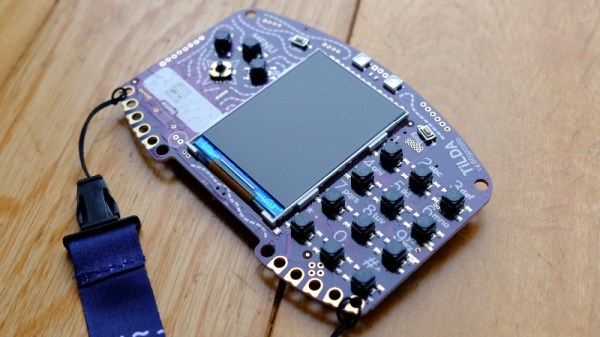
There is an air of excitement among the hackerspaces of Europe, because this month is hacker camp season. In Denmark they have Bornhack beginning on Thursday, in Italy IHC was held earlier in the month, while here in the UK we are looking forward to Electromagnetic Field. We’re excited be at Eastnor Castle for Electromagnetic Field at the cusp of August and September for several days under canvas surrounded by our community’s best and brightest work. We’ll even have a Hackaday Readers’ Village this year!

If you’ve never been to a hacker camp before, this is one that’s not to be missed. Technically this is camping, but where every structure from the smallest tent upwards has mains power and gigabit Ethernet. It’s the equivalent of a music festival if you replace the music with technology and other cool stuff from our world. There are talks on a huge variety of fascinating subjects, the chance to see up close some of the things you’ll have read about here on Hackaday, and best of all, a significant proportion of Europe’s hackerspace communities all together in one place. They are a uniquely stimulating and exciting environment.

Continue reading “Looking Forward To Electromagnetic Field 2018”

Build Your Own Linux Single Board Computer

We are fortunate enough to have a huge choice of single-board computers before us, not just those with a bare-metal microcontroller, but also those capable of running fully-fledged general purpose operating systems such as GNU/Linux. The Raspberry Pi is probably the best known of this latter crop of boards, and it has spawned a host of competitors with similarly fruity names. With an entire cornucopia to choose from, it takes a bit more than evoking a berry to catch our attention. The form factors are becoming established and the usual SoCs are pretty well covered already, show us something we haven’t seen before!

[Marcel Thürmer] may have managed that feat, with his Blueberry Pi. On the face of it this is just Yet Another SBC With A Fruity Pi Name, but what caught our attention is that unlike all the others, this is one you can build yourself if you want. It’s entirely open-source, but it differs from other boards that release their files to the world in that it manages to keep construction within the realm of what is possible on the bench rather than the pick-and-place. He’s done this by choosing an Alwinner V3, an SoC originally produced for the action camera market that is available in a readily-solderable TQFP package. It’s a choice that has allowed him to pull off another constructor-friendly feat: the board is only two layers, so it won’t break the bank to have it made.

It’s fair to say that the Allwinner V3 (PDF) isn’t the most powerful of Linux-capable SoCs, but it has the advantage of built-in RAM to avoid more tricky soldering. With only 64Mb of memory, it’s never going to be a powerhouse, but it does pack onboard Ethernet, serial and parallel camera interfaces, and audio as well as the usual interfaces you’d expect. There is no video support on the Blueberry Pi, but the chip has LVDS for an LCD panel, so it’s not impossible to imagine something could be put together. Meanwhile, all you need to know about the board can be found on its GitHub repository. There is no handy OS image to download, u-boot instructions are provided to build your own. We suspect if you’re the kind of person who is building a Blueberry Pi though this may not present a problem to you.

We hope the Blueberry Pi receives more interest, develops a wider community, and becomes a board with a solid footing. We like its achievement of being both a powerful platform and one that is within reach of the home constructor, and we look forward to it being the subject of more attention.

The Electric Vehicles Of Electromagnetic Field: The Dustbin 7

We’re producing an occasional series following some of the miniature electric vehicle builds currently underway at a feverish pace to be ready for the upcoming Electromagnetic Field hacker camp in the UK. Today we’re going down to Somerset, where [Rory] has produced a very serviceable machine he calls the Dustbin 7.

The Hacky Racers series stipulates a £500 budget along with a few rules covering vehicle safety and dimensions, so he had to pick his components carefully to allow enough cash for the pile of LiPo batteries he’d have to buy new in the absence of a convenient surplus source. The motor he picked was a 2kW brushless scooter motor, and that he mated to a 48V e-bike controller

Running gear came from a surplus school project race car but looks suspiciously similar to the wheels you’d see on a typical electric wheelchair. His chassis is welded box section steel, and the bodywork has a classic car feel to it as he comes from a family of Triumph owners. The name “Dustbin 7” comes from the affectionate nickname for the popular pre-war British Austin 7 people’s car.

In use, as you can see below it appears to have a fair turn of speed without displaying too alarming a handling characteristic. If this is the standard of vehicles in the competition then we can imagine that racing will be an exciting spectacle!

For more EMF electric vehicle tomfoolery, take a look at this modified Sinclair C5.

Continue reading “The Electric Vehicles Of Electromagnetic Field: The Dustbin 7”

Electrostatically Accelerated Ping-Pong Ball Travels The Circuit

There is a special breed of hardware hacker whose playground lies in the high voltage arena. Their bench sizzles with the ozone and plasma of Tesla coils, and perhaps it’s best not to approach it without a handy fluorescent light tube to sniff for unseen hazards. There are many amazing things that can come of these experiments, and fortunately for those of us who lack the means or courage to experiment with them there are many YouTube videos to satisfy our curiosity.

One such comes from [Plasma channel], in the form of a table-top ping-pong ball accelerator. It lacks impressive sparks  but makes up for it in scientific edification, because it uses static electricity to send a conductive-paint-coated ping-pong ball spinning round the inside of a curved glass bowl. It does this using alternate positive and negatively charged strips of aluminium tape on the inside of the bowl, each of which charges the ball as it rolls over it, then giving it a bit of repulsive force to keep it spinning. His power comes from a couple of small Wimshurst machines, but no doubt other similar generators could be used instead.

The whole is an entertaining if a little hazardous talking point, and a fun weekend build. The parts are easy enough to find that you might even have them to hand. If continued electrostatic diversion floats your boat, you might like to read our recent excursion into the subject.

Continue reading “Electrostatically Accelerated Ping-Pong Ball Travels The Circuit”

Rediffusion Television: Early Cable TV Delivered Like Telephone

Recently I spent an enjoyable weekend in Canterbury, staying in my friend’s flat with a superb view across the rooftops to the city’s mediaeval cathedral. Bleary-eyed and in search of a coffee on the Sunday morning, my attention was immediately drawn to one of her abode’s original built-in features. There on the wall in the corner of the room was a mysterious switch.

Housed on a standard-sized British electrical fascia was a 12-position rotary switch, marked with letters A through L. An unexpected thing to see in the 21st century and one probably unfamiliar to most people under about 40, I’d found something I’d not seen since my university days in the early 1990s: a Rediffusion selector switch.

If you have cable TV, there is probably a co-axial cable coming into your home. It is likely to carry a VHF signal, either a series of traditional analogue channels or a set of digital multiplexes. “Cable ready” analogue TVs had wideband VHF tuners to allow the channels to be viewed, and on encrypted systems there would have been a set-top box with its own analogue tuner and decoder circuitry.

Your digital cable TV set-top box will do a similar thing, giving you the channels you have subscribed to as it decodes the multiplex. At the dawn of television transmission though, none of this would have been possible. Co-axial cable was expensive and not particularly high quality, and transistorised wideband VHF tuners were still a very long way away. Engineers designing the earliest cable TV systems were left with the technology of the day derived from that of the telephone networks, and in Britain at least that manifested itself in the Rediffusion system whose relics I’d found.

Continue reading “Rediffusion Television: Early Cable TV Delivered Like Telephone”

A Display Made From Shoelaces

In our time here at Hackaday, we have seen many display builds, but this one from [Brian Lough] has to be a first. He’s created a 7-segment display made from shoelaces, and it works rather well.

Before you imagine the fabric cords you’re used to with your trainers, it’s worth explaining that these aren’t shoelaces in the traditional sense, but transparent light pipe taken from commercially available light-up shoelaces. He’s created a 3D-printed frame with receptacles for each end of the light pipe sections he’s used as segments, and spaces for addressable LEDs on the rear. He makes no bones about his soldering job being less than perfect, but the result when hooked up to an Arduino is very impressive. A large 7-segment LED display that’s visible in the glare of his bench lighting and not just in subdued illumination. Future plans include replacing the messy wiring with stripboard sections for a better result.

This isn’t the first 7-segment display using a light pipe that we’ve seen here at Hackaday, a previous effort used a more novel substance. But perhaps this Nixie-inspired take on the same idea also deserves a mention.

Continue reading “A Display Made From Shoelaces”

Using Acoustic Levitation For Applications Going Way Beyond Novelty

We’ve all seen acoustic levitation, it’s one of the scientific novelties of our age and a regular on the circuit of really impressive physical demonstrations of science to the public. The sight of arrays of ultrasonic speakers causing small objects and beads of liquid to float in mid-air without any suspension is magical, captivating people of all ages. Thus a lecture at Hackaday Belgrade on the subject from Asier Marzo, a research scientist with a speciality in the field of ultrasonics at the UK’s University of Bristol, was a particularly fascinating and informative one.

He started by explaining acoustic levitation as a concept, and its mechanism. As an idea it’s one with a long history, he tells us that hundreds of years ago people tried mass ranks of the loudest musical instruments at their disposal to move rocks, all to no avail. The array of musicians of yore lacked the ability to control their individual phase, and of course their combined output would have balked at a pea-sized piece of gravel, let alone a boulder.

Explaining the standing wave produced by an ultrasonic array.

The Power of Standing Waves

Given that we can now create standing waves between phased arrays of ultrasonic speakers, he explained the mechanism that allows the levitation. The standing wave creates patterns of high intensity and “quiet” low intensity sound, and the object nestles in one of these quiet areas. There is thus a size limit dictated by the wavelength of the sound in question, which for the ultrasound he’s using is in the order of a few millimetres.

Having explained how it all works, we were then taken into the fields in which it finds an application. This was particularly interesting, because it’s the side we never see in the for-the-kids demos where it’s all about “Look, we can make the water droplet float!”. The number of fields that can find a use for it was a surprise, and formed the next phase of the talk.

Real World Uses for Acoustic Levitation

The first example given was in the field of spectroscopy, when reflecting light from a droplet of liquid on a substrate a certain amount of the reflected light comes from the substrate. If the sample is levitated, all the reflection comes from it and nothing else. Microgravity experiments are another interesting application, where it is possible to replicate some of the work that has previously required  the environment of a space craft such as the International Space Station. This was a particularly unexpected twist.

Explaining the standing wave produced by an ultrasonic array.
Manipulating a solid particle with a wearable array.

The technique can be used for tiny particles in a liquid medium with a much higher frequency — a demonstration involves moving a single blood cell in a pattern. But Asier has more tricks up his sleeve. This technique can be used in human interactions with computers and with the real world. We saw a display in which the pixels were small plastic balls suspended in a grid, they could even be flipped in colour by being rotated under an electric field. A successive display used the balls not in a grid but as a point cloud in a graph, proving that rasters are not the only means of conveying information. Finally we saw the arrays applied to wearable devices, a handheld tractor beam, and a set of standing wave tweezers. He gave the example of picking up an SMD component, something that we can see would be invaluable.

Levitation is Within Our Grasp

The good news for us is that this is a piece of cutting-edge science that is accessible to us at our level too. He’s made a selection of designs available online through the Acoustic Levitator site. There is an ultrasonic array, an acoustic levitator, and an acoustic tractor beam, and the components are such run-of-the-mill parts as Arduinos and motor driver boards. Even schoolchildren building them from kits, with an experimenter using one for Schlieren photography of the acoustic field. Finally we’re shown Ultraino, an ambitious project providing software and driver hardware for large arrays in which every transducer is individually driven, before a tantalising look at future work in fluid ultrasonics and the promise of an ultrasonic audio speaker project.

Hackaday covers a huge array of projects and topics from all corners of our community. Each one is exciting in its own way, from a simple-looking Arduino project that encapsulates a cool hack to a multi-year labour of love. It’s not often though that we can say we’ve seen a genuinely cutting-edge piece of science, while simultaneously having it explained in terms we understand and being given an accessible version that we can experiment with ourselves. We are really looking forward to the projects that will come from this direction, as acoustic levitation becomes yet another known quantity in the hardware hacker’s armoury.