In our time here at Hackaday, we have seen many display builds, but this one from [Brian Lough] has to be a first. He’s created a 7-segment display made from shoelaces, and it works rather well.
Before you imagine the fabric cords you’re used to with your trainers, it’s worth explaining that these aren’t shoelaces in the traditional sense, but transparent light pipe taken from commercially available light-up shoelaces. He’s created a 3D-printed frame with receptacles for each end of the light pipe sections he’s used as segments, and spaces for addressable LEDs on the rear. He makes no bones about his soldering job being less than perfect, but the result when hooked up to an Arduino is very impressive. A large 7-segment LED display that’s visible in the glare of his bench lighting and not just in subdued illumination. Future plans include replacing the messy wiring with stripboard sections for a better result.
We’ve all seen acoustic levitation, it’s one of the scientific novelties of our age and a regular on the circuit of really impressive physical demonstrations of science to the public. The sight of arrays of ultrasonic speakers causing small objects and beads of liquid to float in mid-air without any suspension is magical, captivating people of all ages. Thus a lecture at Hackaday Belgrade on the subject from Asier Marzo, a research scientist with a speciality in the field of ultrasonics at the UK’s University of Bristol, was a particularly fascinating and informative one.
He started by explaining acoustic levitation as a concept, and its mechanism. As an idea it’s one with a long history, he tells us that hundreds of years ago people tried mass ranks of the loudest musical instruments at their disposal to move rocks, all to no avail. The array of musicians of yore lacked the ability to control their individual phase, and of course their combined output would have balked at a pea-sized piece of gravel, let alone a boulder.
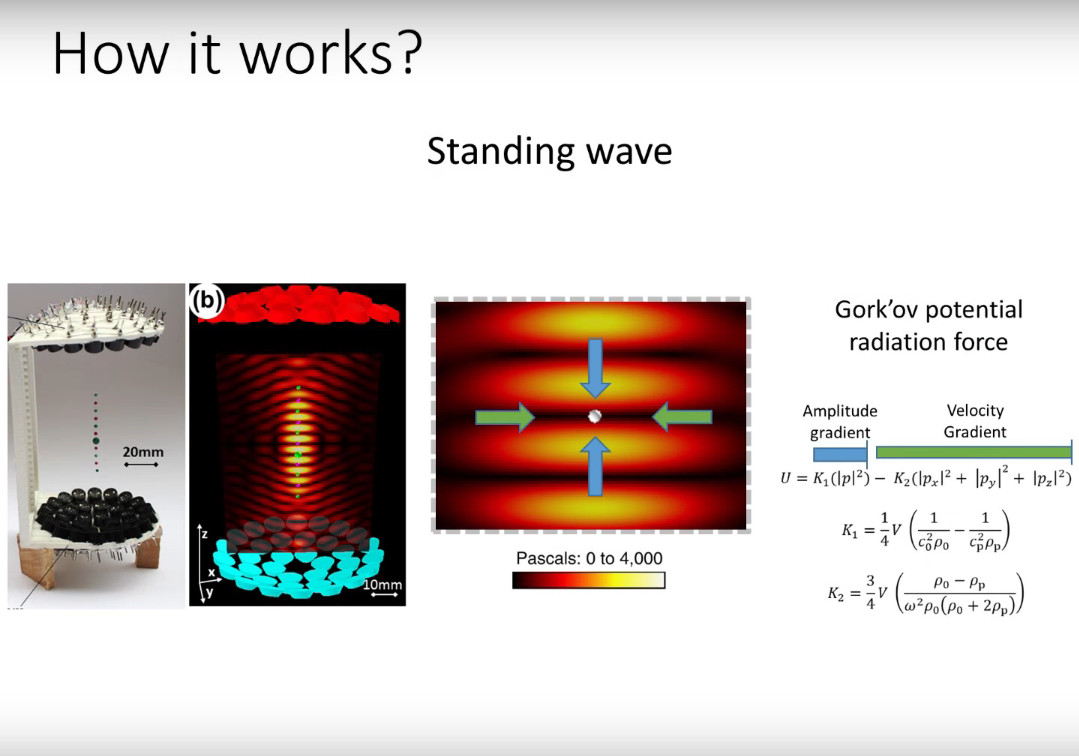
Explaining the standing wave produced by an ultrasonic array.
The Power of Standing Waves
Given that we can now create standing waves between phased arrays of ultrasonic speakers, he explained the mechanism that allows the levitation. The standing wave creates patterns of high intensity and “quiet” low intensity sound, and the object nestles in one of these quiet areas. There is thus a size limit dictated by the wavelength of the sound in question, which for the ultrasound he’s using is in the order of a few millimetres.
Having explained how it all works, we were then taken into the fields in which it finds an application. This was particularly interesting, because it’s the side we never see in the for-the-kids demos where it’s all about “Look, we can make the water droplet float!”. The number of fields that can find a use for it was a surprise, and formed the next phase of the talk.
Real World Uses for Acoustic Levitation
The first example given was in the field of spectroscopy, when reflecting light from a droplet of liquid on a substrate a certain amount of the reflected light comes from the substrate. If the sample is levitated, all the reflection comes from it and nothing else. Microgravity experiments are another interesting application, where it is possible to replicate some of the work that has previously required the environment of a space craft such as the International Space Station. This was a particularly unexpected twist.
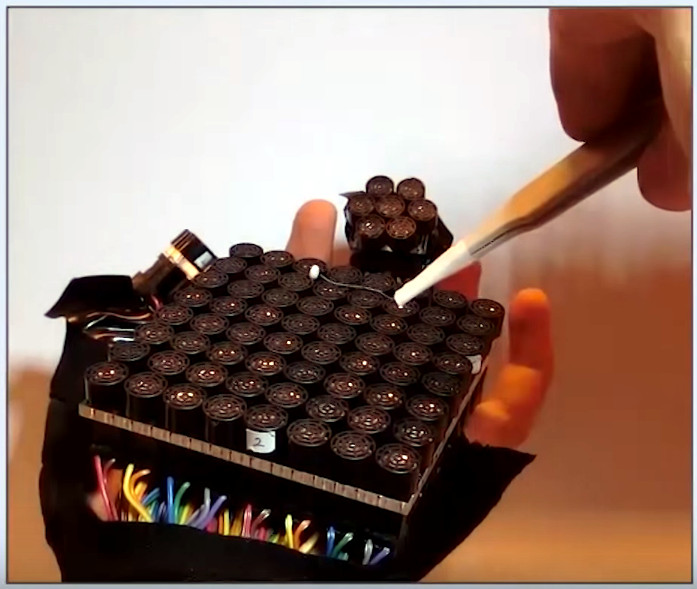
Manipulating a solid particle with a wearable array.
The technique can be used for tiny particles in a liquid medium with a much higher frequency — a demonstration involves moving a single blood cell in a pattern. But Asier has more tricks up his sleeve. This technique can be used in human interactions with computers and with the real world. We saw a display in which the pixels were small plastic balls suspended in a grid, they could even be flipped in colour by being rotated under an electric field. A successive display used the balls not in a grid but as a point cloud in a graph, proving that rasters are not the only means of conveying information. Finally we saw the arrays applied to wearable devices, a handheld tractor beam, and a set of standing wave tweezers. He gave the example of picking up an SMD component, something that we can see would be invaluable.
Levitation is Within Our Grasp
The good news for us is that this is a piece of cutting-edge science that is accessible to us at our level too. He’s made a selection of designs available online through the Acoustic Levitator site. There is an ultrasonic array, an acoustic levitator, and an acoustic tractor beam, and the components are such run-of-the-mill parts as Arduinos and motor driver boards. Even schoolchildren building them from kits, with an experimenter using one for Schlieren photography of the acoustic field. Finally we’re shown Ultraino, an ambitious project providing software and driver hardware for large arrays in which every transducer is individually driven, before a tantalising look at future work in fluid ultrasonics and the promise of an ultrasonic audio speaker project.
Hackaday covers a huge array of projects and topics from all corners of our community. Each one is exciting in its own way, from a simple-looking Arduino project that encapsulates a cool hack to a multi-year labour of love. It’s not often though that we can say we’ve seen a genuinely cutting-edge piece of science, while simultaneously having it explained in terms we understand and being given an accessible version that we can experiment with ourselves. We are really looking forward to the projects that will come from this direction, as acoustic levitation becomes yet another known quantity in the hardware hacker’s armoury.
Heaven, for tech-inclined late-1970s British kids.
Early last spring, we featured a book review, as part of our occasional Books You Should Read series. Usually these are seminal tomes, those really useful books that stay with you for life and become well-thumbed, but in this case it was a children’s book. Making a Transistor Radio, by [George Dobbs, G3RJV], was a part of the long-running series of Ladybird books that educated, entertained, and enthralled mid-20th-century British kids, and its subject was the construction of a 3-transistor regenerative AM receiver. If you talk to a British electronic engineer of A Certain Age there is a good chance that this was the volume that first introduced them to their art, and they may even still have their prized radio somewhere.
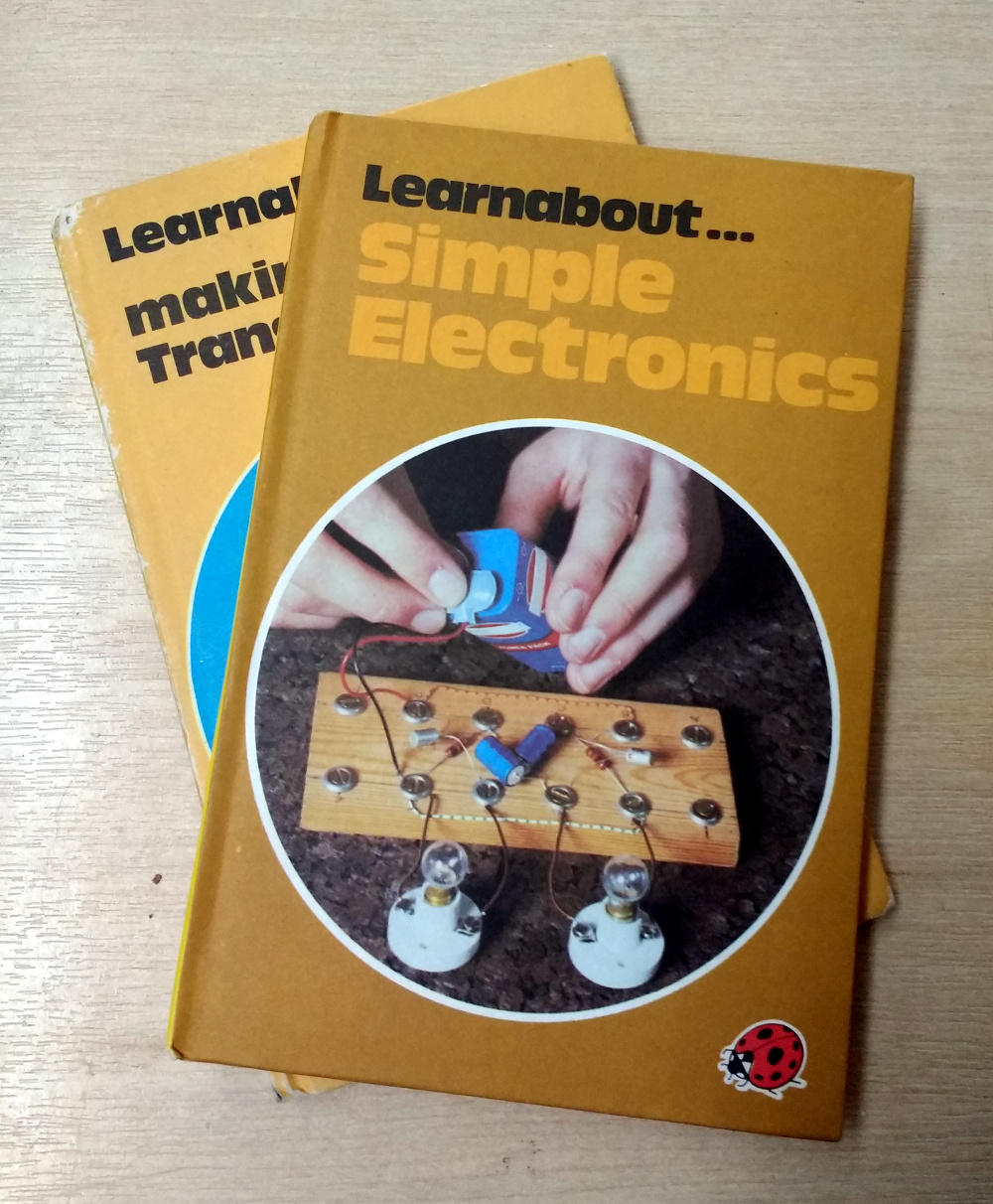
Making a Transistor Radio was a success story, but what’s not so well-known is that there was a companion volume published a few years later in 1979. Simple Electronics was part of the imprint’s Learnabout series, and it took the basic premise of its predecessor away from the realm of radio into other transistor circuits. Transistor timers and multivibrators were covered, Morse code, and finally quite an ambitious project, an electronic organ.
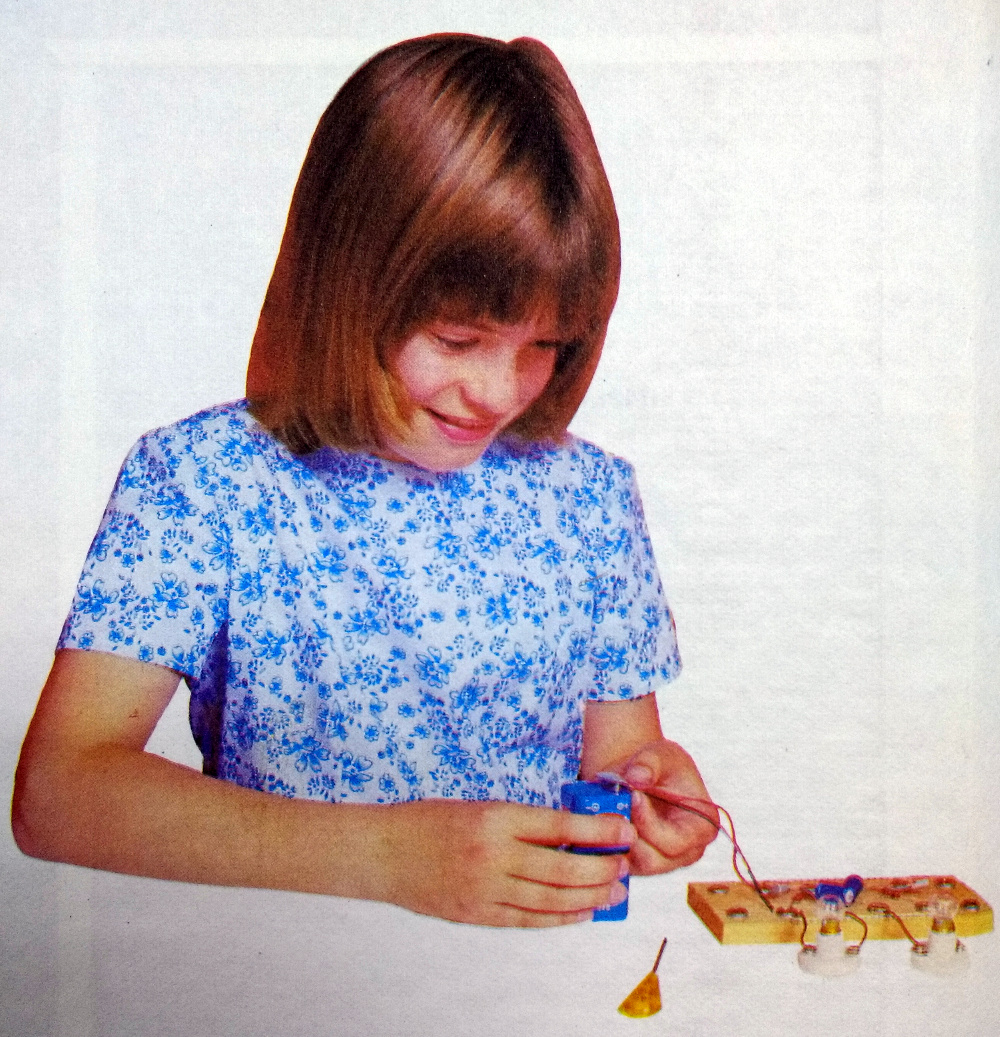
Opening the book it is evident that there has been a slight cultural shift since the first volume was published. The typography is much more modern in feel, and the picture of the child experimenter on the inside of the cover is a photograph of a late-70s young girl in place of the 1950s-style boy wearing a tie building the radio. The practical nature of the writing hasn’t changed though, while it states that some of the background information is not being repeated from Making a Transistor Radio we are taken straight into the deep end with a section on the tools required to work with the series’ signature screw cup on wooden baseboard construction technique.
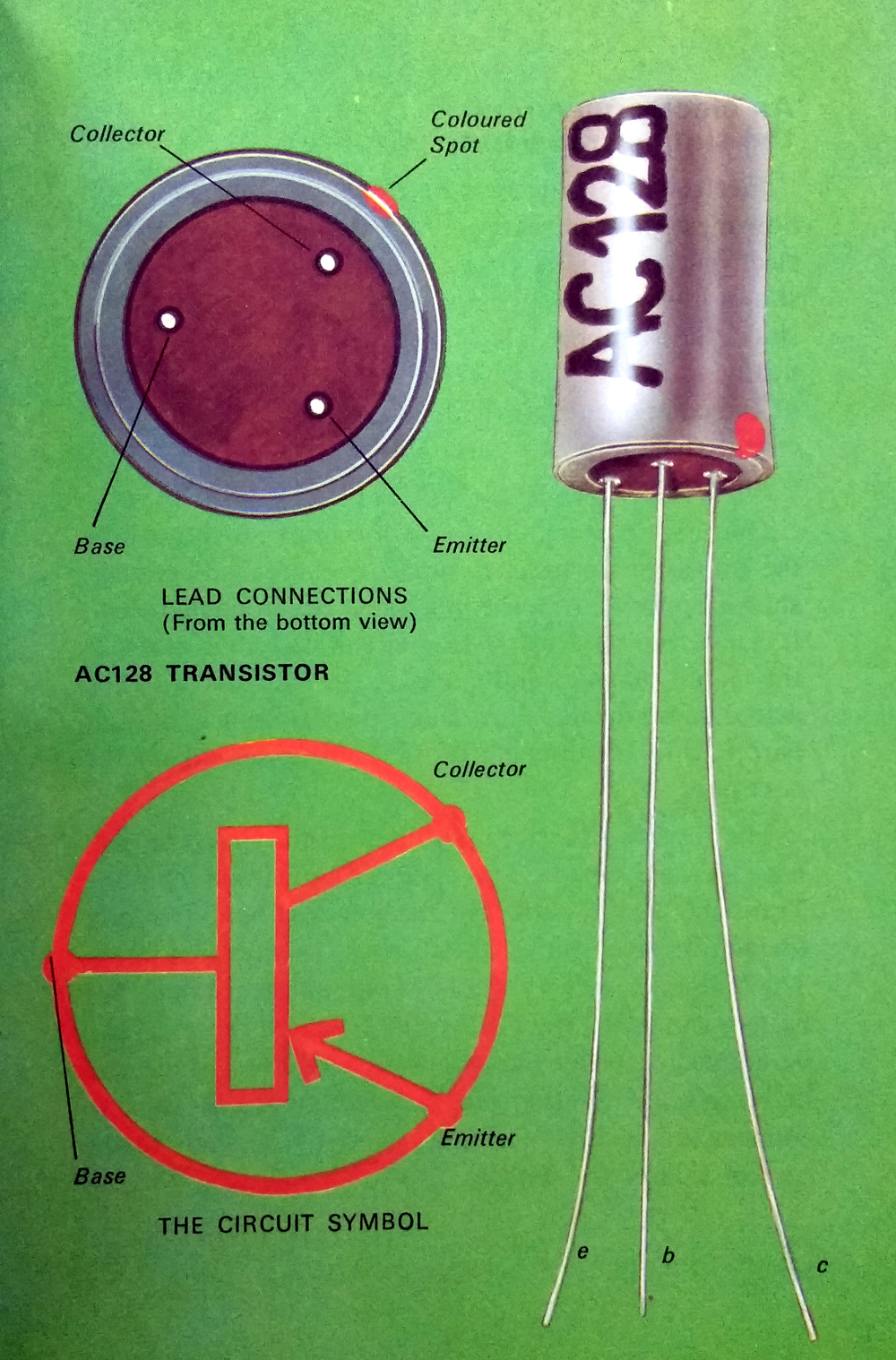
Construction was so much easier when transistors came with long leads.
The original book used germanium transistors from the Mullard OC series, OC71s and an OC44. These were some of the earliest British transistors, and as I can attest from building my radio in that period, difficult to obtain by the late 1970s. This book has therefore moved on to a later design, the AC128. Still a germanium PNP device, but this time in a metal can and crucially still available at the time due to having been a part used in more than one mid-70s colour TV set. We’re given a no-nonsense introduction to the device, told about its package, pinout, and schematic diagram. It’s refreshing to see a children’s book in which the child is introduced to such an adult subject as this without being constantly reminded that they are a child.
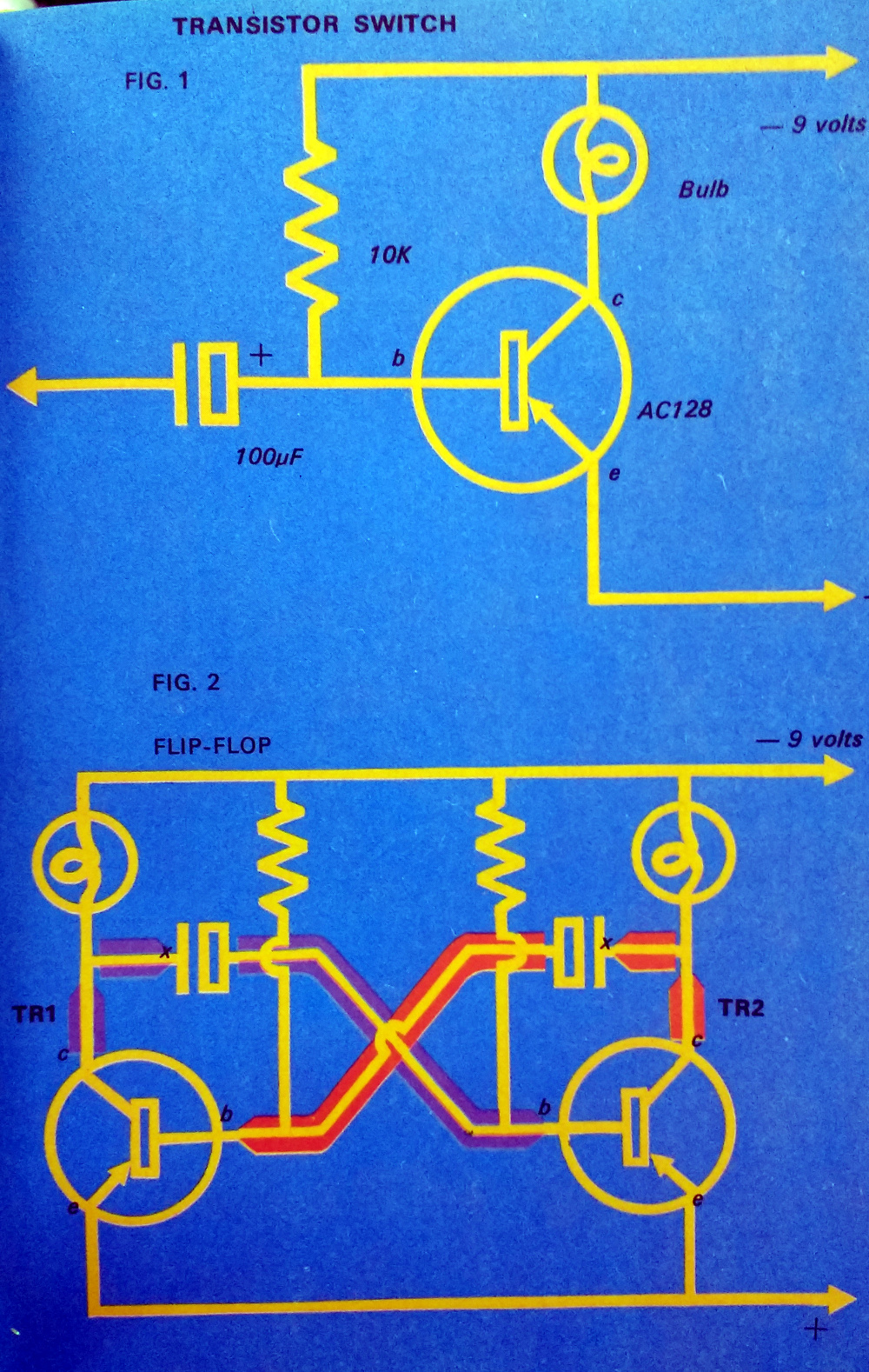
We then spend a couple of pages looking at a transistor as a switch. A 10K base resistor is used to bias an AC128 with a flashlight bulb as its collector load, and with a flying lead to the negative supply (remember this is a PNP transistor!) the bulb can be turned on and off. In typical form, we’re shown how to make a bulb holder from a paper clip should we not be able to source a dedicated component. The basic switch is then extended with an electrolytic capacitor to make a simple time delay switch, and finally we’re shown how two such circuits combine to make an astable multivibrator and flash a pair of bulbs.
The astable multivibrator, explained for kids.
For me, circa 1979 or 1980, this was something of an earth-shattering moment. For the first time, I understood how an oscillator worked. That transistor turned on, triggering the other transistor after a delay, which in turn triggered the first transistor after a further delay, and so on and so on. It’s a simple enough circuit, but to a kid who had only recently been introduced to electronics, it was an amazing moment of revelation to have an insight into how it worked. It probably gave me a lifetime bad habit in that the two-transistor astable has become my go-to circuit when I need a quick and dirty square wave. They can be assembled from commonly desolderable scrap components on a bit of PCB or tinplate in a matter of minutes, and I have used them for nasty logic clocks, harmonic-rich signal sources, PWM oscillators, switching power supplies, and many more applications all because of this book.
Enough reminiscences, and time to turn the page. For a bit of fun we’re shown the light flasher as a robot with flashing eyes, before substituting some of the components and adding a crystal earpiece for an audio oscillator. This is the first part of the serious business of the book, because it forms the basis of all the following projects. It’s also the furthest I got with the book as a child, because of a lack of enough AC128s for the complete organ project, and a lack of aptitude for music. I was shown how to use a soldering iron, discovered that scrap TV sets in dumpsters contained a goldmine of parts, and never looked back.
[George Dobbs] is a radio amateur, so of course once he has a legion of British kids with audio oscillators he then leads them into making a Morse Code practice oscillator with a filter and a key made from tinplate. In typical no-nonsense style we’re introduced to amateur radio, code, and basic operating procedure. There are even instructions for making a two-station setup using three-core mains flex, how many kids who built that went on to have callsigns of their own?
The organ project awaits, but before then we have time for a couple more circuits to get used to varying the pitch of the oscillator. A “violin” using a potentiometer, and a photoelectric cell each get their own page, after which you have to wonder: how many kids managed to get their parents to shell out for that ORP12 CdS cell?
Never lose the fascination you gain from your first project!
The organ is of the “Stylophone” variety, with notes picked out using a stylus over conductive pads on the keyboard. Skeleton preset potentiometers are used for tuning, with the alternative of filing notches in carbon resistors. This would not have been a cheap project at all on a pocket-money budget in 1979, did any readers build it? If they went for the final two pages, the same 1-transistor loudspeaker amplifier as that used in the transistor radio, and a vibrato circuit using a low-frequency version of the multivibrator, then pocket money would have been in very short supply indeed.
But to look at it this way probably misses the point of the book. Where the previous book was all about presenting a single project in stages, this one is more about teaching some basic transistor circuits in stages. When I was given a copy I had a basic idea about transistors from those OC71s in the radio, but when I’d read this one and built some of the circuits I had a much more varied grasp of solid-state electronics. I knew about RC circuits and oscillators, and the effect of changing the values of an RC circuit on frequency. Some of the things I learned from this book I still use today, and nearly a decade after reading it when I was a 1st year electronic engineering undergraduate I hit the ground running in our course on transistor circuits because of it.
Learnabout Simple Electronics has been out of print for well over three decades now, but if you want a copy you should be able to find it in second-hand book stores online. There’s also at least one PDF version available too, if all you want is a quick look.
The oscilloscope is an essential tool of any electronics bench, and it is also an instrument whose capabilities have expanded exponentially over the decades. Your entirely analogue CRT ‘scope of a few decades ago has now been supplanted by a digital device that takes on many of the functions of both an expensive multimeter a frequency counter, and more. At the top end of the market the sky is the limit when it comes to budget, and the lower end stretches down to low-bandwidth devices based upon commodity microcontrollers for near-pocket-money prices.
These super-cheap ‘scopes are usually sold as kits, and despite their very low bandwidth are surprisingly capable instruments with a useful feature set due to well-written software. I reviewed a typical model last year, and came away lamenting its lack of an internal battery and a decent quality probe. If only someone would produce an inexpensive miniature ‘scope with a decent bandwidth, decent probe, and an internal battery!
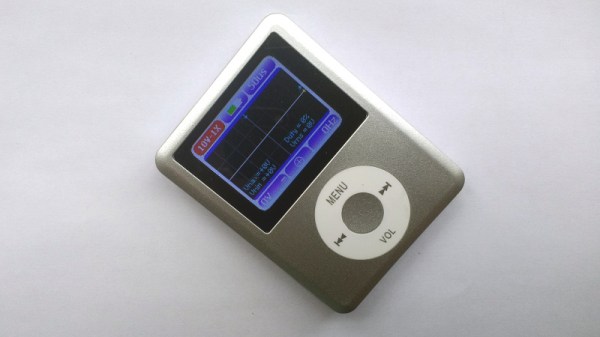
As it happens, I didn’t have long to wait for my wish to be satisfied, with news of the release of the DSO Nano 3. Let’s see what you can do with a portable scope for less than $50.
We’re used to loudspeakers as circular components with a paper cone and a big magnet inside which is suspended a coil that is connected to our audio amplifier. But moving-coil speakers are not the only way to create sound from electricity, there are one or two other weapons in the audio designer’s arsenal.
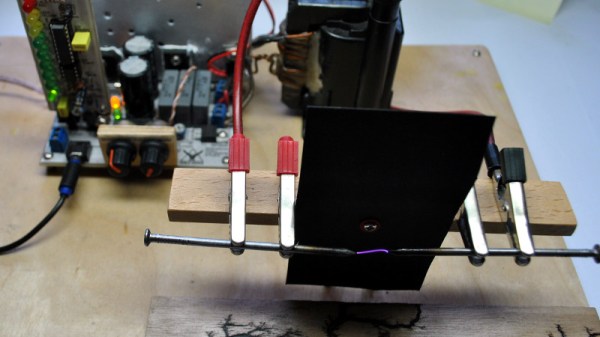
One of the more spectacular and entertaining is the plasma speaker, and it’s one [Marcin Wachowiak] has been experimenting with. A continuous plasma in the form of a discharge between two electrodes is modulated with an audio signal, and the resulting rapid changes in the volume of plasma creates a sound. The value of a plasma speaker lies in the exceptionally low size and mass of the element producing the sound, meaning that while it can only effectively reproduce high frequencies it can do so from a much closer approximation to a point source than can other types of tweeter. For this reason it’s beloved of some audiophiles, and you will find a few commercially produced plasma tweeters at the high-end of the audio market.
[Marcin] isn’t in it for the audiophilia, instead he’s interested in the properties of the plasma. His plasma speaker does do the job well though, and in particular he’s put a lot of thought into the design of its drive circuit. At its heart is the ubiquitous TL494 PWM controller that you may be more familiar with in the context of switching power supplies, this one applies the audio drive as PWM to the gate of a MOSFET that switches the primary of a flyback transformer. He’s added refinements such as a gate discharge circuit and a second primary winding with a freewheel diode.
The result is an effective plasma speaker. It’s difficult to judge from his YouTube video below the break whether he’s achieved audiophile purity, but happily that’s not the point. We’ve shown you a few other plasma speakers in our time, if the subject interests you then take a look at this rotating plasma vortex, or a version using a 555 timer.
The ever-effusive Dave from EEVblog has posted a video in which he takes a tour, and like us he’s continually exclaiming over the items he finds. An EAI analog computer, a full set of DEC PDP-11 technical documentation, a huge Intel development system, Tektronix printers, huge DEC racks, memory cards for VAXen, piles and piles of boxes of documentation, and much, much more.
So, if you are an Aussie within reach of Sydney who happens to have a currently-unused warehouse, barn, or industrial unit that could house some of this stuff, get in touch with them quickly. Some of it may well be junk, but within that treasure trove undoubtedly lies a lot of things that need to be saved. We’d be down there ourselves, but are sadly on the other side of the world.
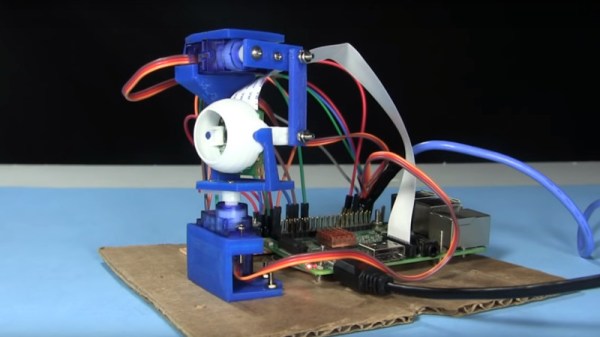
Most of us, if we have bought a single board computer with the capability to support a camera, will have succumbed to temptation and shelled out for that peripheral in the hope that we can coax our new toy into having sight. We’ll have played with the command line tool and taken a few random images of our bench, but then what? There is so much possibility in a camera that our colleague [Steven Dufresne] wanted to explore with his Raspberry Pi, so he built a motorised eyeball mount with which to do so.
Pan & tilt mounts using RC servos are nothing especially new, but in this one he’s put some design effort that maybe some of the others lack. A lot of effort has gone in to ensuring no interference between the two axes, and in a slightly macabre twist until you remember it’s a model he’s talking about, the unit has been designed to fit inside a human head.
The servos are driven from the Pi using a servo driver board he’s discussed in another video, so once he’s described the assembly with a few design tweaks thrown in he has a quick look at the software demo he’s written emulating neurons for eye tracking. He promises that will be put up somewhere for download in due course.
If you’re in the market for a pan & tilt mount for your Pi, this one could make a lot of sense to throw at your 3D printer. It’s certainly more accomplished than this previous one we’ve shown you.