Only Mechanical Relays Will Do For Automated Hi-Fi Audio Source Switching

If you are a devotee of audiophile-quality analogue hi-fi, switching between sources simply can not be done through a solid-state device. Only physical switches will do because they come without the risk of extra noise or distortion that their silicon equivalents might bring.

That is the philosophy that lies behind [Skrodahl]’s relay-based audio switching board, which boasts 5 high-quality relays each handling a stereo input, with their control passed either to a rotary switch or to an ESP32 module. The ground connections on audio and switching sides are isolated from each other to avoid transient noise finding its way to the speakers.

You might think that an audio switching board is a very simple device indeed and thus not worthy of Hackaday’s attention, but it’s surprisingly easy to make a mess of a module like this one and they have put in some effort to avoid the pitfalls. The metal-can version of the switching transistors seems a little overkill, but fancy audio is a funny business.

If the ESP isn’t your bag, we’ve brought you another relay based audio switcher in the past that used an Atmel chip.

An Autonomous Drone For Working Rare Squares

Amateur radio is an extremely broad church when it comes to the numerous different activities that it covers. Most of the stories featuring radio amateurs that we cover here have involved home-made radios, but that represents a surprisingly small subset of licence holders.

One activity that captivates many operators is grid square collecting. The map is divided into grid squares, can you make contact with all of them? Land-based squares in Europe and North America are easy, those in some more sparsely populated regions a little less so, and some squares out in the ocean are nigh-on impossible. As an attempt to solve this problem, the Jupiter Research Foundation Amateur Radio Club have put an HF transceiver and associated electronics in a WaveGlider autonomous seagoing vehicle. The idea is that it will traverse the ocean, and you can work it, thus getting the contact you require to add those rarest of grid squares to your list.

The transceiver in question is a commercial portable one, an Elecraft KX3, and the brain of the payload is a Raspberry PI. It’s operating the FT8 mode, and will respond to a call on 14074 kHz in an automated fashion (Or it would, were its status page not telling us that it is offline due to power issues). It’s currently somewhere in the Pacific ocean, having been at sea now for a couple of months.

We spotted this through a spirited online discussion as to whether working an automated station is really a proper contact at all, with one amateur commenting that it might be a way for him to keep on going post mortem. But the ethics of the contact aside, it’s an extremely interesting project and one we hope eventually will come back online.

Thanks Sotabeams, via [AE5X].

A Simple POV Business Card

The business card is an odd survivor from the past, when you think about it. When a salesman in a Mad Men style suit stepped out of his Studebaker and walked past a room full of typists to the boss’s wood-paneled office, he would have handed over a card as a matter of course. It would get filed away in the Rolodex.

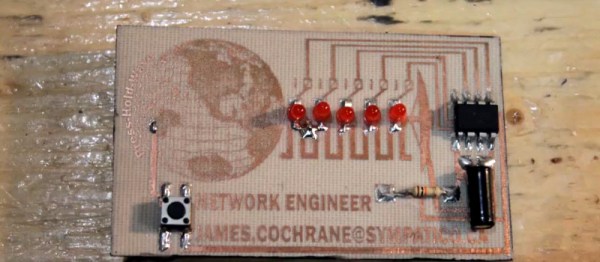
These days, making your card stand out from the crowd of print-shop specials has become an art form. In our community this extends to cards with integrated electronics, such as this one with a persistence-of-vision display driven by an ATtiny from [James Cochrane], shown in the video below.  It’s by no means the first such card, but he takes us through its design and construction in great detail which makes the video below the break worth a look. If you have never made a toner transfer PCB for example, you can see how his was made.

He makes the point that while a POV spinner needs only to display in one direction, a card has to be waved back and forth. Thus it needs to change the direction of its display, and needs a tilt sensor to activate this. His construction method uses through-hole components, but is surface mount in that they are soldered to the top surface of the board. The result is a rather attractive POV card that maybe isn’t something you’d hand out to all and sundry, but perhaps that’s not the point.

Continue reading “A Simple POV Business Card”

Europe Loses Six Minutes Due To Sagging Frequency And International Politics

You might be reading this six minutes early. Assuming that the Hackaday editors have done their job, this article should have appeared in your feed right on the half-hour. We have a set schedule to keep you supplied with the tastiest of hardware hacks and news. For some of you though perhaps there has been a treat, you’ve seen it and all the other stories six minutes early.

Have you perfected time travel? Sadly not unless there’s something you’d like to send to our tips line last week, but the culprit is equally fascinating. A dispute between Serbia and Kosovo has caused the frequency of the interconnected continental European electricity grid to drift below its usual 50 Hz figure for a sustained period, and as a result all clocks that use the mains frequency as a time reference have been getting ever slower.

How Can a Continental Power Grid Dip?

Think for a minute of a modern car on a hot day. When you turn on the air conditioning you will hear a slight dip in the engine revs as it accommodates the extra load. So it is with an alternating current power grid; a simple example is a power station supplying a city. In periods such as cold nights when the demands of the city go up, the result would be that the power station needs to work harder to satisfy it, and until that happens there would be a slight dip in its line frequency. Power grids compensate for this by increasing and decreasing the available generating capacity in real time, maintaining a mean frequency such that the “grid time” of a clock controlled by it matches an atomic clock as closely as possible over time.

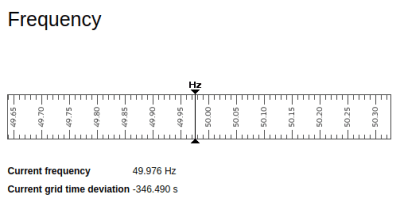
Screenshot of Swissgrid live frequency data

In the case of continental Europe, grids across multiple countries are connected (PDF), and the task of maintaining that mean frequency falls upon Swissgrid which currently shows a sagging 49.976 Hz frequency. The time deviation of -346 seconds puts this close to a six minute loss and clocks running on this frequency will make you late to your next appointment.

It is at this point we leave the realm of electrical engineering and enter that of international politics, normally something far removed from Hackaday’s remit. It is fair to say that the history between Serbia and Kosovo is extremely delicate, and to understand some of the context of this story you should read about the war at the end of the 1990s. After the conflict the Serbian-majority region of what is now Kosovo refused to pay the Kosovan utility for its electricity, eventually leading to the Kosovans refusing to pay for that region’s share of the power received by Kosovo from Serbia. The resulting imbalance between demand and supply was enough to drag the supply frequency down across the whole continent, and though a short-term agreement has been reached the problem still remains on the grid.

Clocks and Mains Frequency

So if you are a continental European and you find yourself six minutes behind your British or American friends, don’t worry. We know that among our readers are people with significant experience in the power generation world, perhaps some of you would like to use your six minutes to give us a bit of insight in the comments. Meanwhile here at Hackaday we maintain an interest in the mechanics of power distribution even if some might say that it is Not A Hack. We’ve taken a look at utility poles, and examined how power grids are synchronised.

As for those slow clocks, the use of mains frequency to keep accurate time is quite brilliant and has been used reliably for decades. Tightly regulating grid frequency means that any clock plugged into an outlet can have the same dead-on accuracy for the cost of a few diodes. These clocks count the zero crossing of the alternating current. There may be moment to moment drifts but the power utility injects or removes cycles over the long term so the sum of crossings is dead on over the course of the day. It’s an interesting phenomenon to experiment with and that’s why we see it in microcontroller projects from time to time.

A Bit More Than A Microphone: The Electret Story

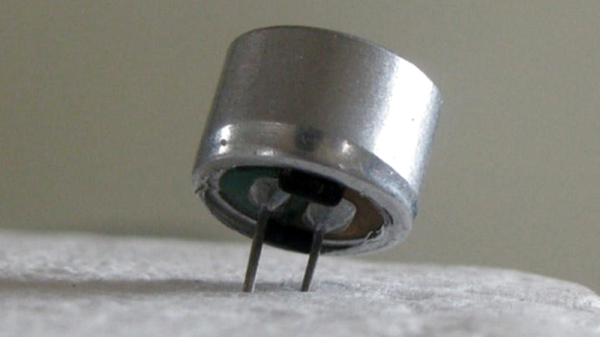
When designing a microphone assembly the other day, I reached for an electret condenser microphone capsule without thinking. To be strictly accurate I ordered a pack of them, these small cylindrical microphones are of extremely high quality for their relatively tiny price.

It was only upon submitting the order that I had a thought for the first time in my life: Just what IS an electret condenser microphone?

A condenser microphone is easy enough to explain. It’s a capacitor formed from a very thin conductive sheet that functions as the diaphragm, mounted in front of another conductor, usually a piece of mesh. Sound waves cause the diaphragm to vibrate, and these vibrations change the capacitance between diaphragm and mesh.

If that capacitance is incorporated into an RC circuit with a very high impedance and a high voltage is applied, a near constant charge is placed upon it. Since the charge stays constant, changing the capacitance causes a tiny voltage fluctuation that can be retrieved as the audio signal from the microphone. Condenser microphones built in this way can be extremely high quality, but come at the expense of needing a high voltage power supply to supply the charge and an amplifier to buffer and magnify the audio.

Continue reading “A Bit More Than A Microphone: The Electret Story”

Retrotechtacular: A Very British MagLev

When we look back to the 1970s it is often in a light of somehow a time before technology, a time when analogue was still king, motor vehicles had carburettors, and telephones still had rotary dials.

In fact the decade had a keen sense of being on the threshold of an exciting future, one of supersonic air travel, and holidays in space. Some of the ideas that were mainstream in those heady days didn’t make it as far as the 1980s, but wouldn’t look out of place in 2018.

The unlikely setting for todays Retrotechtacular piece is the Bedford Levels, part of the huge area of reclaimed farmland in the east of England known collectively as the Fens. The Old Bedford River and the New Bedford River are two straight parallel artificial waterways that bisect the lower half of the Fens for over 20 miles, and carry the flood waters of the River Ouse towards the sea. They are several hundred years old, but next to the Old Bedford River at their southern end are a few concrete remains of a much newer structure from 1970. They are all that is left of a bold experiment to create Britain’s first full-sized magnetic levitating train, an experiment which succeeded in its aim and demonstrated its train at 170 miles per hour, but was eventually canceled as part of Government budget cuts.

A track consisting of several miles of concrete beams was constructed during 1970 alongside the Old Bedford River, and on it was placed a single prototype train. There was a hangar with a crane and gantry for removing the vehicle from the track, and a selection of support and maintenance vehicles. There was an electrical pick-up alongside the track from which the train could draw its power, and the track had a low level for the hangar before rising to a higher level for most of its length.

After cancellation the track was fairly swiftly demolished, but the train itself survived. It was first moved to Cranfield University as a technology exhibit, before in more recent years being moved to the Railworld exhibit at Peterborough where it can be viewed by the general public. The dream of a British MagLev wasn’t over, but the 1980s Birmingham Airport shuttle was hardly in the same class even if it does hold the honour of being the world’s first commercial MagLev.

We have two videos for you below the break, the first is a Cambridge Archaeology documentary on the system while the second is a contemporary account of its design and construction from Imperial College. We don’t take high-speed MagLevs on our travels in 2018, but they provide a fascinating glimpse of one possible future in which we might have.

It does make one wonder: will the test tracks for Hyperloop transportation break the mold and find mainstream use or will we find ourselves 50 years from now running a Retrotechtacular on abandoned, vacuum tubes?

Continue reading “Retrotechtacular: A Very British MagLev”

A Tabletop Star Wars Themed Lego Racer Game

When it comes to the title of undisputed king of the toy construction kit world, the Danes have it. Lego are ubiquitous in the toybox, and parents worldwide know the joy of stepping barefoot on a stray brick. Aside from the themed sets for youngsters and collectors, we see a lot of Lego in projects that make it to these pages. Sometimes they are from hardware hackers who’ve chosen Lego because they had some to hand or because of its utility, but at other times they come from the Lego community rather than the wider one.

Take the Star Racer from [Alexis Dos Santos] as an example of the former. It’s a table top racing game made entirely from Lego, and with control courtesy of Lego Mindstorms. It’s a real rolling road game, with a track made from five continuous belts of grey Lego sections, with obstacles attached to them. The Podracer slides from side to side at the front under user control, and the object is to avoid them as they come towards you at varying speed.

It’s a beautiful piece of work, and as well as the linked Flickr photographs it can be seen in the YouTube video below the break. The sticker says it’s a highly addictive game, and we’d be inclined not to disagree.

Continue reading “A Tabletop Star Wars Themed Lego Racer Game”