Reusing A Wire Bonded Chip

We will all at some point have opened up a device to investigate its internal workings, and encountered a blob of resin on the PCB concealing an integrated circuit. It’s usually a cost thing, the manufacturer has sourced the chip as bare silicon rather than in encapsulated form, and it has been bonded to the board with its connections made directly using fine wires. The whole fragile component is then hidden by a protective layer of resin.

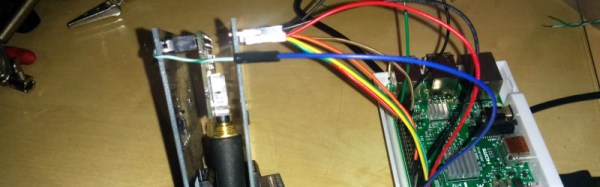
Normally these chips are off-limits to we experimenters because they can not be removed from the board without damage, and we have no information such as a part number about their function. Today though we have a rare example of a wire bonded chip being reused courtesy of Reddit user [BarockObongle], who has incorporated the controller from a multi-game joystick into his handheld NES project by cutting a square of PCB containing the chip, and soldering lengths of wire to the PCB tracks.

Of course, he’s in the rare position of knowing the function of the chip in question, and having a ready application for it. But it’s probable that few of us have considered the possibility of taking a resin blob from its original board and using it in a different way, so even though this is quite a straightforward piece of work it is sufficiently unusual to be worth a look. Sadly we don’t have the rest of the build to see it in context, it would be nice to think we’ll be able to feature it when it is completed.

If you are interested in what goes on underneath the blob, have a look at SparkFun’s explanation. Or charge your laser.


A Mini-ITX Atari 800

As a community has grown up around the 8-bit microcomputers of the 1980s, there have been some beautifully crafted rebuilds of classic machines to take advantage of newer hardware or to interface to peripherals such as keyboards or displays that were unavailable at the time. Often these have taken the form of small boards, or boards that are designed to follow the form factor of the original machine, and fit in an original case.

[mytekcontrols] has taken a different tack with his Atari 800 build, he’s produced an Atari clone designed to take the most popular upgrade boards produced by the 8-bit Atari community, as daughter boards. And he’s followed an existing form factor, though it’s not one from the Atari world. Instead, he’s made it as a mini-ITX motherboard of the type you may well be familiar with from the world of PCs.

He’s calling it the 1088XEL, because with a popular 1MB upgrade board fitted it boasts a generous 1088k of memory. It sports the original five Atari LSI chips, and manages the task without resorting to surface-mount construction.

The forum thread linked above is a long one that makes for a fascinating read as it deals in depth with the design of an 8-bit micro clone. But if you want to skip straight to the hardware, start at about page 13.

We’ve had more than one 8-bit Atari on these pages over the years. Most memorable though is probably this laptop.

Thanks [Lenore Underwood].

A Remotely Tuned Magnetic Loop Antenna

If you are a radio amateur, you may be familiar with the magnetic loop antenna. It’s different from most conventional wire antennas, taking the form of a tuned circuit with a very large single-turn coil and a tuning capacitor. Magnetic loops have the advantage of extreme selectivity and good directionality, but the danger of a high voltage induced across that tuning capacitor and the annoyance of needing to retune every time there is a frequency change.

[Oleg Borisov, RL5D] has a magnetic loop, and soon tired of the constant retuning. His solution is an elegant one, he’s made a remote retuning setup using a stepper motor, an Arduino, and a Bluetooth module (translated here). The stepper is connected to the capacitor via a short flexible coupling, and tuning is performed with the help of a custom Android app. We’d be interested to know what the effect of a high RF field is on these components, but he doesn’t report any problems so it must be working.

He’s posted a video of the unit in operation which we’ve posted below the break, if you’ve ever had to constantly retune a magnetic loop you will appreciate the convenience.

Continue reading “A Remotely Tuned Magnetic Loop Antenna”

Cooking With The Awesome Power Of Plasma!

There is something special about food that has been cooked in a grill, barbecue, or broiler. The charred surface brings both flavour and texture to the food, that other cooking methods fail to emulate. Of course, should you come from a part of the world in which the locals steam their hamburgers those are fighting words, but for [Robots Everywhere] the prospect of a flaccid patty cooked in a microwave oven was too much.

His solution? Broil the microwaved meat in double-quick time, using a plasma arc generated with a high voltage supply. The patty is placed in a grounded metal frying pan, and the high voltage probe is run over each side with accompanying plasma and sparks to lend that essential grilled exterior.

The power supply is a fairly simple affair, if a little hair-raising. A simple push-pull MOSFET oscillator drives a pair of flyback transformers whose secondaries are connected in series. It’s not the most efficient way to generate high voltages with a flyback transformer – the key is in the word “flyback” – but it generates enough juice for the job in hand.

It’s hardly the safest cooking method, and we’d be worried about contamination from whatever metal the electrode is made from. But it’s entertaining to watch, as you’ll be able to see from the video below the break.

Continue reading “Cooking With The Awesome Power Of Plasma!”

The SHA2017 Badge Revealed

It’s that excellent time of year in which one slowly comes to the realisation that the summer’s eagerly anticipated events are now no longer at some impossibly distant point in the future, but in fact only a matter of a few months or even weeks away. For our European readers, this means that August’s SHA2017 hacker camp is appearing on the horizon, four days of outdoor technological indulgence for our community in a scout camp on the Dutch polders.

As it is a tradition of such events to have an electronic badge incorporating ever more impressive levels of computing power, it follows that the pre-production announcement of an event badge has become an important milestone in the countdown to the day. SHA2017 is no exception, and thus today we see the announcement of their take on the essentials for a hacker camp badge in 2017.

The most immediately obvious thing about the badge is its 296×128 pixel e-ink display, which should provide an immediate benefit in terms of battery life. There are the usual plethora of interfaces, GPIOs, USB, and Neopixels, and the user input is via a set of capacitive buttons. Powering the device is an ESP32, and a key design goal was to have a network for the badges that does not put pressure on the 2.4GHz infrastructure. We’re guessing they’re doing this using raw WiFi packets in the same way as the MAGfest swadge. On the software front it will provide a straightforward development route via MicroPython, and there will be an app library for those without the inclination to code their own. You can get an early look at the schematic from the project repo (PDF).

Their target is to have the badge ready and with stable software on day 1 of the event, a laudable aim if they can manage it.

Members of the Hackaday team will be making the trip to the Netherlands for SHA2017, we look forward to seeing you if you attend too, and please show us anything interesting you do with your badges! Keep your eyes peeled for the Jolly Wrench, and come say hello. You’ll find me with the OxHack contingent and giving a talk on the kit biz which I have also published in the Project to Kit series of articles.

We’ve covered so many badges here at Hackaday that we could almost serve of a retrospective exhibition of the art form. Of particular interest to us though is our own [Voja Antonic]’s badge for last year’s Hackaday SuperConference.

Thanks [Sebastius] for the tip.

A Digital Tacho For A Harley

If you are a lover of motorcycling, you’ll probably fit into one or other of the distinct groups of riders. Maybe you’re a sportsbike lover always trying to get your knee down, a supermotard who gets their knee down without trying, a trailie rider for whom tarmac is an annoyance between real rides, or a classic bike enthusiast who spends more time in the workshop than riding.

[Xavier Morales] is none of these, for he cruises the roads of his native Catalonia on a Harley-Davidson Sportster. If you’re familiar with Harleys only from popular culture, or you’re a sportsbike rider who derides them for anachronistic handling and brakes, it’s worth taking a look at a modern Harley from a technical standpoint. Despite styling and brand ethos that evokes another era with the trademark large V-twin engine that looks to the untrained eye the same as it did decades ago, today’s Harley is a very modern machine, and much more capable than the sneering sportsbiker would give it credit for.

There is one area though in which [Xavier]’s Harley was sorely lacking. Its single instrument was a speedometer, it had no rev counter. You might think this would be less of an issue with the lower-revving Harley engine than it would be with a Japanese sportsbike that exists in a hail of revs, but it was annoying enough to him that he built his own tachometer. His write-up of the project is both lengthy and fascinating, and well worth a read.

The Sportster’s data bus follows an established but obsolete standard, SAE J1850 VPW. Since driver chips for this bus are out of production, he had to create his own using a transistor and a couple of resistors. Once he has the data he feeds it to a PIC 18F2553 which in turn runs a display driver chip controlling a brace of 7-segment LEDs. There are also a set of LEDs to indicate gear changes. The whole is installed in a 3D-printed housing alongside the original speedometer, behind the glass from another dial. As a result it looks as though the bike was always meant to be a two-clock design, with a professional appearance.

If you’d like to see it in action, he’s posted a few videos, and we’ve put one below the break. The beautiful Catalan scenery and the mountain twisties look very inviting.

Continue reading “A Digital Tacho For A Harley”

The Internet Connected Dog Treat Machine

[Eric] and [Shirin] have a dog called [Pickles], who is the kind of animal that if you are a dog lover you will secretly covet. They evidently dote upon [Pickles], but face the problem that they can’t always be at home to express their appreciation of him. But rather than abandon him entirely, they’ve applied technology to the problem. [Eric] has built an Internet-connected dog treat dispenser, through which they can dispense treats, and watch the lucky mutt wolfing them down.

The body of the machine has been made with lasercut acrylic, and the dispenser mechanism is a rotating hopper driven by a stepper motor. The whole thing — in all its transparent glory — is controlled through a Raspberry Pi, which plays a sound clip of [Shirin] calling [Pickles] for his treat, records his dining enjoyment with its camera, and emails the result to his owners. Behind the scenes it hosts an MQTT server, which can be triggered via an iPhone app, Alexa, or the adafruit.io site. Imagine for a moment: “Alexa, feed my dog!”. It has a ring to it.

He makes the point that this machine is not simply limited to dispensing treats, it could be used to engage [Pickles] in more activities. He hints at a future project involving a ball throwing device (have you ever seen such joy from a dog). There’s no substitute for being there with your dog, but maybe with this device they can make their dog’s life a little less of, well, a dog’s life.

You can see the machine in action in the video we’ve posted below the break.

Continue reading “The Internet Connected Dog Treat Machine”